


Merck Life Science sits at the intersection of science, technology and commerce, supplying the tools, materials and services that enable drug discovery, bioprocessing and laboratory research across the global life sciences industry. In India, that means managing a workforce that spans researchers, manufacturing specialists, sales professionals and shared services teams, all operating in a highly regulated environment where the cost of getting things wrong is measured not just in revenue but in scientific credibility.
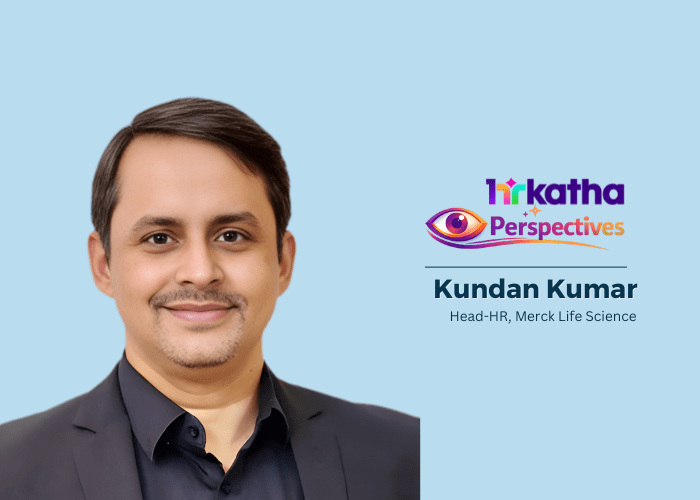
Kundan Kumar leads HR across that complexity. In conversation with HRKatha, he explains why building, buying and partnering are not alternatives but simultaneous requirements, why gender representation data at Merck Life Science tells only part of the diversity story, and why psychological safety in a scientific culture requires something more specific than open-door policies and engagement surveys.
Build, buy and partner simultaneously
As biotechnology, AI and data science reshape life sciences, how do you decide what to build internally, what to hire and what to access through partnerships?
The honest answer is that we do all three. The discipline lies in knowing when each approach is appropriate.
We build internally where institutional knowledge creates long-term advantage. We hire externally where speed matters or where capabilities do not yet exist inside the organisation.
And we partner with academia, startups and technology ecosystems where emerging innovation is moving faster than any one organisation can keep pace with.
The formulation I find most useful is this: build where it matters, buy where it accelerates, partner where it differentiates. The competitive advantage comes from integrating all three. Organisations that rely too heavily on any one approach eventually become either too insular, too dependent on external hiring, or too disconnected from the scientific ecosystem they operate in.
“The most honest HR metric is not activity. It is whether the organisation becomes more capable because of its people practices.”
Building capability, not just filling roles
How confident are you in your succession pipeline, and how do you measure whether learning investments are actually translating into innovation and business outcomes?
Succession planning at Merck Life Science is not a periodic exercise. It is a continuous capability-building agenda. Pipeline strength and learning effectiveness are really two sides of the same question.
Our focus is on identifying high-potential talent early, giving them cross-functional exposure and investing in leadership development that combines scientific depth with business judgement. The biggest gaps we anticipate over the next five years are at the intersection of science, digital capability and operational leadership. Those are not pure scientific roles and they are not pure management roles. They require people who can move comfortably across both, and that profile takes time to develop deliberately.
On measuring learning: we do not treat completion rates or training hours as meaningful outcomes. What we track is whether learning translates into role readiness, internal mobility and succession strength. The relevant indicators are whether people can take on larger responsibilities, whether they are adopting new technologies in practice, whether they are solving problems they could not solve before. Learning that does not show up in those ways has not created value regardless of how many hours it consumed.
Every learning initiative is aligned to business priorities from the outset. That alignment is not retrospective; it is built into how we design the programme, not added as a reporting layer afterwards.
“Psychological safety in a scientific organisation means something more specific than open-door policies and engagement surveys.”
Numbers are a milestone, not a destination
Beyond gender, what dimensions of diversity matter most for driving innovation at Merck Life Science, and where does the industry still have work to do?
Our overall gender representation has grown from 23 per cent in 2020 to 30 per cent today. Women in leadership roles have risen from 14.6 per cent in 2022 to nearly 25 per cent. We have achieved gender parity across our Healthcare, R&D and Shared Business Services organisations. Those numbers reflect deliberate effort. They are also a milestone, not a destination.
The diversity conversation in life sciences needs to move beyond gender. Cultural and ethnic diversity, neurodiversity, disability inclusion and socioeconomic inclusion are equally central to building teams that can drive scientific innovation. Organisations that create environments where neurodivergent talent and people with disabilities can genuinely contribute will have a meaningful advantage over the next decade because scientific breakthroughs increasingly depend as much on cognitive diversity as they do on technical expertise.
The industry also has structural work to do on access. Too many people from underrepresented socioeconomic backgrounds never reach the point of being considered for roles in life sciences because the pathways in (education, professional networks, early career exposure) remain unequal. At Merck, we have worked consistently with academic institutions to address that gap. It is not philanthropy. It is pipeline-building, and the industry needs to treat it as such.
Diversity creates real value only when it is underpinned by inclusion, where every person feels heard, respected and genuinely empowered to contribute. Representation without that is a headcount exercise.
“Build where it matters, buy where it accelerates, partner where it differentiates.”
Rethinking where talent comes from
How much of the diverse STEM talent shortage is a genuine pipeline problem, and how much is a failure to look in the right places?
Both, and the distinction matters because they require different responses.
There are genuine pipeline constraints in life sciences. The combinations of skills that emerging roles require: scientific depth, digital fluency and operational judgement, are not being produced at the rate the industry needs them, and training institutions are not yet fully aligned with where the sector is headed. That is a real problem and organisations cannot solve it alone.
But a significant portion of what gets called a pipeline shortage is actually a sourcing problem. Organisations default to the same institutions, the same profiles and the same recruitment channels they have always used, then report that diverse talent is not available. The talent exists. It requires different relationships, different outreach and a willingness to develop people who do not arrive fully formed.
At Merck, our industry-academia partnerships, internship programmes and skill-building initiatives are not conventional recruitment pipelines. They are long-term investments in developing the next generation of researchers and innovators from a broader talent base. The return takes years, which is precisely why organisations that are not investing today will find themselves behind tomorrow.
Strengthening the STEM pipeline is not separable from the inclusion agenda. A pipeline that delivers diverse talent into an environment where people cannot thrive simply accelerates attrition.
“Women in leadership have risen from 14.6 per cent in 2022 to nearly 25 per cent. Those numbers reflect deliberate effort. They are also a milestone, not a destination.”
Safety to be wrong in the right ways
Innovation depends on questioning assumptions. How do you build psychological safety in a scientific culture where peer review and rigour can themselves suppress unconventional thinking?
Psychological safety in a scientific organisation means something more specific than it does in other contexts.
In a research environment, there is a legitimate and important culture of rigour: evidence, peer review and methodological discipline. That culture exists for good reasons and should not be dismantled in the name of openness. The challenge is that the same culture can become a mechanism for suppressing unconventional ideas before they have had the chance to be properly tested. The instinct to challenge weak evidence can easily become an instinct to dismiss unfamiliar thinking. The two are not the same.
What we try to build is an environment where people feel safe to be wrong in the right ways, to propose ideas that may not work, to question established methods, to raise concerns about direction, without those acts being treated as failures of scientific judgement. That requires leaders who model intellectual curiosity rather than just intellectual rigour, and who visibly engage with ideas from junior team members rather than filtering everything through seniority.
We reinforce this through inclusive leadership development, cross-functional collaboration and structured forums for open dialogue. But the most powerful signal is what happens when someone raises an unconventional idea. If it is engaged with seriously, the culture shifts. If it is dismissed or ignored, no formal programme will compensate for that signal.
On the global-local dimension: our global framework sets consistent principles around inclusion, ethics and psychological safety. But what those principles look like in practice in India, where a young, digitally fluent workforce operates with different expectations and career rhythms than counterparts elsewhere, requires genuine local adaptation. The principles do not change. The expression of them does.
“Diversity creates real value only when it is underpinned by inclusion, where every person feels heard, respected and empowered to contribute.”
What HR in life sciences actually requires
What capabilities will define effective HR leadership in science and technology organisations over the next decade?
The HR leader in a science-driven organisation needs capabilities that most HR development programmes do not yet systematically build.
The obvious capabilities are data literacy, comfort with AI, and the ability to translate people analytics into decisions that business leaders trust.
What is less obvious and more important is scientific literacy, not at a researcher’s level, but enough to understand what drives innovation in the specific domain the organisation operates in, what the talent scarcity points are, what the regulatory environment demands of the workforce and where the scientific frontier is heading. An HR leader in life sciences who does not understand the difference between bioprocessing and drug discovery, or who cannot follow a conversation about digital lab automation, will always be operating with one hand behind their back.
Beyond that: the ability to operate at the intersection of global consistency and local relevance. Multinational science companies set principles globally but compete for talent locally, and the HR leader who can hold both simultaneously (maintaining the integrity of a global people framework while adapting meaningfully to what a young Indian workforce actually needs) is genuinely valuable.
HR has evolved from a process custodian to a strategic builder of capability and culture. The leaders who will matter in science and technology organisations are those who understand the science well enough to shape talent strategy, not simply support it.
“The competitive advantage comes from integrating all three rather than treating them as alternatives.”
1 Comment
Very well articulated. ?