

Close Menu
    Facebook X (Twitter) Instagram
    • Our Story
    • Partner with us
    • Reach Us
    • Career
    Subscribe Newsletter
    HR KathaHR Katha
    • Exclusive
      • Exclusive Features
      • Perspectives
      • Friday Features
      • herSTORY
      • Rising Stars
      • Case-In-Point
      • Point Of View
      • Research
      • HR Pops
      • Dialogue
      • Movement
      • Profile
      • Beyond Work
      • By Invitation
    • News
      • Global HR News
      • Compensation & Benefits
      • Diversity
      • Events
      • Gen Y
      • Hiring & Firing
      • HR & Labour Laws
      • Learning & Development
      • Merger & Acquisition
      • Performance Management & Productivity
      • Talent Management
      • Tools & Technology
      • Work-Life Balance
    • Special
      • HR Forecast 2026
      • Cover Story
      • Editorial
      • HR Forecast 2024
      • HR Forecast 2023
      • HR Forecast 2022
      • HR Forecast 2021
      • HR Forecast 2020
      • HR Forecast 2019
      • New Age Learning
      • Coaching and Training
      • Learn-Engage-Transform
    • Magazine
    • Reports
      • Whitepaper
        • HR Forecast 2024 e-mag
        • Future-proofing Manufacturing Through Digital Transformation
        • Employee Healthcare & Wellness Benefits: A Guide for Indian MSMEs
        • Build a Future Ready Organisation For The Road Ahead
        • Employee Experience Strategy
        • HRKatha 2019 Forecast
        • Decoding and Driving Employee Engagement
        • One Platform, Infinite Possibilities
      • Survey Reports
        • Happiness at Work
        • Upskilling for Jobs of the Future
        • The Labour Code 2020
    • Conferences
      • Leadership Summit 2025
      • Rising Star Leadership Awards
      • HRKatha Futurecast
      • Automation.NXT
      • The Great HR Debate
    WhatsApp LinkedIn X (Twitter) Facebook Instagram
    HR KathaHR Katha
    Home»Exclusive Features»HR Pops»Career portfolio mindset: Why careers are beginning to look like investment portfolios
    HR Pops

    Career portfolio mindset: Why careers are beginning to look like investment portfolios

    How a concept born from economic uncertainty in the 1980s is reshaping professional careers, and why HR must catch up
    mmBy Liji Narayan | HRKathaJuly 14, 2026Updated:July 14, 20264 Mins Read9027 Views
    Share LinkedIn Twitter Facebook WhatsApp
    HR Pops career portfolio mindset
    Share
    LinkedIn Twitter Facebook WhatsApp

    What does it mean?

    For decades, careers resembled ladders. People climbed one rung at a time, usually within the same organisation or industry, accumulating experience, promotions, and tenure.

    Today, careers increasingly resemble investment portfolios.

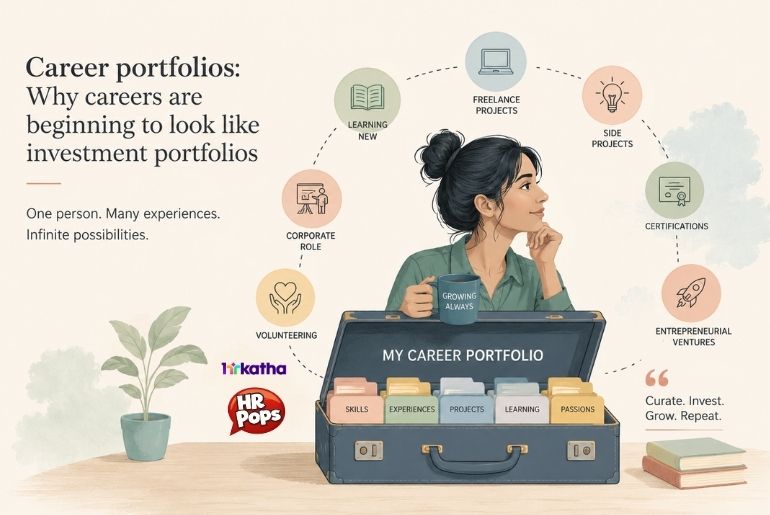
    The career portfolio mindset encourages professionals to build a diverse mix of experiences rather than rely on a single employer, role, or career path. A full-time job may remain the anchor, but it increasingly sits alongside certifications, cross-functional projects, mentoring, freelancing, entrepreneurship, volunteering, or content creation.

    The objective is not to collect jobs. It is to accumulate capabilities.

    A traditional résumé tells employers where someone has worked. A career portfolio reveals what that person has learnt, built, and become.

    Where did the idea come from?

    The idea emerged during the economic upheavals of the 1980s and 1990s, when globalisation, restructuring, and automation began weakening the promise of lifelong employment.

    British management thinker Charles Handy described this shift through the idea of the portfolio career. Instead of depending on one employer for identity and income, professionals would increasingly combine consulting, teaching, project work, entrepreneurship, and part-time roles.

    At the time, the prediction appeared unconventional.

    The internet proved him right.

    Digital platforms allowed professionals to build reputations beyond their employers. Remote work, the gig economy, and online learning accelerated the trend. The pandemic reinforced it further as millions explored freelance work, side businesses, and new skills, not simply to earn more but to reduce dependence on a single source of employment.

    Why is it relevant for HR?

    The portfolio mindset challenges several assumptions that have shaped HR for decades.
    Recruitment can no longer rely solely on linear career histories. Candidates increasingly arrive with experience gained through startups, independent consulting, creator platforms, open-source projects, or community leadership. These experiences often demonstrate capability as effectively as traditional job titles.

    Learning and development is changing too. Employees are investing in skills that improve their long-term market value, not merely their prospects within one organisation. Internal mobility, cross-functional assignments, certifications, and stretch projects help employees expand their portfolios without leaving.

    Retention is evolving in the same direction. Many professionals no longer measure career progress only through promotions or bigger teams. Variety, learning, and exposure often matter just as much. Organisations that provide continuous opportunities to grow are more likely to retain talent than those offering only hierarchical advancement.

    The conversation is gradually shifting from career progression to career resilience.

    The uncomfortable reality

    The portfolio mindset is not transforming only careers. It is changing the workforce itself.
    Organisations increasingly depend on a mix of permanent employees, consultants, freelancers, contractors, and gig workers. Talent is becoming a network rather than a payroll.

    That creates new challenges for HR. Performance, learning, culture, inclusion, and engagement can no longer be designed exclusively for full-time employees. Capability increasingly exists both inside and outside organisational boundaries.

    There is another trade-off.

    Building a career portfolio can create resilience, but it can also produce constant pressure to keep learning, remain visible, and juggle multiple commitments. More opportunities often mean more complexity. Without clear boundaries, career portfolio mindset can become exhausting rather than empowering.

    The takeaway

    The career portfolio mindset reflects a fundamental shift in how professionals think about work. Careers are no longer built around one employer. They are built around transferable capabilities, continuous learning, and diverse experiences that strengthen long-term resilience.

    For HR, the challenge is no longer simply retaining employees. It is creating workplaces where people can keep expanding their capabilities without feeling they have to leave in order to grow.

    The question is no longer how to build employee loyalty. It is how to become an important investment within someone else’s career portfolio.

    Career portfolio mindset certifications clear boundaries Continuous learning cross-functional projects diverse experiences Employee employer Entrepreneurship freelancing HR Human Resources important investmen LEAD Mentoring or content creation. portfolio mindset transferable capabilities volunteering Workforce
    Share. LinkedIn Twitter Facebook WhatsApp
    mm
    Liji Narayan | HRKatha

    HRKatha prides itself in being a good journalistic product and Liji deserves all the credit for it. Thanks to her, our readers get clean copies to read every morning while our writers are kept on their toes.

    Leave A Reply Cancel Reply

    Related Posts

    Richa Malik joins Hero MotoCorp as head HR – corporate & enabling functions

    September 4, 2026

    Amazon India creates over 1.6 lakh seasonal work opportunities ahead of festive season

    September 4, 2026

    Volkswagen plans another 50,000 job cuts globally

    September 4, 2026

    Nearly 1 in 4 CHROs expect AI to cut workforce by up to 20%: Study

    September 4, 2026
    zoha
    Editorial

    Employees are redesigning work before their companies do

    Nobody announced that work would change this way. There was no strategy document, pilot programme…

    “My door is always open” is an expensive sentence in leadership

    Walk into almost any organisation and you will hear some version of it. In town…

    EDITOR'S PICKS

    The career lessons hiding in unfamiliar territory

    September 4, 2026

    Case-in-Point: The pregnancy disclosure dilemma

    September 3, 2026

    herSTORY: Sejal Haribhakti Mody, CHRO, Akasa Air

    September 3, 2026

    59% of employees are financially stressed. Most HR dashboards cannot see it

    September 2, 2026
    Latest Post

    Dhananjay Singh, DG, NHRDN, moves on; Nidhi Vashishtha appointed executive director, NHRDN

    Movement September 4, 2026

    The National HRD Network (NHRDN) has announced that Dhananjay Singh, director general, NHRDN has moved…

    Richa Malik joins Hero MotoCorp as head HR – corporate & enabling functions

    Movement September 4, 2026

    Hero MotoCorp has announced the appointment of Richa Malik as head HR – corporate &…

    Amazon India creates over 1.6 lakh seasonal work opportunities ahead of festive season

    News September 4, 2026

    Amazon India has created more than 1.6 lakh seasonal work opportunities across its operations network…

    Volkswagen plans another 50,000 job cuts globally

    News September 4, 2026

    Volkswagen Group is planning to eliminate another 50,000 jobs globally as part of a major…

    Asia's No.1 HR Platform

    Facebook X (Twitter) Instagram LinkedIn WhatsApp Bluesky
    • Our Story
    • Partner with us
    • Career
    • Reach Us
    • Exclusive Features
    • Cover Story
    • Editorial
    • Dive into the Future of Work: Download HRForecast 2024 Now!
    © 2026 HRKatha.com
    • Disclaimer
    • Refunds & Cancellation Policy
    • Terms of Service

    Type above and press Enter to search. Press Esc to cancel.