


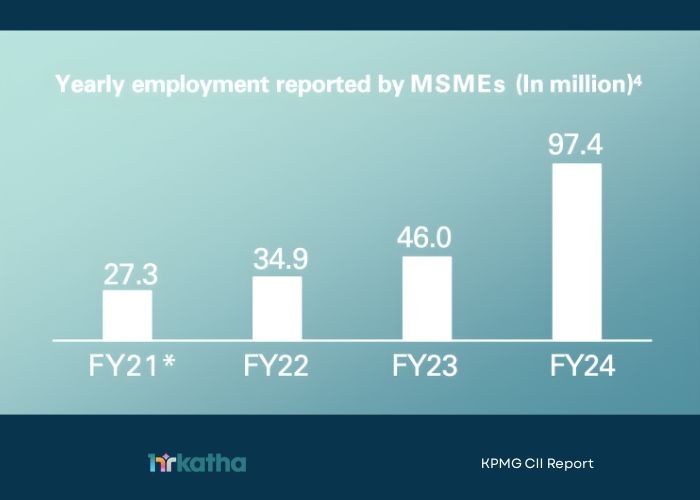
India’s micro, small and medium enterprises (MSME) employ 32.9 crore people—nearly 330 million workers. They account for 62 per cent of non-agricultural employment and contribute roughly 30 per cent of GDP. By headcount, they form the backbone of the economy.
Yet by output per worker, they are startlingly thin.
The average MSME employee produces only 14 per cent of the output generated by a worker in a large enterprise. Capital intensity explains part of the disparity. Informality and weak skill formation explain much of the rest.
The issue is not scale. It is efficiency.
Even a modest narrowing of this productivity differential would unlock substantial economic value annually. The constraint is structural rather than cyclical.
The formality deficit
More than 7.4 crore enterprises are now registered under Udyam (the official registration process for MSMEs in India), reflecting steady formalisation. Yet millions—particularly micro enterprises—remain outside formal systems.
Around 82 per cent of India’s workforce is informal. Informality limits access to institutional credit, supply-chain integration, structured apprenticeships and formal skilling programmes. Workers without recognised credentials face restricted mobility and lower returns on skill investment.
Formality is not administrative compliance. It is an economic enabler.
The skills arithmetic
The data is sobering.
Nearly 70 per cent of MSMEs report difficulty sourcing skilled labour. Only about 10 per cent of their workforce has formal vocational training, compared with 50–60 per cent across many Organisation for Economic Co-operation and Development or OECD economies. Digital literacy among MSME workers remains below 35 per cent. Adoption of AI hovers in the low teens.
Meanwhile, close to 45 per cent of core job skills are projected to change by 2030 as automation, digitisation and sustainability standards reshape production.
Low skills limit technology absorption. Limited technology suppresses productivity. Weak productivity constrains reinvestment. The cycle reinforces itself.
The capability constraint
Micro, small and medium enterprises face three simultaneous shifts.
Digital and AI adoption: Automation in invoicing, inventory management, quality control and customer interaction is increasingly standard. Firms unable to embed digital workflows risk exclusion from formal supply chains.
Operational discipline: Many MSMEs lose productivity to rework, process inconsistency and absent standard operating procedures. Lean systems require trained supervisors and certified shopfloor capability.
Green transition: Export markets increasingly demand low-carbon compliance and traceability. Green skills are expected to expand sharply in job descriptions this decade. Estimates suggest India will require several million additional green-skilled workers by 2030.
In each case, technology is available. Capability remains the constraint.
Apprenticeship as infrastructure
Globally, only about four in ten adults participate in job-related learning. For MSMEs, structured apprenticeships offer a pragmatic pathway to capability building.
Evidence from industry case studies shows that phased apprentice intakes, graded stipends and alignment with digital tools can produce shopfloor-ready technicians. Yet execution varies. Uniform policy designs often favour larger firms. Smaller enterprises struggle with administrative complexity and working-capital pressures.
Intent alone does not build capability. Design and implementation matter.
The cluster solution
More than a quarter of MSMEs cite skill shortages. Individual firm-level training is often financially prohibitive. Cluster ecosystems—shared labs, common training facilities, pooled upskilling programmes—spread fixed costs and accelerate diffusion of best practice.
International evidence suggests cluster-based capability development outperforms isolated efforts. For smaller firms, collaboration can substitute for scale.
Digital marketplaces now provide national reach. But market access without internal capability merely exposes weaknesses more quickly.
Inclusion as supply expansion
Women’s workforce participation has risen in recent years, though gaps remain across sectors. Youth account for nearly 65 per cent of the population, yet job-readiness indicators remain uneven.
Micro-credentials aligned to national qualification frameworks, flexible role design and blended learning can expand effective labour supply. Inclusion is not simply a social imperative; it enlarges the productive workforce.
Measuring capability, not just output
Most MSMEs track financial indicators. Few systematically measure skills readiness.
A skills-first operating model links critical roles to certified capabilities and aligns them with performance metrics. Capability gaps often surface indirectly—through quality failures, missed deadlines or customer attrition. By the time financial stress appears, the underlying skills deficit has already eroded resilience.
In labour-intensive enterprises, human capability is the primary asset. It is rarely monitored with equivalent rigour.
The economic stakes
India’s MSMEs are vast in employment terms yet modest in output per worker. A workforce of 330 million producing at 14 per cent of large-enterprise productivity represents both a vulnerability and an opportunity.
Closing even part of the gap would raise aggregate output meaningfully without adding a single new worker.
The next decade will not be defined by how many jobs MSMEs create. It will be defined by how effectively they convert scale into skill, embed digital fluency and prepare for AI-driven and sustainability-aligned production.
Fourteen per cent is not a verdict. It is a signal.
Whether that number rises will shape the trajectory of India’s competitiveness far more than headline employment figures ever could.