


For decades, the equation seemed fixed: bigger city, bigger salary. Mumbai commanded premiums. Bengaluru set benchmarks. Tier-2 cities offered lower costs and lower pay in return. That compact is breaking.
Randstad’s 2025-26 Salary Trends Report, analysing over 100,000 jobs across 32 Indian cities, reveals a striking inversion: Thane, a tier-2 city, now pays senior professionals an average Rs 40.85 lakhs annually—surpassing Mumbai’s Rs 40.04 lakhs. This represents a 25 per cent surge over the previous year. Kochi matches Chennai’s senior salaries at Rs 34.72 lakhs. The top two tier-2 cities now stand level with their tier-1 counterparts.
This is not marginal convergence. It is structural reordering.
The infrastructure dividend
What explains Thane overtaking Mumbai? Infrastructure investment, proximity without congestion, and deliberate corporate strategy. Thane offers modern office parks, improved highways and access to Mumbai’s ecosystem without Mumbai’s dysfunction. For multinationals establishing Global Capability Centres (GCCs), the calculation is straightforward: comparable talent at comparable cost, with superior infrastructure and lower friction.
The pattern repeats. Kochi’s Rs 34.72 lakhs follows Kerala’s GCC push. Digital parks, semiconductor investments and startup collaborations shifted the city from efficiency-driven operations to innovation-led growth. Surat reached Rs 32.16 lakhs, transforming from textiles to technology via its 2023 IT hub and startup centre. Vadodara’s senior salaries jumped 11 per cent to Rs 30.19 lakhs. Jaipur entered the top ten at Rs 29.60 lakhs, propelled by Rajasthan’s GCC policy targeting AI, semiconductors and aerospace.
Almost all top 12 tier-2 locations showed significant senior compensation increases over the previous year. A recent study projects tier-2 cities will contribute 60 per cent of new job creation by 2026, particularly in clean technology, advanced manufacturing and digital healthcare—sectors requiring strategic leadership.

The technology premium
What unites these cities is not geography but specialisation. IT salaries surged nationally: junior Rs 6.65 lakhs, middle Rs 20.75 lakhs, senior Rs 32.66 lakhs. This rise, driven by demand for cloud computing, AI/ML, cybersecurity, data analytics and DevOps, benefits tier-2 cities disproportionately because they are building from a lower base with modern infrastructure.
Operations-technical roles command the highest salaries at junior (Rs 7.16 lakhs) and middle (Rs 22.35 lakhs) levels. IT-technical leads at senior level (Rs 32.39 lakhs). The top ten paying mid-level jobs are all technology-driven. These roles exist wherever digital infrastructure and talent pools meet—increasingly beyond traditional metros.
Professional services, despite a marginal dip, remain competitive across levels. Energy and utilities, driven by renewable acceleration, feature in the top five at all levels. Infrastructure and construction salaries stay strong, fuelled by government spending and tier-2/tier-3 urbanisation.
The GCC effect
Behind these numbers lies a structural shift: the maturation of Global Capability Centres. India hosts over 1,600 GCCs employing 1.5 million professionals. What began as cost arbitrage has evolved into innovation hubs that architect, design and lead.
Bengaluru hosts 875 GCCs (42 per cent of India’s total). But expansion is migrating. Hyderabad gained 6,400 GCC professionals. Chennai doubled its count in four years. Tier-2 cities capture domain-specific work: Kochi in AI and semiconductors, Indore in automation, Bhopal in drone technology and AVGC-XR. These demand senior leadership compensated accordingly.
The India Skills Report 2025 projects over 55 per cent of graduates are globally employable in IT, GenAI, cybersecurity and renewable energy. Combined with government incentives (Union Budget 2025 raised tax exemptions), this creates conditions for distributed growth.
The metro trap
Mumbai retains its edge at middle (Rs 18.98 lakhs) and senior (Rs 40.04 lakhs) levels among tier-1 cities. But Thane’s overtaking signals something deeper: metros are beginning to price themselves out of their own advantage. Congestion, cost of living, infrastructure strain—these erode the premium that once justified concentration.
Bengaluru leads at junior level (Rs 7.16 lakhs). Chennai ranks second in senior salaries (Rs 34.72 lakhs). Hyderabad, Pune and Ahmedabad cluster competitively. But variance across tier-1 cities is narrowing.
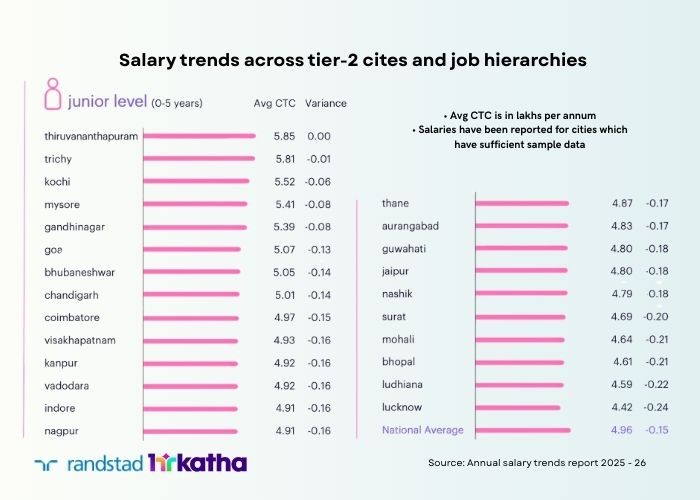
Meanwhile, tier-2 convergence accelerates. Thiruvananthapuram tops junior salaries (Rs 5.85 lakhs). Kochi leads middle level (Rs 16.81 lakhs). Thane dominates senior (Rs 40.85 lakhs). Gandhinagar and Aurangabad, making their debut, rank among top 20 at junior and middle levels.
The implications are uncomfortable for established metros: talent has options, and those options increasingly involve leaving.

The retention calculation
National salary averages show stability: junior Rs 5.92 lakhs (marginally up), middle Rs 16.70 lakhs (slightly down), senior Rs 32.40 lakhs (slightly down). But averages obscure geographic and functional divergence.
Organisations shifted from pure salary increases toward holistic rewards: flexibility, wellness, recognition, learning. India Inc’s attrition declined from 18.3 per cent in 2023 to 17.5 per cent in 2024. Yet salary remains the anchor. When tier-2 cities offer comparable or superior compensation alongside better quality of life, retention strategies predicated on metro premiums unravel.
Functional premiums also matter. Legal and compliance roles rank third at junior (Rs 6.40 lakhs) and middle (Rs 19.96 lakhs) levels, elevated by AI governance, ESG and M&A growth. IT-functional roles hold fourth given GCC demand for specialists. Senior HR salaries climbed to second position (Rs 30.32 lakhs), reflecting the need for strategic leadership in digital talent management.
The convergence paradox
Salary convergence between tier-1 and tier-2 cities creates a paradox: it benefits individuals whilst complicating workforce planning. When Thane pays as much as Mumbai, talent disperses rather than concentrates. This distribution can enhance resilience but also fragments labour markets.
For job seekers, the implications are clear: geography matters less than industry and function. A senior IT-technical professional earns Rs 32.39 lakhs nationally, whether in tier-1 or tier-2. Skills, not skylines, determine compensation.
For employers, the calculus shifts. Metro premiums no longer guarantee talent acquisition when tier-2 cities match or exceed them. Companies must compete on total proposition: career trajectory, project quality, learning, culture. Salary becomes table stakes.
The infrastructure wager
Tier-2 salary growth stems from infrastructure investment. Gujarat’s GCC policy (2025-2030) targets 250 GCCs, 50,000 jobs and Rs 10,000 crore investment. Maharashtra, Kerala and Rajasthan policies mirror this approach. Union Budget 2025 reinforced the trajectory with tax exemptions and welfare formalisation.
Yet infrastructure alone cannot sustain premiums. Tier-2 cities must justify compensation by delivering innovation. The GCCs opening are product development labs and data analytics hubs, not call centres. As long as the work remains strategic, salaries will stay competitive.
The redrawn map
Randstad’s data reveals not salary adjustments but geographic rebalancing. The traditional hierarchy is dissolving. Specialisation, infrastructure and policy now matter more than legacy status.
Thane paying more than Mumbai signals the old rules no longer bind. Talent flows to opportunity, and opportunity increasingly flows to places combining modern infrastructure, strategic work and competitive compensation.
For India’s economy, tier-2 convergence creates circulation rather than concentration. Talent need not migrate to metros to earn competitively. This reduces metro strain, develops smaller cities and lowers regional inequality. Professionals can now build entire careers in tier-2 cities. Kochi, Indore, Jaipur offer trajectories previously requiring migration.
Distributed growth builds resilience and spreads prosperity. Yet tier-2 cities must sustain quality of life as populations grow. Infrastructure investment must continue. Education, healthcare and governance must scale.
India’s salary map is being redrawn. The new geography rewards infrastructure, specialisation and policy foresight. Tier-2 cities executing on all three will not merely converge with metros—some already surpass them. Whether this is broad redistribution’s beginning or an infrastructure cycle’s peak will become clear in coming years. For now, the direction is unmistakable: the centre is weakening, and the periphery is rising.