



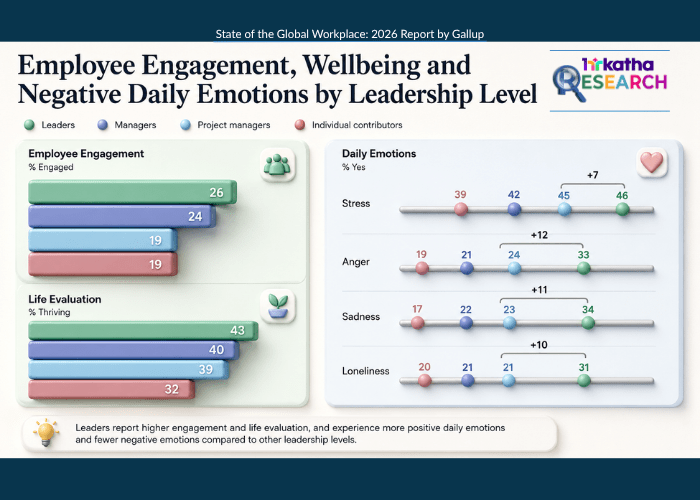
There is a paradox at the top of the corporate ladder that Gallup’s 2026 ‘State of the Global Workplace’ report captures with unusual clarity. Leaders evaluate their lives more positively than the employees they manage. Yet on a day-to-day basis, they feel markedly worse.
Compared with individual contributors, leaders are 12 percentage points more likely to report anger, 11 points more likely to report sadness and 10 points more likely to report loneliness. They are also seven points more likely to report significant stress.

The findings matter because they challenge one of corporate life’s most persistent assumptions: that seniority naturally brings greater control, satisfaction and wellbeing. Gallup’s data suggests something more complicated is happening. Leadership improves how people evaluate their lives in the abstract while simultaneously worsening how many of those lives are actually experienced.
The emotional cost of authority
Gallup separates wellbeing into two dimensions. The first is evaluative wellbeing – how people assess their lives overall. The second is experiential wellbeing – how they actually felt yesterday.
On the evaluative measure, leaders perform strongly. They are more likely than managers or individual contributors to describe themselves as thriving. They report higher engagement levels and greater life satisfaction.
The experiential data tells a much darker story.
Some 46 per cent of leaders say they experienced stress during a lot of the previous day, compared with 39 per cent of individual contributors. Anger was reported by 33 per cent of leaders against 21 per cent of employees lower in the hierarchy. Sadness affected 34 per cent of leaders versus 23 per cent of individual contributors, while loneliness stood at 31 per cent versus 21 per cent.
These are not marginal differences. They are consistent across every negative emotional category Gallup measured.
Leaders are also less likely than individual contributors to say they smiled or laughed a lot the previous day. Compared with managers, they are less likely to report enjoyment.
The explanation is structural rather than psychological. Leadership brings status, influence and decision-making authority. It also creates distance.
The higher people rise, the fewer peers they retain. Conversations become more guarded. Feedback becomes filtered. Decisions carry broader consequences, including layoffs, restructurings and trade-offs that affect thousands of employees. The authority associated with leadership and the emotional burden attached to it are inseparable parts of the same role.
The engagement protection effect
One finding in the report complicates the narrative in an important way.
When leaders themselves are engaged at work, the emotional burden falls sharply.
Engaged managers report lower levels of stress, anger, sadness and loneliness than individual contributors. They are also 14 percentage points more likely to be thriving overall than the average leader.
This suggests that the emotional costs of leadership are not fixed. They are heavily influenced by whether leaders feel connected to purpose, supported in their role and energised by their work.
The implication for organisations is significant. Most engagement programmes focus downward – towards frontline employees and middle management. Senior leaders are often assumed to be self-sustaining. Gallup’s data suggests that assumption is increasingly risky.
This matters even more because leader engagement itself is weakening.
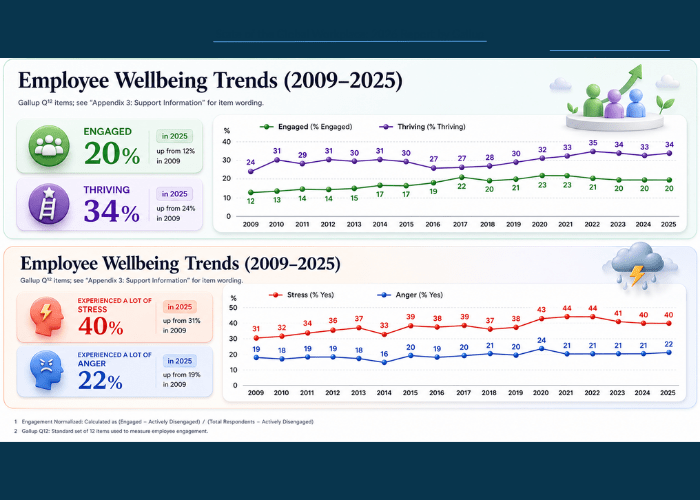
Global employee engagement fell to 20 per cent in 2025, down from 23 per cent in 2022 and the lowest level since the pandemic period. Manager engagement has fallen even faster, from 31 per cent in 2022 to 22 per cent in 2025.
The people carrying the greatest emotional load are simultaneously becoming less engaged in their work.
South Asia’s warning signal
The regional picture sharpens the concern.
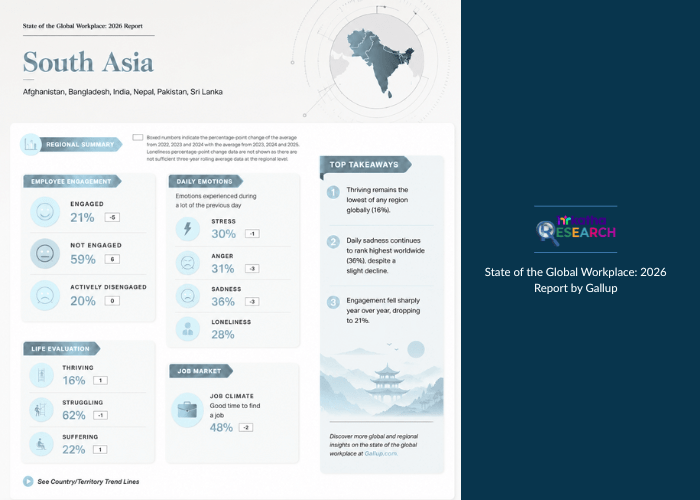
South Asia recorded the world’s lowest thriving rate at just 16 per cent, far below Latin America and the Caribbean at 56 per cent, Australia and New Zealand at 55 per cent, and Europe at 49 per cent.
At the same time, South Asia experienced one of the sharpest declines in manager engagement globally.
The reasons are partly structural. Organisations across sectors – particularly technology and services – have flattened management layers while expecting remaining leaders to supervise larger teams and navigate rapid AI-driven change.
Gallup’s research consistently shows that engagement declines as spans of control expand.
Managers overseeing increasingly large teams face more coordination work, more emotional labour and less time for meaningful coaching.
The result is a leadership layer absorbing pressure from both above and below.
The AI pressure multiplier
Artificial intelligence is intensifying the problem.
Gallup’s Q1 2026 workforce data shows that manager support is the single strongest driver of successful AI adoption inside organisations.
Among employees who frequently use AI, 79 per cent strongly agree that their manager actively supports the technology. Among infrequent users, that figure falls to 46 per cent.
Employees whose managers actively support AI are 8.7 times more likely to believe AI has transformed how work gets done and 7.4 times more likely to feel AI helps them focus on higher-value work.
The technology itself is not the differentiator. Manager behaviour is.
Yet, fewer than one-third of employees in organisations implementing AI strongly agree that their managers actively support its use.
This creates a compound leadership challenge. Organisations are reducing management layers while simultaneously expecting remaining managers to lead technological transformation, maintain engagement, absorb uncertainty and support increasingly anxious teams.
Each of those demands is difficult individually. Together, they are reshaping leadership into a role with significantly higher emotional intensity than before.
The succession question organisations are avoiding
The report leaves one uncomfortable question hanging in the background: if leadership increasingly looks emotionally exhausting, who will want those jobs?
This matters because younger employees are recalibrating what they want from work.
Recent workforce studies increasingly show that employees place growing importance on emotional experience, flexibility and day-to-day wellbeing. Gallup’s findings present leadership as delivering status and influence, but also higher stress, more loneliness and worse daily emotional outcomes.
The result may become a pipeline problem.
Ambitious employees traditionally accepted managerial stress as the price of advancement because leadership also promised greater autonomy, security and prestige. But if younger generations increasingly prioritise quality of life over hierarchical progression, organisations may discover that fewer people are willing to absorb the emotional trade-offs leadership now requires.
That would create a structural problem extending far beyond wellbeing. Organisations that have not asked themselves who their next generation of leaders actually is, and whether those people want the job, are carrying a risk that does not yet appear on any balance sheet.
The hidden organisational cost
The business case for leader wellbeing is not a welfare argument. It is a performance argument.
Leaders shape culture, decision-making speed, communication quality and team engagement. A disengaged leader affects not only their own productivity but also the experience of every employee reporting to them.
Gallup’s broader data already places the global productivity cost of disengagement at nearly $10 trillion annually, around 9 per cent of global GDP.
The leadership wellbeing findings suggest part of that cost originates at the very top of organisational structures.
The image of leadership still associated with control, confidence and authority remains only partially true. Gallup’s data presents a more modern reality: leaders may evaluate their lives positively because they possess status and influence, while simultaneously experiencing their working days under significantly heavier emotional strain.
The crown, it turns out, looks considerably lighter from a distance than it feels up close.