


Fast-growing companies usually respond to pressure with more hiring. Demand rises, headcount follows. Licious, the meat and seafood delivery company, initially operated the same way. Then growth became more expensive.
“At some point, the conversation changes from asking how many people are required to asking what outcomes need to be delivered,” says Sahil Mathur, the company’s chief human resources officer.
That shift sounds managerial. It is actually structural. As margins tighten, labour stops being treated as expandable capacity and starts being treated as a productivity system. For Licious, HR increasingly moved away from pure recruitment and towards operational efficiency: onboarding quality, workforce stability, output consistency, and retention.
“At some point, the conversation changes from asking how many people are required to asking what outcomes need to be delivered.”
Sahil Mathur, CHRO (people & culture), Licious

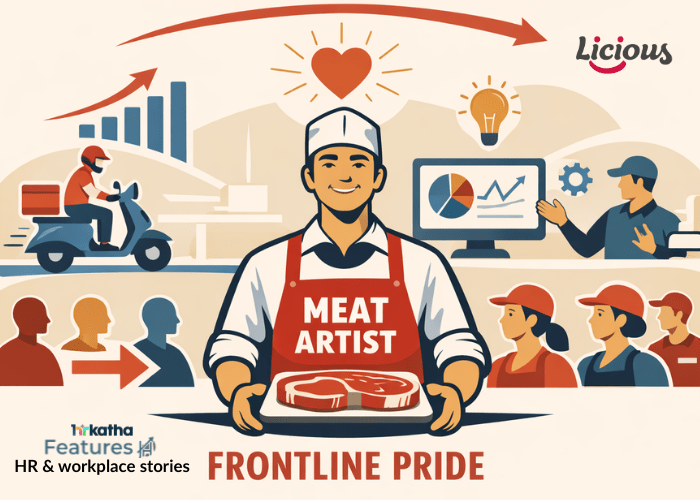
Its most unusual intervention was linguistic. Riders became “delivery heroes”. Butchers became “meat artists” and “meat technicians”.
The titles sound cosmetic, perhaps even faintly ridiculous. Yet Mathur insists they altered how frontline workers perceived themselves. “Names create pride,” he says. “They create ownership and trust in what people do.”
Whether a new title genuinely changes behaviour or merely softens the harsh realities of frontline work is debatable. But the experiment reveals something larger: many operational employees care less about corporate purpose statements than about whether their daily work carries dignity.
One company, several workforces
Licious operates less like a single company than several layered together. Processing centres, sourcing teams, logistics networks, delivery operations, omnichannel retail, and technology functions all coexist inside the same business.
That creates HR problems which standardised systems struggle to solve.
A meat-processing workforce behaves differently from a logistics workforce. Delivery operations have little in common with technology teams. Uniform policies often produce the illusion of consistency whilst ignoring operational realities.
Mathur says the company increasingly designs people systems around local conditions. “Our business is hyperlocal and city-driven, so our people strategy also has to evolve with that speed and agility,” he says.
In practice, this means workforce planning extends beyond skills and qualifications. Licious pays attention to where workers live, their family structures, community networks, and commuting realities. Some facilities employ siblings, spouses, and cousins together.
Conventional HR orthodoxy often treats such arrangements cautiously because of concerns around favouritism or conflict. Licious appears to view them differently: community ties improve workforce continuity in high-attrition environments.
The logic is commercially sensible. Employees embedded in local social networks are often more stable than workers with weak attachment to place. But family-linked hiring carries its own risks. Performance management becomes harder when disciplinary action affects entire households rather than individuals.
The onboarding correction
Licious initially optimised onboarding for speed. Faster onboarding meant employees became productive sooner.
Then the company realised something was missing.
“People joined quickly and began earning quickly, but they were not fully understanding the Licious way of doing things,” Mathur says.
For processing workers especially, shallow onboarding created downstream problems around quality and consistency. The company responded by extending onboarding from a rapid compliance exercise into a 30-45 day capability-building process.
The emphasis shifted from seat-filling to operational readiness.
“We shifted the conversation from speed to productivity and quality,” Mathur says.
This reflects a broader correction happening across many fast-scaling companies. Aggressive hiring creates the appearance of growth efficiency. Weak onboarding quietly transfers costs elsewhere through errors, inconsistency, attrition, and rework.
Longer onboarding, however, is expensive. It delays full productivity and increases training investment. The economics work only if employees stay long enough to justify the effort.
Licious does not disclose whether retention improved after the redesign. Without that, the effectiveness of the intervention remains difficult to judge.
Analytics meets operational reality
Like many scaling firms, Licious has invested heavily in workforce analytics. Attrition prediction systems analyse employee cohorts for disengagement patterns. Recruitment funnels track sourcing, conversion, joining behaviour, and early exits.
Mathur describes this as moving HR “from reporting to diagnosis”.
The ambition is familiar across corporate India. HR departments increasingly want to position themselves as operational intelligence functions rather than administrative support units.
The challenge lies less in collecting data than in acting on it. Many companies build sophisticated dashboards that predict attrition accurately but fail to intervene meaningfully because retention itself is expensive.
Licious appears aware of another limitation: systems often miss what employees actually experience.
The company discovered this during onboarding feedback. Employees appreciated faster income generation but wanted stronger guidance and clearer understanding of organisational expectations.
That realisation led to another initiative called Spark, through which employees suggest operational improvements directly.
The premise is sensible. Data explains patterns. Employees explain causes.
Still, listening systems can become performative if organisations solicit feedback faster than they act on it. Employee voice matters only when it changes decisions.
The dignity question
The most revealing aspect of Licious’ approach may not be its analytics or onboarding redesign, but its focus on identity.
Calling a butcher a “meat artist” does not reduce physical strain, improve working hours, or eliminate operational pressure. Yet it acknowledges something companies often overlook: frontline work carries social perception costs.
In India, many operational roles remain economically necessary but culturally undervalued. Delivery riders, processing workers, warehouse staff, and retail associates often occupy awkward social positions – visible enough to be relied upon, invisible enough to be dismissed.
Licious seems to have recognised that respect itself can become a retention lever.
Whether symbolic recognition meaningfully changes workforce outcomes remains uncertain. Titles alone rarely compensate for weak pay or difficult conditions. But they can shape whether employees feel their work is seen as skilled labour or disposable labour.
That distinction matters more than many companies assume.
Beyond hiring
Licious’ broader HR evolution reflects a common problem among scaling businesses. Once rapid hiring stops being economically viable, operational discipline replaces expansion instinct.
That forces harder questions.
Can productivity improve without exhausting workers? Can onboarding deepen without slowing growth? Can workforce stability emerge in sectors built around churn? Can dignity be operationalised rather than merely advertised?
Licious offers a nuanced perspective on these questions, highlighting both progress and areas still evolving, but it demonstrates that managing frontline workforces at scale requires more than recruitment targets and engagement slogans.
At some point, companies stop competing only for customers. They begin competing for whether employees believe the work itself deserves pride.