


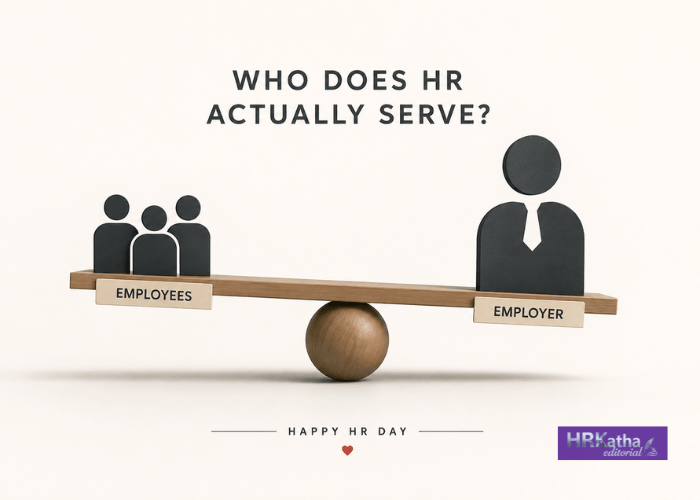
Happy HR Day.
Across LinkedIn today, companies will celebrate HR as the “voice of employees,” “people champions,” or “culture custodians.” The language will be warm, reassuring, and deeply familiar. HR exists, employees are told, to support people.
The problem is not that this is entirely false.
The problem is that it is only partially true.
HR does help employees. It resolves grievances, designs learning programmes, supports wellbeing initiatives, manages careers, and often acts as the first line of emotional support inside organisations. Many HR professionals enter the field precisely because they want to improve workplaces and help people navigate work more humanely.
But structurally, HR does not exist to represent employees. It exists to help organisations manage people.
That distinction matters far more than corporate language admits.
The ambiguity built into HR
Most corporate functions have relatively clear loyalties.
Finance protects financial health. Legal protects legal interests. Strategy protects competitive positioning. Nobody mistakes these functions for neutral intermediaries between the company and employees.
HR is different because it presents itself simultaneously as business partner and employee advocate.
The contradiction sits at the centre of the profession.
Employees are encouraged to see HR as approachable, supportive, and employee-facing.
Organisations need this trust because employees who speak early about conflict, burnout, misconduct, or disengagement allow problems to be managed before they escalate into attrition, litigation, or reputational crises.
But when employee interests and organisational interests diverge, HR does not operate as an independent representative of labour. It operates as part of management.
Not because HR professionals are dishonest.
Because structurally, that is the role.
HR reports into management structures. Its budgets are approved by leadership. Its effectiveness is evaluated through organisational outcomes: hiring efficiency, retention, workforce productivity, restructuring execution, leadership capability, legal exposure, and cultural stability.
Those are business metrics, not employee representation metrics.
The distinction becomes visible precisely in the moments employees need HR most.
The layoff moment
The clearest illustration is restructuring.
During layoffs, HR does not function as employee counsel. It does not negotiate against management on behalf of workers. It does not independently challenge whether reductions should happen.
HR designs the process. It manages communication. It reduces legal risk. It ensures the organisation exits employees in a controlled and compliant manner.
The language is compassionate because modern corporations understand reputational management. But the structural role remains unchanged.
This does not make HR uniquely unethical. Every management function executes organisational decisions. The discomfort comes from the fact that HR simultaneously continues to speak the language of employee advocacy while carrying out employer priorities.
That tension creates distrust because employees often discover the structural reality only during moments of vulnerability.
The complaint paradox
The same contradiction appears during workplace disputes.
An employee approaches HR about harassment, discrimination, managerial misconduct, or psychological safety. HR listens, documents concerns, and initiates inquiry processes.
Employees often interpret this as advocacy.
Structurally, it is closer to risk assessment.
HR’s responsibility is to determine:
• whether policy has been violated,
• whether legal or reputational exposure exists,
• whether intervention is necessary to protect organisational stability.
Sometimes this aligns with employee welfare. Sometimes it does not.
When misconduct is clear and organisational exposure is high, action tends to follow. When situations are ambiguous, politically sensitive, or involve powerful stakeholders, the balancing act becomes more visible.
Employees experience this as betrayal because they assumed HR represented them. HR experiences it as organisational management because that is how the function is designed.
The misunderstanding is structural, not emotional.
Why the “employee champion” language persists
If the contradiction is so obvious, why does the language continue?
Because modern organisations need emotional legitimacy.
Industrial-era personnel departments could operate transactionally because work itself was transactional. Contemporary corporations demand far deeper psychological engagement.
Employees are expected to identify with culture, values, purpose, and belonging.
That requires a softer management interface.
Modern HR therefore evolved beyond administration into culture-building, employee experience, engagement, and wellbeing. The function became emotionally fluent because emotional alignment improves retention, productivity, and organisational cohesion.
None of this is inherently manipulative. Healthier workplaces genuinely matter. Better managers matter. Mental-health support matters.
But the emotional language sometimes obscures the underlying power structure.
HR can improve the employee experience while still fundamentally operating as an employer function.
Those are not contradictory ideas. The problem begins when organisations pretend they are the same thing.
The impossible balancing act
The modern HR leader is expected to satisfy multiple constituencies simultaneously.
Leadership expects productivity, workforce flexibility, cost control, succession planning, and cultural stability.
Employees expect fairness, advocacy, empathy, development, and psychological safety.
These expectations do not always align.
In periods of growth, the contradiction remains manageable because organisational and employee interests broadly move together. Companies hire aggressively, salaries rise, careers expand, and culture initiatives flourish.
The tension becomes visible during downturns.
When budgets tighten, restructurings begin, or performance pressures intensify, HR’s structural alignment becomes unmistakable. Workforce costs become variables to optimise.
Flexibility becomes asymmetrical. Employee wellbeing remains important until it collides with business priorities.
This is not hypocrisy unique to HR. It reflects the underlying reality of corporations themselves.
Businesses exist to sustain the organisation first. Every function ultimately operates within that logic.
What genuine employee representation would require
True employee representation would require structural independence.
It would mean employee bodies that are not funded, evaluated, or controlled by management. Unions, works councils, labour representatives, and collective bargaining structures exist precisely because management functions cannot simultaneously represent labour neutrally.
In parts of Europe, these structures formally coexist with corporate HR. Employees therefore understand the distinction clearly: HR manages employment; independent labour structures represent worker interests.
In much of corporate India, however, such structures are weak or absent in white-collar environments. HR becomes the only visible “people” interface, which encourages employees to project representative expectations onto a function that was never structurally designed to fulfil them.
This creates recurring disappointment.
Employees expect advocacy. HR delivers organisational management with varying degrees of empathy.
The more honest framing
Perhaps the issue is not that HR serves management.
Every corporate function serves management in some form.
The issue is that organisations often describe HR in language that implies neutrality where none structurally exists.
A more honest framing would acknowledge the tension directly.
HR exists to help organisations manage people effectively and sustainably. That includes improving employee experience, resolving conflict, developing talent, and protecting workplace culture. But it also includes restructuring, performance management, workforce optimisation, and risk control.
HR is not a union.
It is not employee counsel.
It is not independent arbitration.
It is management’s function for managing people.
That may sound less comforting than the language typically used on HR Day. But it is probably closer to the truth.
The uncomfortable question behind HR Day
This does not make HR professionals insincere.
Many genuinely care about employees and try to create better workplaces within the constraints of organisational structures. Some push leadership aggressively on culture, burnout, inclusion, and managerial behaviour. Others absorb enormous emotional labour while acting as intermediaries between business pressure and employee frustration.
But individual intent cannot fully override institutional design.
The real question is not whether HR professionals are good people.
It is whether the profession can continue presenting itself primarily as employee advocacy while remaining structurally accountable to management priorities.
Because eventually, every function reveals who it serves when interests collide.
And in that moment, HR’s role becomes very clear.
1 Comment
Excellent and thought provoking HR article..