

Close Menu
    Facebook X (Twitter) Instagram
    • Our Story
    • Partner with us
    • Reach Us
    • Career
    Subscribe Newsletter
    HR KathaHR Katha
    • Exclusive
      • Exclusive Features
      • Perspectives
      • Friday Features
      • herSTORY
      • Case-In-Point
      • Point Of View
      • Research
      • HR Pops
      • Dialogue
      • Movement
      • Profile
      • Beyond Work
      • Rising Star
      • By Invitation
    • News
      • Global HR News
      • Compensation & Benefits
      • Diversity
      • Events
      • Gen Y
      • Hiring & Firing
      • HR & Labour Laws
      • Learning & Development
      • Merger & Acquisition
      • Performance Management & Productivity
      • Talent Management
      • Tools & Technology
      • Work-Life Balance
    • Special
      • HR Forecast 2026
      • Cover Story
      • Editorial
      • HR Forecast 2024
      • HR Forecast 2023
      • HR Forecast 2022
      • HR Forecast 2021
      • HR Forecast 2020
      • HR Forecast 2019
      • New Age Learning
      • Coaching and Training
      • Learn-Engage-Transform
    • Magazine
    • Reports
      • Whitepaper
        • HR Forecast 2024 e-mag
        • Future-proofing Manufacturing Through Digital Transformation
        • Employee Healthcare & Wellness Benefits: A Guide for Indian MSMEs
        • Build a Future Ready Organisation For The Road Ahead
        • Employee Experience Strategy
        • HRKatha 2019 Forecast
        • Decoding and Driving Employee Engagement
        • One Platform, Infinite Possibilities
      • Survey Reports
        • Happiness at Work
        • Upskilling for Jobs of the Future
        • The Labour Code 2020
    • Conferences
      • Leadership Summit 2025
      • Rising Star Leadership Awards
      • HRKatha Futurecast
      • Automation.NXT
      • The Great HR Debate
    • HR Jobs
    WhatsApp LinkedIn X (Twitter) Facebook Instagram
    HR KathaHR Katha
    Home»Exclusive Features»HR Pops»At-will employment: The American HR idea that does not exist in India
    HR Pops

    At-will employment: The American HR idea that does not exist in India

    Why Indian HR professionals keep encountering a workplace practice that Indian labour law does not recognise, and why the confusion is growing
    mmBy Liji Narayan | HRKathaMay 19, 2026Updated:May 19, 20264 Mins Read99 Views
    Share LinkedIn Twitter Facebook WhatsApp
    HR Pops: At-will employment
    Share
    LinkedIn Twitter Facebook WhatsApp

    What does ‘at-will employment’ mean?

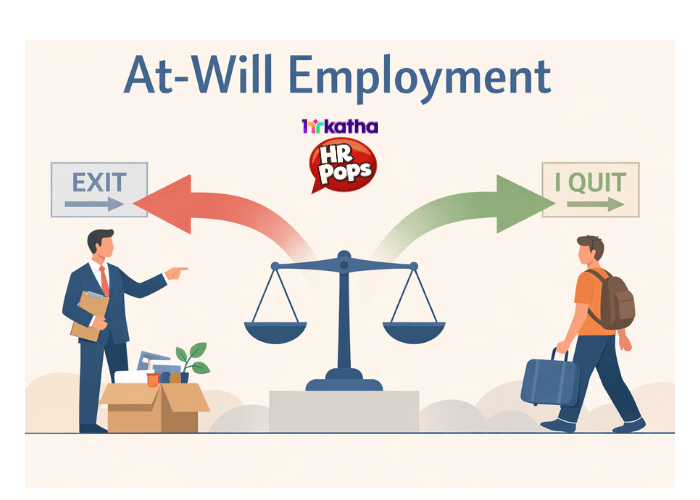
    At-will employment is an American employment practice under which either the employer or employee can end the employment relationship at any time, for almost any reason, and without prior notice.

    In practical terms, it means a company can terminate an employee without having to establish misconduct, redundancy, or long-term performance failure. Equally, employees may leave without serving notice periods unless contractual obligations state otherwise.

    zoha

    There are exceptions. US law still prohibits termination based on discrimination, retaliation, or certain protected rights. But outside those protections, employment remains largely flexible and termination-centric.

    This framework does not exist in India.

    Indian labour law follows a very different philosophy. Employment is not treated merely as a private contract between two parties, but as a relationship governed by statutory protections, procedural fairness, and worker rights.

    Yet despite this, Indian HR professionals increasingly hear the language of at-will employment – particularly in multinational firms, startups influenced by Silicon Valley culture, and companies adopting US-style HR practices.

    Where did the idea come from?

    The concept emerged in the US States during the late 19th century.

    In 1877, legal scholar Horace Gray Wood argued that if no employment duration was specified, either party should be free to terminate the relationship at any time. American courts gradually adopted this interpretation, and over time it became the default employment model across most US states.

    zoha

    The idea aligned with America’s broader economic philosophy: minimal state intervention, freedom of contract, and labour market flexibility.

    India evolved differently.

    Indian labour protections developed in the context of industrialisation, labour exploitation, and post-independence social welfare policies. The legal framework therefore emphasised procedural safeguards, notice periods, severance obligations, and protections against arbitrary dismissal.

    The difference is not merely legal. It reflects two fundamentally different ideas about employment itself.

    Why is it relevant for HR in India?

    Even though at-will employment is not legally recognised in India, Indian HR professionals encounter its influence regularly.

    Global companies headquartered in the US often expect faster terminations and greater workforce flexibility than Indian law permits. HR teams frequently find themselves explaining why documentation, notice periods, domestic enquiries, and statutory processes cannot simply be bypassed.

    Startup culture has amplified this tension. Founders influenced by Silicon Valley sometimes assume Indian employment systems operate similarly to the US model. Terms such as “hire fast, fire fast” increasingly enter workplace conversations despite having weak legal standing in India.

    The confusion also appears in employment contracts. Some companies continue using clauses copied from US templates that refer to “termination without cause” or immediate separation rights. While such clauses may sound commercially modern, many are difficult to enforce under Indian law.

    For HR, this creates operational and ethical complexity. The role increasingly involves balancing global expectations with local legal realities.

    The uncomfortable reality

    Here lies the real issue: some organisations attempt to replicate at-will employment informally even when it is legally unsustainable.

    Employees may be pressured into resigning rather than being formally terminated. “Mutual separation” agreements are sometimes used to avoid legal obligations. Extended probation periods become mechanisms for easier exits. Startups occasionally rely on the assumption that employees lack the resources or awareness to challenge questionable practices legally.

    In many cases, these approaches survive not because they are lawful, but because they go uncontested.

    This places HR in a difficult position.

    When leadership demands American-style flexibility inside an Indian legal framework, HR becomes the interpreter between corporate aspiration and legal reality. The challenge is not simply compliance. It is resisting the normalisation of practices that undermine employee protections whilst being framed as agility or modernisation.

    The takeaway

    At-will employment remains one of the most misunderstood imported ideas in Indian workplaces.

    It is often discussed as though it were a modern management practice that can simply be adopted globally. In reality, it is a legal doctrine rooted in a specific American economic and cultural context.

    India follows a different employment philosophy – one that places greater emphasis on procedural fairness and worker protection.

    For HR professionals, understanding this distinction matters increasingly as global workplace language spreads faster than legal understanding.

    Because when companies attempt to import at-will employment into India, they are not merely adopting a management style. They are colliding with an entirely different legal and social framework.

    American-style flexibility at-will employment at-will employment in US law Employee employer Horace Gray Wood HR HR Pops HR Pops. HRPops HRKatha HR Pops Human Resources import at-will employment in India labour exploitation legal doctrine no employment duration was specified post-independence social welfare policies Silicon Valley culture US-style HR practices worker protection Workforce
    Share. LinkedIn Twitter Facebook WhatsApp
    mm
    Liji Narayan | HRKatha

    HRKatha prides itself in being a good journalistic product and Liji deserves all the credit for it. Thanks to her, our readers get clean copies to read every morning while our writers are kept on their toes.

    Leave A Reply Cancel Reply

    Related Posts

    When office boys become store managers

    May 19, 2026

    Saraswathi Chandrasekharan is the new global CPO, Ascendion

    May 19, 2026

    Age limit raised for West Bengal government jobs

    May 19, 2026

    Salesforce believes in investing in AI-human collaboration, not hiring more

    May 19, 2026
    Editorial

    Why experience appreciates in manufacturing but depreciates in tech

    A manufacturing engineer with twenty-five years in an automotive plant is an asset. They understand…

    Why great ‘Number Twos’ rarely become ‘Number One’

    The pattern is familiar enough that it no longer surprises. A senior leader exits. The…

    EDITOR'S PICKS

    At-will employment: The American HR idea that does not exist in India

    May 19, 2026

    When office boys become store managers

    May 19, 2026

    POV: Are productivity tools becoming workplace surveillance?

    May 18, 2026

    Why experience appreciates in manufacturing but depreciates in tech

    May 17, 2026
    Latest Post

    At-will employment: The American HR idea that does not exist in India

    HR Pops May 19, 2026

    What does ‘at-will employment’ mean? At-will employment is an American employment practice under which either…

    When office boys become store managers

    Exclusive Features May 19, 2026

    Family businesses often discover that culture becomes harder to scale than operations. Stores can be…

    Saraswathi Chandrasekharan is the new global CPO, Ascendion

    Movement May 19, 2026

    After a long and successful tenure of over 16 years at Infosys,  Saraswathi Chandrasekharan has…

    Age limit raised for West Bengal government jobs

    News May 19, 2026

    The West Bengal government has announced a major change in recruitment rules by raising the…

    Asia's No.1 HR Platform

    Facebook X (Twitter) Instagram LinkedIn WhatsApp Bluesky
    • Our Story
    • Partner with us
    • Career
    • Reach Us
    • Exclusive Features
    • Cover Story
    • Editorial
    • Dive into the Future of Work: Download HRForecast 2024 Now!
    © 2026 HRKatha.com
    • Disclaimer
    • Refunds & Cancellation Policy
    • Terms of Service

    Type above and press Enter to search. Press Esc to cancel.