


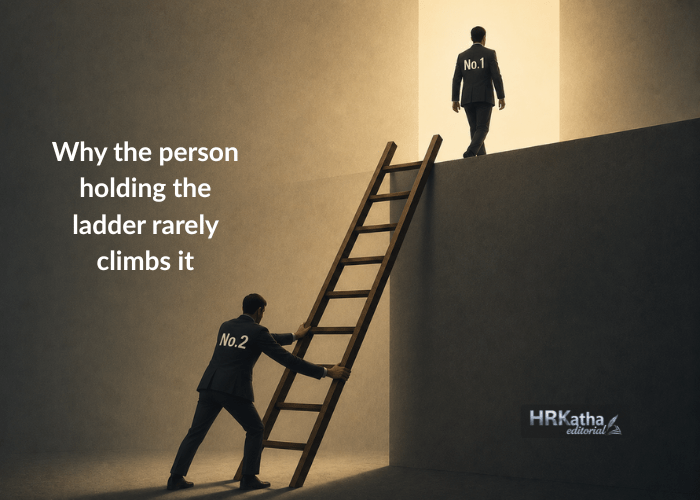
The pattern is familiar enough that it no longer surprises.
A senior leader exits. The succession discussion begins. And the person most people assumed would step in does not get the role.
Inside the organisation, the reaction is usually a mix of surprise and quiet confusion. This was the dependable one. The person who knew where every lever sat, who could get decisions moving across silos, calm internal friction, and keep execution from collapsing under complexity. When something went wrong, this was the person people called.
And yet, when the top job opened, the organisation chose someone else. Sometimes an outsider. Sometimes someone seen as more strategic. Occasionally someone with less operational depth altogether.
The explanation usually arrives wrapped in corporate language. The business needed transformation. A different profile. Someone for the next phase.
What is rarely said directly is simpler: the Number Two became indispensable in the wrong role.
What great deputies actually do
Exceptional deputies create stability. They absorb operational complexity before it reaches the top, ensure that commitments get delivered, and keep large systems functioning even under strain. In many organisations, the deputy becomes the institutional memory of the business. They know which relationships matter, where execution tends to break down, and which tensions need managing quietly before they become visible problems.
Over time, this creates a particular kind of trust. Not performative trust, but operational trust: the confidence that one person can repeatedly make difficult systems work under pressure. Organisations genuinely value this kind of leadership. The problem is that it signals something specific: capability in the present tense.
Top roles, by contrast, are usually filled on perceived capability in the future tense.
The distinction is not about intelligence. It is about orientation. A ‘Number Two’ is expected to make the existing system work better. A ‘Number One’ is expected to decide whether the system itself still makes sense.
Deputies optimise execution, while chief executives are expected to define direction. One role reduces friction; the other creates movement.
This is why succession decisions often appear irrational from the inside. The person who understands the business most deeply is not always the person the board believes can redefine it. That does not mean the deputy lacks strategic capability. Often they do not. But organisations promote visible signals, not invisible potential.
And visibility is shaped by where time goes.
The deputy who spends most of the week resolving operational problems, reviewing delivery timelines, managing stakeholders and stabilising execution begins to look operational, regardless of how strategically capable they may actually be.
Meanwhile, another leader spends visible time discussing market shifts, reshaping business models, or articulating where the industry may be heading over the next three years. Even if both are equally intelligent, one appears to be managing the present while the other appears to be shaping the future.
Boards notice the difference.
“The ‘Number Two’ became indispensable in the wrong role.”
The trap of indispensability
This creates a paradox many high-performing deputies recognise too late. The behaviours that make someone exceptional in the second seat, reliability, responsiveness and being the person who fixes problems, can also make them appear too deeply embedded in the machinery of the present.
The organisation gradually begins to see the deputy as essential to execution rather than central to direction. And once that perception settles, it becomes difficult to reverse, because capability that is not visibly demonstrated is often treated as capability that does not exist.
The issue is not whether the deputy can think strategically. The issue is whether anyone has seen enough evidence of it.
That evidence is rarely created in operational reviews or crisis-management meetings. It emerges elsewhere: in long-term initiatives, strategic ambiguity, industry positioning and difficult conversations about what the organisation should become next.
But those activities require time. And time spent shaping the future is time not spent keeping the present stable. Organisations want both, but the structure of the role often makes both impossible.
Why organisations make this choice
There is a logic behind these decisions, even when they frustrate people internally. Boards tend to believe that operational execution can be strengthened around a leader more easily than strategic direction can. A company can hire strong operators and functional experts underneath the chief executive. Uncertainty around direction at the top is harder to compensate for.
So succession decisions often overweight signals of strategic orientation and underweight operational depth.
Sometimes organisations overcorrect. This is why companies occasionally appoint visionary leaders who struggle to execute. The strategy sounds compelling, but the organisation lacks the operational coherence required to make that strategy real.
Still, most organisations fear strategic stagnation more than operational inefficiency. And that fear shapes who gets promoted.
“To appear promotable, the deputy must spend less time being indispensable.”
The invisible career trade-off
The advice given to aspiring senior leaders sounds deceptively simple: delegate more, think more strategically, spend less time in the weeds.
But this ignores the practical reality of many deputy roles. If the strongest operator steps back from operational involvement, things often deteriorate. Deadlines slip. Coordination weakens. Problems escalate further before someone notices them.
The deputy knows this because they are usually the person holding the system together.
Which creates the real dilemma. The behaviours required to become seen as ready for the top role can directly conflict with the behaviours required to succeed in the role currently being performed.
To appear promotable, the deputy must spend less time being indispensable.
Some manage that transition deliberately. They delegate more aggressively, tolerate a degree of operational imperfection, and redirect attention toward longer-term priorities and strategic visibility.
Others struggle to do it. Partly because the organisation depends too heavily on them. Partly because high-performing operators often derive professional identity from reliability itself.
Walking away from operational involvement feels irresponsible.
So they continue solving problems. And in doing so, continue reinforcing the perception that they are best suited to solving problems created by someone else’s strategy rather than defining strategy themselves.
There is a reason succession decisions like these generate frustration internally. The passed-over deputy often understands the organisation more deeply than the person selected. They know the informal networks, operational realities and institutional constraints that strategy must eventually confront.
Then an external leader arrives with sharper language around transformation, but thinner understanding of how the organisation actually functions.
Sometimes that works. Fresh perspective matters. But sometimes organisations mistake strategic vocabulary for strategic capability.
The deputy watches someone with less operational credibility inherit authority over systems they themselves spent years stabilising. The frustration becomes understandable.
Still, organisations are often responding to something real. The deputy who excels at preserving organisational continuity is not automatically the person best positioned to redefine the organisation’s future. Those are different activities, and organisations rarely confuse them at the moment succession matters most.
This dynamic is becoming more visible partly because younger leadership cohorts interpret ambition differently. Earlier generations often assumed that operational indispensability would eventually translate into advancement.
Younger leaders appear less convinced.
Increasingly, they understand that visibility, narrative and strategic positioning are not secondary to advancement. They are part of advancement itself.
This is changing leadership behaviour. More emerging leaders are consciously building external visibility earlier, seeking strategic projects instead of purely operational ones, and optimising not only for performance but for how performance is perceived.
Older leadership cultures sometimes interpret this as impatience or self-promotion.
Structurally, however, it is often a rational response to how succession decisions are actually made.
“Indispensability is a ceiling, not a ladder.”
The uncomfortable reality
For ambitious deputies, the implication is uncomfortable. Operational excellence alone is rarely enough.
The organisation may value it enormously. It may reward it financially. It may publicly celebrate it. But the leader who becomes too associated with maintaining the present can gradually stop being seen as the person who will define the future.
That is the risk of indispensability. The more essential someone becomes to the current system, the harder it becomes for the organisation to imagine them redesigning it.
And organisations promote based not only on capability, but on imagination. On who they can picture in the role before the role is vacant.
That imagination is shaped by signals: where attention goes, what conversations leaders occupy, and whether they are seen stabilising execution or shaping direction.
Because succession decisions are rarely made only on competence. They are made on perceived readiness for what comes next. And readiness is inferred from behaviour long before the top role becomes available.
Which is why great ‘Number Twos’ so often remain ‘Number Twos’. Not because they lack capability, but because the system learned to depend on them in the wrong way.
Indispensability is a ceiling, not a ladder.