


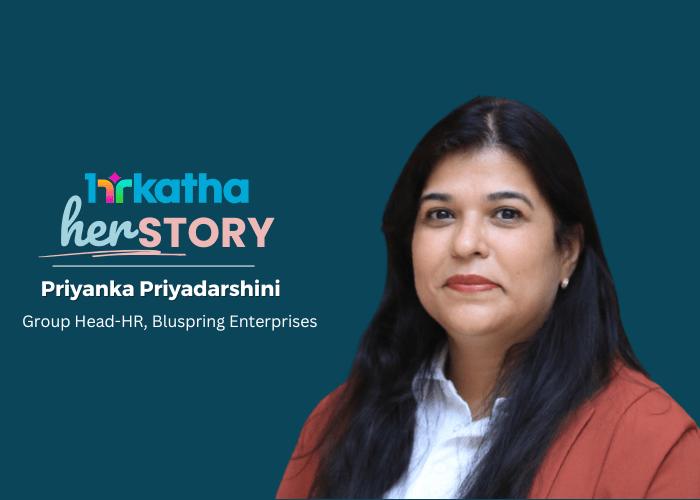
Curiosity about people
It was curiosity about people, what drives them, how teams come together, and what makes some environments thrive while others don’t, that drew Priyanka Priyadarshini to Human Resources. It wasn’t a sharply defined decision, but a natural inclination that became clearer over time.
Human Resources offered the right intersection of business and people, giving her a lens to understand not just individuals, but organisations as living systems. As she moved through different roles and organisations, that curiosity evolved into a deeper sense of purpose.
Today, as group head-HR at Bluspring Enterprises, Priyadarshini sees HR as more than a function that manages processes or policies. It is about shaping organisations through people and creating environments where both individuals and businesses can grow together.
“Sustained performance and quiet confidence can gradually shift perceptions.”
Overcoming bias through performance
There were moments early in her career when expectations were subtly different, particularly around mobility, long-term commitment, or assumptions post marriage. Nothing overt, but enough to signal that the bar was being viewed differently.
At that stage, she made a conscious choice not to react defensively, but to focus on building credibility through consistency, ownership and outcomes.
Over time, she realised that while bias may exist, sustained performance and quiet confidence can gradually shift perceptions.
The bias may not disappear immediately, but it is possible to create your own space by staying grounded in your work and not letting those perceptions define your trajectory.
Clarity of intent, fairness and transparency
Some of the toughest decisions in her career have come during periods of transition, particularly when managing workforce changes, restructuring, or balancing business priorities with people impact.
These are never straightforward decisions, she notes, because behind every role is an individual, a family, and a story. There have been situations where she had to take calls that were critical for the sustainability of the business, while knowing they would have a direct human impact.
In those moments, what guided her was clarity of intent, being fair, being transparent, and ensuring that decisions are taken with integrity. Equally important is how those decisions are communicated, with empathy, respect and honesty.
She points out how HR leadership often operates in this delicate balance between business and people. These are the moments that truly test judgement and values.
Asking the right questions
For Priyadarshini, strategic HR begins with a deep understanding of the business, its priorities, challenges, and direction.
It is not about creating policies in isolation, but about designing people practices that directly enable business outcomes, whether that is driving productivity, building leadership pipelines, improving capability, or shaping culture.
In practice, it means asking the right questions. What does the business need to achieve? What kind of talent and leadership will enable that? Where are the gaps? The answers to these questions shape the interventions that follow.
Human resources becomes truly strategic when it starts influencing business decisions instead of merely supporting them.
“When HR influences business decisions, not just supports them, it becomes truly strategic.”
Challenge in sustaining the pipeline
There has been meaningful progress. Today, there are more women in leadership roles, greater visibility, and a stronger organisational focus on diversity and inclusion than before.
Yet, the challenge persists in sustaining that pipeline, especially at mid-career stages where many women tend to step back or slow down due to competing responsibilities.
Organisations need to consciously create access to high-impact roles, decision-making forums, and business-critical assignments. Representation is improving, but inclusion is measured by influence.
That is where organisations still need to push harder, with intent and not just initiatives.
Quick fire round
Best career advice you’ve ever received?
Always keep investing in yourself, your learning, your perspective, and your growth.
One thing you wish people understood about being a woman in HR leadership?
Leadership is defined by capability and impact, not gender.
Morning ritual that sets you up for success?
Starting the day with clarity on priorities and what truly needs attention.
If not HR, what career path would you have pursued?
Something in business strategy or people consulting.
What energises you most about your work?
Seeing people and organisations evolve and grow together.
Converting resistance to acceptance
There have been several instances, particularly around changes in performance frameworks or productivity expectations, where the initial response was resistance or hesitation.
She has learnt that pushing change is not enough. It must be understood.
The turning point often lies in clearly articulating the “why”, why the change is needed, what problem it is solving, and how it will create value in the long run.
She believes in involving stakeholders early, listening to concerns without dismissing them, and being transparent in how the change will be implemented.
Over time, when people see consistency in approach and fairness in execution, resistance gradually turns into acceptance. Trust plays a critical role in making any change sustainable.
HR as a strategic partner
The mindset that HR is only a support function needs to retire.
Today, HR plays a far more significant role in shaping business outcomes through talent, leadership, culture, and capability building. Treating it as purely operational or administrative limits its impact.
What deserves greater attention is HR as a strategic partner, one that is deeply integrated with the business, understands its realities, and actively contributes to its growth.
And in many ways, that belief continues to shape how Priyadarshini leads, quietly, consistently, and with an emphasis on outcomes over perception.