

Close Menu
    Facebook X (Twitter) Instagram
    • Our Story
    • Partner with us
    • Reach Us
    • Career
    Subscribe Newsletter
    HR KathaHR Katha
    • Exclusive
      • Exclusive Features
      • Perspectives
      • Friday Features
      • herSTORY
      • Case-In-Point
      • Point Of View
      • Research
      • HR Pops
      • Dialogue
      • Movement
      • Profile
      • Beyond Work
      • Rising Star
      • By Invitation
    • News
      • Global HR News
      • Compensation & Benefits
      • Diversity
      • Events
      • Gen Y
      • Hiring & Firing
      • HR & Labour Laws
      • Learning & Development
      • Merger & Acquisition
      • Performance Management & Productivity
      • Talent Management
      • Tools & Technology
      • Work-Life Balance
    • Special
      • HR Forecast 2026
      • Cover Story
      • Editorial
      • HR Forecast 2024
      • HR Forecast 2023
      • HR Forecast 2022
      • HR Forecast 2021
      • HR Forecast 2020
      • HR Forecast 2019
      • New Age Learning
      • Coaching and Training
      • Learn-Engage-Transform
    • Magazine
    • Reports
      • Whitepaper
        • HR Forecast 2024 e-mag
        • Future-proofing Manufacturing Through Digital Transformation
        • Employee Healthcare & Wellness Benefits: A Guide for Indian MSMEs
        • Build a Future Ready Organisation For The Road Ahead
        • Employee Experience Strategy
        • HRKatha 2019 Forecast
        • Decoding and Driving Employee Engagement
        • One Platform, Infinite Possibilities
      • Survey Reports
        • Happiness at Work
        • Upskilling for Jobs of the Future
        • The Labour Code 2020
    • Conferences
      • Leadership Summit 2025
      • Rising Star Leadership Awards
      • HRKatha Futurecast
      • Automation.NXT
      • The Great HR Debate
    • HR Jobs
    WhatsApp LinkedIn X (Twitter) Facebook Instagram
    HR KathaHR Katha
    Home»Exclusive Features»Case-In-Point»Case-in-Point: Intent vs impact in leadership communication
    Case-In-Point

    Case-in-Point: Intent vs impact in leadership communication

    When a leader’s words spark outrage, does walking them back signal accountability or capitulation?
    mmBy Radhika Sharma | HRKathaMay 7, 20264 Mins Read228 Views
    Share LinkedIn Twitter Facebook WhatsApp
    Intent vs impact
    Share
    LinkedIn Twitter Facebook WhatsApp

    HRKatha’s Case-in-Point presents real-world HR dilemmas and invites leaders to weigh competing business and ethical choices.

    Company: Unified Dynamics (fictitious), a Rs 2,000 crore conglomerate operating in FMCG, retail, and logistics

    zoha

    Background

    Unified Dynamics recently held its quarterly town hall, attended virtually by 8,000 employees. The agenda covered business performance, strategic priorities, and an open Q&A.

    The situation

    During the Q&A, an employee asked:

    “Our DEI report shows women hold only 12 per cent of leadership roles. What are we doing to change this?”

    The CHRO, Ritesh Deshmukh, responded:

    zoha

    “We are committed to diversity, but we also have to be realistic. Leadership roles require long hours, travel, and tough decisions. Not everyone, male or female, is willing to make those sacrifices. We promote based on merit and availability, not quotas.”

    Within an hour, backlash began.

    An employee wrote on the internal platform:
    “Did the CHRO just say women aren’t in leadership because they’re not willing to sacrifice?”

    The post drew over 200 reactions. Comments followed. Women leaders shared instances of being passed over despite long hours. The women’s employee resource group wrote to the CEO seeking a public apology.

    Their message was direct: the statement reflected bias and undermined the company’s credibility on inclusion.

    The CEO forwarded the note to HR.

    Ritesh remained firm: “I didn’t say women don’t sacrifice. People are twisting my words. I’m not apologising for something I didn’t mean.”

    Sentiment across the organisation is largely against him. Some senior women leaders have indicated they may resign.

    HR now faces a difficult choice.

    The dilemma

    Should HR advise a public clarification, acknowledging the impact of the statement?

    Or support the CHRO’s position that intent matters and the reaction is a misinterpretation?

    What’s really at stake

    This is a test of leadership accountability in a world where every word is amplified instantly.

    If Ritesh apologises, he may be seen as conceding to pressure. If he doesn’t, the organisation risks losing trust, credibility, and possibly key talent.

    The deeper tension is harder to ignore: when does accountability for impact begin to suppress honest, if imperfect, expression?


    What HR leaders said

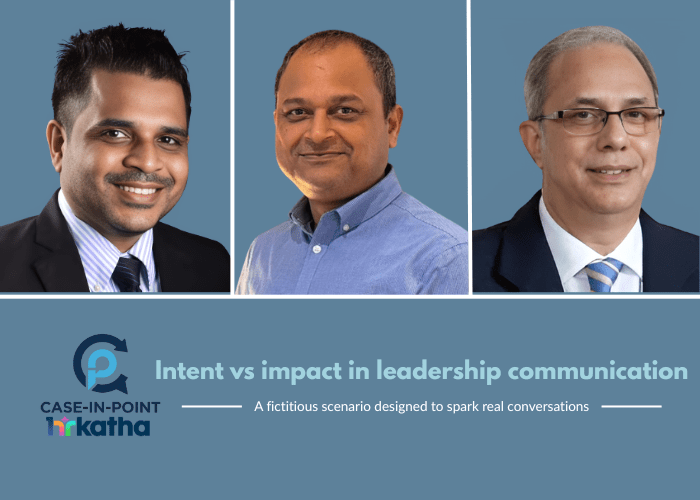
    Rajeev Singh, CHRO, Yokohama ATG

    “The response was poorly framed for a public forum. The question was about representation, but the answer shifted to sacrifice and availability.

    That said, I would not rush to a public apology. The organisation should clearly reinforce its commitment to equal opportunity. That message should come institutionally.

    A clarification from the CHRO explaining the broader context may be sufficient if there was no discriminatory intent.

    We must also be careful not to create an environment where every misstep demands a public apology. That risks making leaders overly cautious.

    This is a reminder that leaders must be far more deliberate with language, especially in large forums.

    Not every communication error requires an apology. Sometimes, clarity and institutional reassurance are enough.


    Satyajit Mohanty, Senior HR leader

    “For me, this is about impact, not intent.

    Employees respond to what they hear, not what leaders mean. Once words are recorded and shared, perception becomes reality.

    Some form of public clarification is necessary. It does not have to be dramatic, but it must acknowledge that the statement caused discomfort.

    The bigger risk is not reputational for the CHRO. It is cultural for the organisation. If employees begin to question whether inclusion is taken seriously, trust erodes.

    Ignoring the issue or waiting for it to pass is not a solution.

    If diversity is a genuine priority, accountability must be visible.

    Leaders must recognise that impact carries more weight than intent, especially on sensitive issues.


    Chandrasekhar Mukherjee, Senior HR leader

    “The communication could certainly have been better, but I do not see deliberate bias.

    Leaders must be mindful not just of what they say, but where and how they say it. A town hall is not the place for loosely framed responses on sensitive topics.

    The CEO’s role is critical here. If there was no intent to discriminate, leadership should respond collectively, not isolate the CHRO.

    A timely clarification from the CEO could have addressed the situation and prevented escalation.

    Such reactions rarely stem from a single comment. They often reflect underlying trust gaps.

    This is less about one statement and more about how leadership responds under pressure.

    Handled well, it can restore trust. Handled poorly, it can deepen existing fractures.


    If you were the CHRO at Unified Dynamics

    What would you do?

    • Ask for a public clarification acknowledging impact
      • Have the CEO step in and reset the narrative
      • Stand by intent and avoid an apology

    Or is the real question this:
    Does leadership accountability depend on intent or on impact?

    Share your view in the comments or on LinkedIn using #HRKathaCaseInPoint.

    Culture diversity Employee Employee Benefits Employee Engagement employees employer Employment Engagement Human Resources Intent vs impact LEAD Leadership leadership communication Productivity public apology Recruitment Skill Development Training Workforce Workplace
    Share. LinkedIn Twitter Facebook WhatsApp
    mm
    Radhika Sharma | HRKatha

    Radhika is a commerce graduate with a curious mind and an adaptable spirit. A quick learner by nature, she thrives on exploring new ideas and embracing challenges. When she’s not chasing the latest news or trends, you’ll likely find her lost in a book or discovering a new favourite at her go-to Asian eatery. She also have a soft spot for Asian dramas—they’re her perfect escape after a busy day.

    Leave A Reply Cancel Reply

    Related Posts

    herSTORY: Priyanka Priyadarshini, group head-HR, Bluspring Enterprises

    May 7, 2026

    Burj Khalifa’s builder finds Indian workers dependable, consistent, dedicated

    May 7, 2026

    PayPal’s job cuts aimed at saving $1.5 billion

    May 7, 2026

    Rajeev Singh rejoins Yokohama ATG as CHRO

    May 6, 2026
    Editorial

    The problem isn’t HR. It’s how managers are measured

    The image circulated widely: a professional working from a parked car, laptop balanced precariously, joining…

    The reference economy: When hiring decisions are made before interviews begin

    Somewhere between the job posting and the final interview, the real hiring decision has already…

    EDITOR'S PICKS

    herSTORY: Priyanka Priyadarshini, group head-HR, Bluspring Enterprises

    May 7, 2026

    Case-in-Point: Intent vs impact in leadership communication

    May 7, 2026

    HR Perspectives by P. Dwarakanath: “Build talent for continuity, buy for disruption”

    May 6, 2026

    85% use AI at work. Only 26% feel ready for it

    May 6, 2026
    Latest Post

    herSTORY: Priyanka Priyadarshini, group head-HR, Bluspring Enterprises

    herSTORY May 7, 2026

    Curiosity about people It was curiosity about people, what drives them, how teams come together,…

    Case-in-Point: Intent vs impact in leadership communication

    Case-In-Point May 7, 2026

    HRKatha’s Case-in-Point presents real-world HR dilemmas and invites leaders to weigh competing business and ethical…

    Burj Khalifa’s builder finds Indian workers dependable, consistent, dedicated

    Employee Behaviour May 7, 2026

    Mohamed Alabbar, founder of Emaar Properties and the developer behind the Burj Khalifa, has highlighted…

    PayPal’s job cuts aimed at saving $1.5 billion

    Layoff May 7, 2026

    PayPal is preparing for a major restructuring under Enrique Lores, CEO, who took charge in…

    Asia's No.1 HR Platform

    Facebook X (Twitter) Instagram LinkedIn WhatsApp Bluesky
    • Our Story
    • Partner with us
    • Career
    • Reach Us
    • Exclusive Features
    • Cover Story
    • Editorial
    • Dive into the Future of Work: Download HRForecast 2024 Now!
    © 2026 HRKatha.com
    • Disclaimer
    • Refunds & Cancellation Policy
    • Terms of Service

    Type above and press Enter to search. Press Esc to cancel.