



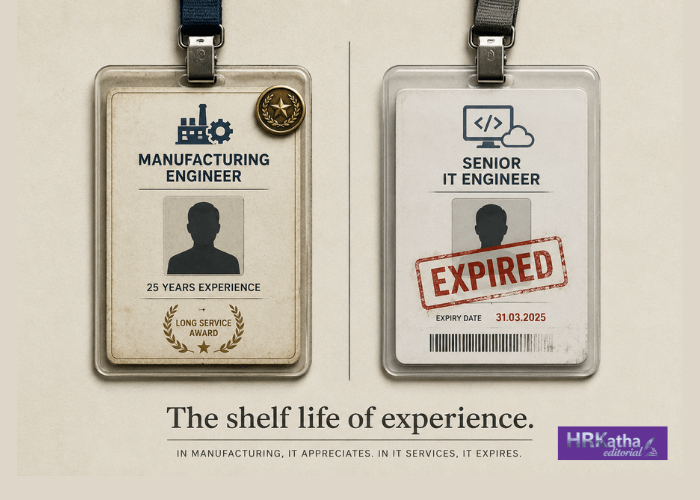
A manufacturing engineer with twenty-five years in an automotive plant is an asset. They understand the production line, the tolerances that matter, the failure modes that recur, and the institutional knowledge that prevents expensive mistakes. Promotions follow experience. Compensation reflects accumulated expertise. Retirement, when it comes, is planned and ceremonial.
A software engineer with twenty-five years in a large Indian IT services company occupies a different position. Expensive. Potentially rigid. Vulnerable during restructuring. The phrase “not keeping up with technology” becomes a convenient explanation for what is often a cost decision. Fresh graduates are cheaper, more “trainable,” and carry none of the salary expectations that come with two decades of work.

This is not primarily a difference in capability. It is a difference in business model.
Where experience compounds
In traditional manufacturing, experience does not merely accumulate. It appreciates.
A senior process engineer in a steel plant or automotive facility holds knowledge that cannot be replicated quickly. They understand equipment behaviour under stress, material tolerances that manuals do not fully capture, and the subtle indicators that distinguish routine variation from impending failure.
This knowledge is earned through years of observation, repeated problem-solving, and exposure to production realities. A junior engineer with technical training cannot easily substitute for someone who has seen the same systems across thousands of production cycles.
Organisations recognise this and pay for it. Careers are built on the assumption that expertise deepens with tenure. Retirement planning assumes decades of employment. Succession involves deliberate transfer of institutional knowledge before senior engineers exit.
The business model rewards continuity. Manufacturing companies produce products whose quality depends on consistency over time. Institutional memory about suppliers, design decisions, production failures, and operational trade-offs prevents costly repetition of old mistakes.
Product businesses value continuity. Continuity requires people who have been around long enough to remember.
“Manufacturing treats experienced workers as repositories of institutional knowledge. Large parts of Indian IT increasingly treat experienced engineers as expensive labour.”
Where experience depreciates
In Indian IT services, the trajectory is structurally different.
The stated explanation is technological obsolescence. Software languages and frameworks evolve rapidly. What was cutting-edge five years ago may now be legacy. Cloud architectures replace on-premise systems. New tools emerge constantly. The argument follows that experienced engineers struggle to adapt, while younger employees arrive trained in the latest frameworks and unburdened by older mental models.
This explanation is not entirely wrong. Technology does change quickly. Some skills genuinely lose relevance. A developer who mastered COBOL in the 1990s and stopped learning thereafter is less useful in a world building cloud-native applications.
But the explanation is incomplete because the deeper driver is not technology cycles. It is the economics of the industry itself.
At scale, many Indian IT services firms operate as labour providers. Clients define the technology stack. The service provider supplies engineers to execute within it. Efficiency is measured through billable hours, utilisation rates, and cost per resource.
In this model, depth of expertise matters less than cost and trainability. A junior engineer who can be billed at a lower rate and trained quickly in the required technology often becomes commercially more attractive than a senior engineer with broader experience but higher salary expectations.
If the project shifts technologies in two years, both employees may need retraining. The junior engineer remains cheaper before, during, and after that transition.
Labour becomes fungible. Experience becomes overhead.
This creates a structural bias against tenure. The longer someone stays, the more expensive they become. Their accumulated understanding of system design, architectural trade-offs, debugging complex issues, and navigating organisational complexity carries limited value if the business model treats engineers primarily as interchangeable resources allocated to client-defined tasks.
The irony is difficult to miss. Manufacturing is typically described as labour-intensive. IT services is positioned as a knowledge industry. Yet manufacturing often treats experienced workers as repositories of institutional knowledge, while parts of the IT services industry increasingly treat experienced engineers as expensive labour.
The language of “learning agility”
When restructuring happens, the language is careful.
Organisations rarely say they are replacing expensive senior engineers with cheaper junior ones. Instead, they speak about “learning agility,” adaptability, and the need to keep pace with changing technology.
Learning agility is difficult to measure and easy to invoke. It becomes a convenient proxy for cost.
The assumption is that younger engineers adapt faster and arrive unburdened by legacy thinking, while senior engineers become slower and more rigid. Sometimes this is true. Often it is not.
An engineer who has learned multiple programming languages over twenty years may learn the next one faster than someone learning their second. Engineers who have worked across architectures often carry transferable judgment that remains valuable even when technologies change.
What is unquestionably true is that senior engineers cost more. In a business model driven by pricing pressure and utilisation metrics, cost frequently matters more than depth of expertise.
The language of agility reframes a financial decision as a capability decision. Responsibility shifts onto the employee: if you are being let go, it is because you failed to remain relevant rather than because the economics no longer favour your salary band.
In some large consulting and technology firms, even senior leadership layers that expanded during growth years are now quietly being reduced. The signal is difficult to miss. Experience is celebrated during expansion cycles and questioned during efficiency cycles.
“The issue is not whether technology evolves too quickly for long careers. It is whether organisations are designed to treat accumulated knowledge as an asset or as cost.”
What gets lost
The long-term consequences emerge slowly.
Institutional memory weakens. Teams repeatedly rediscover solutions because nobody remains who remembers why earlier decisions were made. Technical debt compounds because the people who understood the original trade-offs have exited.
Mentorship becomes shallow. In some organisations, the most experienced engineer available to younger employees has seven or eight years of tenure. Knowledge transfer becomes compressed into short cycles of immediate execution rather than deep apprenticeship.
The difference matters because experienced engineers often contribute less through coding speed than through judgment. They recognise failure patterns earlier, anticipate scaling problems before they become visible, and understand which architectural compromises create future fragility.
These capabilities are built through exposure to complexity over time. When organisations systematically cycle out experience, they also reduce the density of accumulated judgment inside the system.
System-level thinking erodes in quieter ways as well. Experienced engineers learn to see interactions rather than isolated tasks. They understand how decisions taken in one layer create consequences elsewhere. That perspective rarely develops in environments where careers are optimised around short project cycles and constant technological churn.
Whether this matters depends on what organisations ultimately want to become. If the work is primarily commoditised execution, perhaps deep continuity is unnecessary. But organisations that aspire to build enduring products, complex systems, or original intellectual property eventually confront the limits of shallow institutional memory.
The AI acceleration
Artificial intelligence is accelerating this tension.
If coding assistants can generate functional code from prompts, the immediate assumption is that junior engineers equipped with AI tools may become productive enough at significantly lower cost than experienced engineers with higher salaries.
But this misunderstands where senior value often lies.
Experienced engineers contribute judgment more than raw coding output. They understand which architectural decisions scale, which shortcuts create future instability, and which trade-offs matter under pressure.
These capabilities do not disappear when coding tools improve. If anything, they become more valuable. As AI reduces the difficulty of writing code, differentiation shifts toward system design, architectural thinking, and decision-making under ambiguity.
The problem is that these qualities are harder to quantify inside business models optimised around measurable delivery metrics.
If clients continue paying primarily for execution capacity rather than engineering judgment,
AI may strengthen the economic case for replacing expensive experience with cheaper execution supported by automation.
The risk is not technological displacement alone. It is organisational simplification. Companies optimise for what is immediately measurable while underestimating the value of accumulated judgment until its absence creates visible failure.
The structural difference
Manufacturing companies and IT services companies operate under fundamentally different economic logics.
Manufacturing companies build products. They own the brand, the design, and the customer experience. Reputation depends directly on quality consistency over time. A defect caused by poor institutional knowledge damages the company itself. Continuity therefore becomes commercially valuable.
IT services firms, particularly at scale, often operate differently. The client owns the product, defines the architecture, and shapes the strategic direction. The service provider supplies execution capacity. If experienced engineers become expensive and clients remain highly cost-sensitive, replacing them with cheaper equivalents becomes economically rational.
This is not universal across technology. Product firms, research-intensive organisations, semiconductor companies, and deep-tech startups often value expertise deeply. Engineers with rare technical skills in infrastructure, AI systems, cybersecurity, or specialised domains continue to command significant leverage.
But the dominant large-scale Indian IT services model still rewards cost efficiency more than continuity.
The irony is that manufacturing, frequently labelled labour-intensive, often treats experienced employees as irreplaceable repositories of knowledge. Meanwhile, sections of the technology industry described as knowledge-based increasingly behave as though accumulated experience is financially inconvenient.
What this reveals
The difference in how industries value experience is not fundamentally about whether technology changes faster than manufacturing processes. Manufacturing also evolves constantly through automation, robotics, supply-chain digitisation, and advanced materials.
The real difference lies in what the business model rewards.
Body-shopping models reward cost efficiency and fungibility. Product-oriented businesses reward continuity, judgment, and institutional depth.
This explains why tenure creates different emotions across sectors. In manufacturing, long experience signals accumulated value. In large sections of Indian IT services, it increasingly signals cost exposure.
That anxiety is not irrational. Even engineers who continuously upskill remain vulnerable if their compensation rises faster than what cost-conscious clients are willing to pay.
The larger question is whether this model is sustainable for an industry that increasingly speaks about innovation, intellectual property, and building globally competitive products.
An ecosystem that systematically cycles out experience every decade eventually weakens mentorship, institutional memory, and deep systems thinking. Those losses may remain invisible during growth cycles but become harder to ignore when organisations attempt to build complex, enduring technology rather than execute modular client work.
Manufacturing demonstrates that industries facing technological change can still value experience if continuity itself is treated as strategic advantage.
The issue, then, is not whether technology evolves too quickly for long careers. It is whether organisations are designed to treat accumulated knowledge as an asset or as cost.
In large parts of Indian IT, the answer is becoming increasingly clear. And so is the unease that accompanies it.