


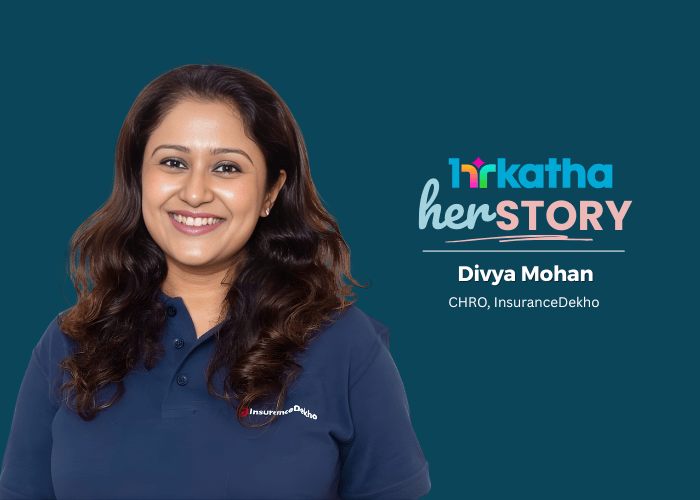
Not black and white
Looking back at her first HR role, Divya Mohan remembers being surprised by how little of it was black and white. She had expected clear policies and defined answers. Instead, she found herself operating in the grey, where every decision involved balancing the needs of an individual with the realities of the organisation.
“You’re constantly balancing compassion with fairness, individual context with collective impact,” she says. There are moments when you deeply understand someone’s situation, and yet you still have to take a decision that serves the larger system.
That tension, she realised, is never really taught. Over time, Mohan came to see HR as the art of holding both truths with integrity.
Today, as CHRO at InsuranceDekho, she leads with a philosophy shaped by those experiences: fairness is not about leaning either way, but about creating conditions where people are seen fully.
Visibility through work
“Gender bias isn’t always dramatic or obvious,” observes Mohan. Sometimes it surfaces quietly, through assumptions people may not even recognise consciously.
There are moments when women are underestimated, and there are also moments when there is an unconscious tendency to be overly supportive. Both, according to her, can shift the conversation away from objective evaluation.
What she consciously tries to do is slow the conversation down and bring it back to role clarity, capability, and long-term contribution.
For Mohan, fairness is not about narratives. It is about creating a space where people are evaluated through their work.
“Fairness is about creating space where people are seen through their work, not through narratives.”
Perfection versus responsibility
According to Mohan, some of the toughest decisions in HR are the ones where there is no perfect answer, only a responsible one.
Whether it involves restructuring, leadership transitions, or balancing business urgency with employee impact, those moments test both conviction and empathy.
Clarity of purpose has helped her navigate such situations, but so has honest communication. She believes that when decisions are made with a long-term perspective and communicated transparently, people may not always agree, but they usually understand.
“Predictability and fairness matter more than perfection,” she says. “People can accept difficult outcomes; what they struggle with is ambiguity or inconsistency.”
Over time, she has learnt that the role of HR is not to avoid difficult decisions, but to ensure they remain principled and humane.
“When you anchor decisions in values rather than convenience, you protect both culture and credibility,” she states.
“When decisions are anchored in values rather than convenience, both culture and credibility remain protected.” |
Respect: the protective shield for culture
For Divya Mohan, respect remains non-negotiable because everything else in an organisation can eventually be improved or rebuilt, but once respect erodes, culture weakens quietly.
Respect reveals itself in everyday behaviour: how leaders listen, how feedback is delivered, how performance is assessed, and how decisions are communicated.
She believes respect is deeply connected to fairness and consistency. High-performance cultures can be demanding, but expectations must remain clear, accountability equitable, and dignity intact.
When people feel respected, they collaborate better, trust the system more deeply, and stay committed even during difficult phases.
Culture, according to Mohan, is never defined by slogans on walls. It is defined by behaviour, especially behaviour displayed under pressure.
HR as an enabler
One mindset that Mohan believes needs to retire is the assumption that people responsibility belongs only to HR.
Culture, feedback, performance, and development cannot be outsourced to a single function. When leaders expect HR alone to manage morale or fix team dynamics, accountability weakens.
“People leadership is a line responsibility; HR is an enabler, not the owner,” she points out.
What deserves far more attention, in her view, is building stronger people capability within business leaders themselves. Coaching managers to have honest conversations, make fair decisions, and own team outcomes creates far stronger organisations than policies alone ever can.
HR becomes most effective when it enables leaders instead of substituting for them.
Beyond mentorship
For Mohan, sponsorship goes far beyond mentorship. It involves visibility, structured opportunities, and actively removing systemic barriers.
She is intentional about ensuring that high-potential women are included in leadership discussions, succession planning conversations, and stretch assignments that accelerate growth.
At InsuranceDekho, this philosophy has translated into initiatives such as SWRA (She Will Rise Again), which supports women returning from career breaks with dignity and role parity, alongside a Women Leadership Coaching programme designed to strengthen confidence, strategic influence, and executive readiness.
The organisation’s broader culture framework, IMPACT, reinforces inclusivity and meritocracy by ensuring that advancement remains performance-led and transparently evaluated.
Mohan believes women do not need to wait for perfect readiness. What they need is access, trust, and institutional support.
Sustainable inclusion, according to her, happens when opportunity becomes embedded within systems rather than depending on individual advocacy alone.
Quick fire round
What energises you most about your work?
Watching people grow into themselves. There is something deeply rewarding about seeing someone discover their voice, build confidence, and step into responsibilities they may never have imagined for themselves earlier.
Best investment you’ve made in yourself?
Investing in self-awareness. Technical competence can take you far, but leadership demands emotional discipline, understanding your triggers, listening deeply, and becoming comfortable with ambiguity. Becoming a certified executive coach strengthened that learning.
One skill you’re currently working on developing?
Deeper digital and AI fluency from a strategic perspective. As HR becomes increasingly data-driven, understanding how AI can support decision-making, talent mapping, and predictive workforce planning is becoming critical.
Your definition of success today versus 10 years ago?
Earlier, success was closely tied to progression, larger roles, bigger teams and measurable outcomes. Today, it feels more layered. It is about building systems that evolve sustainably, shaping cultures that stay resilient under pressure, and developing leaders who can thrive independently.
What’s the best career advice you’ve ever received?
Respect the law of averages in both work and life. Not every effort compounds instantly, and not every setback is permanent.