


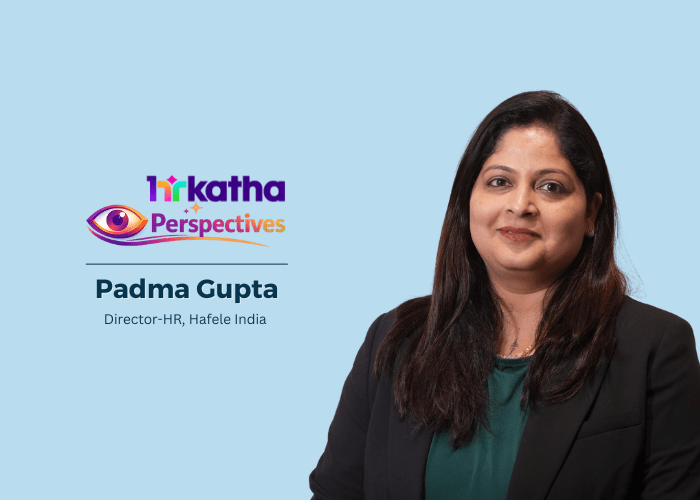
Hafele is a century-old German company specialising in precision engineering, hardware fittings and furniture systems, with a significant presence in India’s construction and interior design market. It is not a sector that generates many headlines, but one where execution quality matters enormously and where the workforce spans everything from sophisticated product specialists to large field and operations teams.
Padma Gupta leads HR at Hafele India and, unusually for an HR leader, also works across customer experience and strategy. That breadth shapes how she approaches the function –less as a process owner and more as someone responsible for connecting people decisions to customer outcomes and business performance.
In conversation with HRKatha, she explains why adaptability is built through exposure rather than classroom learning, why the meritocracy debate often disguises structural bias, and why credibility in HR is earned on the ground rather than inside meeting rooms.
Get on the plane
What shaped you most as a people leader and what would you tell someone entering HR today?
The most defining moment in my career was not a promotion or a programme. It was a decision to get on a plane.
Early in my career at RIL, we were facing serious attrition and unrest at remote drilling sites in Rajasthan and Madhya Pradesh. The conventional HR response would have been to manage the situation from the centre – through reports and interventions designed at a distance. Instead, I travelled to the sites myself. I sat with teams and understood what they were actually dealing with – not what the organisational chart suggested they were dealing with.
Being physically present changed everything. It built trust quickly, surfaced issues that would never have appeared in a survey, and led to solutions grounded in operational reality. It reinforced something I have never forgotten: credibility in HR is not earned through expertise or seniority. It is earned through presence and follow-through.
“The goal is not efficiency for its own sake. It is to create conditions in which people can focus on work that genuinely requires them.”
HR at the leadership table
What actually earns credibility with business leaders, and where does HR still misunderstand what business leaders expect?
What earns credibility is the ability to connect people decisions to business outcomes. Not people metrics alone, but commercial results: revenue, customer satisfaction, execution quality and margin. When HR can demonstrate those links clearly, the nature of the conversation changes.
My own role at Hafele – spanning HR, customer experience and strategy – reinforced that more than any framework could. When you are accountable for customer outcomes as well as people outcomes, you stop treating them as separate conversations. The HR decisions that matter most are often the ones customers eventually feel indirectly.
The gap I see most often is that HR still positions itself as a support function focused on process and policy, while business leaders are looking for partners who can help solve growth and execution challenges. The business leader sitting across the table is not thinking about the HR calendar.
“Some benefits looked impressive on paper and saw almost no use because they did not match what people actually needed.”
Inclusion strengthens meritocracy
How do you respond to leaders who invoke meritocracy as a reason to resist diversity initiatives?
The argument that diversity and meritocracy are somehow in conflict is based on a misunderstanding of both.
Traditional definitions of merit have often been shaped by familiarity – communication styles, educational backgrounds, networks and cultural references that unintentionally advantage people who resemble those already in positions of influence. That is not meritocracy. It is pattern recognition presented as objectivity.
Structured hiring, competency-based evaluations and diverse interview panels do not lower standards. They apply standards more consistently. When organisations assess candidates through transparent criteria rather than cultural fit or instinct, they discover talent they were systematically overlooking.
Inclusion strengthens meritocracy rather than weakening it. The two are not competing ideas.
“When HR can demonstrate the link between people decisions and commercial results, the conversation changes.”
What rewards actually matter
As salary transparency increases, how are you thinking about total rewards, and what have you learned the hard way?
Compensation is no longer a differentiator. It is the baseline. What distinguishes organisations now is the overall employee experience they create, and the honest answer is that most organisations, including ours, are still learning what that truly means in practice.
What genuinely matters to employees is flexibility, meaningful work, growth opportunities and feeling heard. Not as abstract HR values, but as part of everyday working life. Hybrid working, access to learning and managers who are genuinely attentive often matter more than many carefully designed benefit programmes.
One thing I learned the hard way is not to assume. Some benefits looked impressive on paper but saw almost no use because they did not align with what employees actually needed at that stage of their lives. The lesson is not to design more elaborate benefits. It is to keep listening closely enough to recognise shifting needs before attrition reveals them for you.
“The business leader sitting across the table is not thinking about the HR calendar.”
Build for adaptability, not for today’s role
Are you hiring for skills that exist today, or the capacity to learn what does not yet exist?
Our focus is not on hiring for what exists today. It is on hiring for the ability to learn, adapt and grow. Future-ready talent, for us, means individuals who can combine technological fluency with a strong human perspective: curious, agile and genuinely open to continuous learning rather than merely tolerant of it.
The bigger shift is in how we think about development. Training alone is not enough. Real adaptability comes from exposure – cross-functional projects, stretch assignments and situations that force people to operate outside their existing competence. That is what builds the muscle for change rather than just theoretical knowledge about it.
We also use AI and technology to remove repetitive work and free people to focus on problem-solving and human connection. The goal is not efficiency for its own sake. It is to create conditions in which employees can focus on work that genuinely requires judgement, empathy and creativity.
Resistance to change exists at every level, but it is usually rooted in uncertainty rather than unwillingness. We have found that early exposure, visible use cases and honest communication about what is changing and why are far more effective than formal anxiety-management programmes.
“Credibility in HR is not earned through expertise or seniority. It is earned through presence and follow-through.”