


There is a revealing contradiction at the heart of the corporate AI boom. Organisations are deploying artificial intelligence at remarkable speed, employees are completing tasks faster than before, and yet productivity gains at the organisational level remain stubbornly uneven.
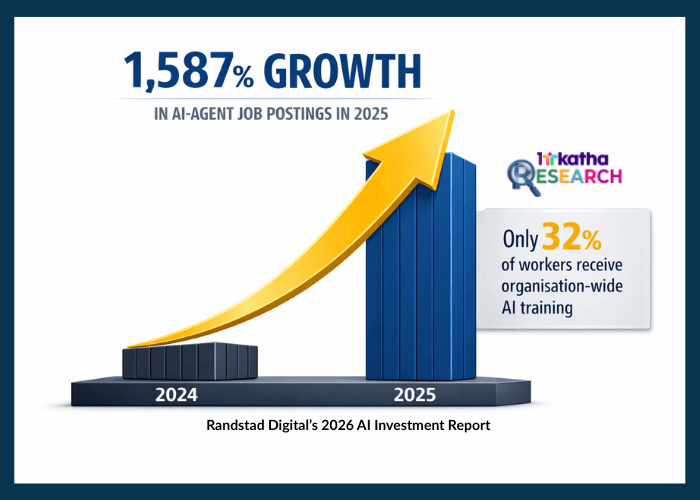
Randstad Digital’s 2026 AI Investment Report puts numbers around the disconnect. Job postings requiring AI-agent skills rose by 1,587 per cent during 2025 alone, signalling how quickly businesses are moving towards autonomous and agentic systems. Yet, across industries investing heavily in AI, only a minority of employers are providing broad-based AI training to their workforce.
The technology is advancing exponentially. Workforce readiness is not.
That imbalance is beginning to shape the next phase of the AI economy. The defining corporate challenge is no longer whether organisations will adopt AI tools. Most already have. The challenge is whether their people can adapt quickly enough to use those tools productively, responsibly and at scale.
The report, based on responses from 27,062 workers and 1,225 employers across 35 markets, describes this as the “AI productivity paradox”.
Faster tasks, slower organisations
More than 60 per cent of workers report productivity gains from AI. Tasks are completed faster, workflows are accelerated and repetitive work is increasingly automated.
Yet, those gains are being partially offset elsewhere.
Time saved through automation is increasingly absorbed by verifying outputs, correcting hallucinations, supervising AI-generated work and managing the operational confusion that rapid technological change creates. In effect, organisations are automating execution faster than they are upgrading human capability.
The result is not failed AI adoption. It is incomplete AI adoption.
The workforce data reveals how exposed many organisations already are.
Some 74 per cent of workers globally say they now need to strengthen their AI skills simply to remain professionally relevant. In IT services, 27 per cent identify AI upskilling as urgent for career survival; in financial services, the figure is 25 per cent.
At the same time, 21 per cent of workers still believe AI will have no impact on their current role.
That may be the report’s most important statistic. Technological disruption becomes far harder to manage when a significant share of the workforce does not yet recognise its proximity. Companies are not merely dealing with a skills gap. They are dealing with a perception gap.
The new reason employees quit
 Employees appear increasingly aware that employers are not moving fast enough to close that gap.
Some 52 per cent of professionals report independently seeking external learning opportunities to future-proof their careers. More strikingly, 23 per cent say they have left a job specifically because learning and development opportunities were insufficient.
Attrition is becoming a capability issue.
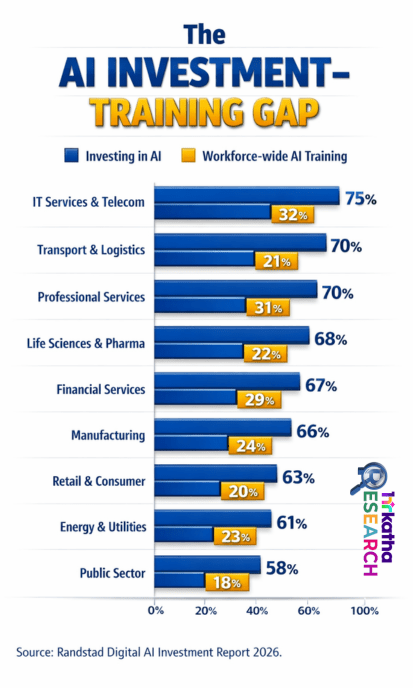
The sectoral breakdown suggests organisations are investing far more aggressively in AI systems than in the workforce required to operate them effectively. In IT services and telecoms, 75 per cent of employers report significant AI investment activity. However, only 32 per cent provide AI training across the workforce. In life sciences and pharmaceuticals, AI investment stands at 68 per cent, while broad workforce training reaches only 22 per cent. Transport and logistics invests at 70 per cent but trains only 21 per cent comprehensively.
Professional services shows a similar pattern: 70 per cent investment, 31 per cent workforce-wide training.
Across sectors, the pattern barely changes. Organisations are buying the technology infrastructure faster than they are building the human infrastructure around it.
Why Millennials feel the pressure most
The report’s central argument follows naturally from this imbalance: the real competitive advantage in the AI economy may not come from AI adoption itself, but from learning velocity – the speed at which organisations can continuously reskill their workforce as technology evolves.
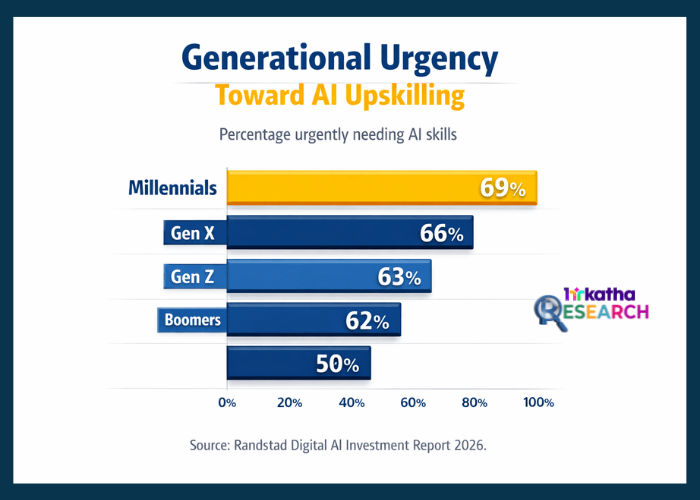
The workers reporting the greatest urgency are not Gen Z employees entering the workforce, but Millennials in mid-career roles. Some 69 per cent of Millennials say they urgently need to strengthen AI capabilities, ahead of Gen X at 66 per cent, Gen Z at 63 per cent and Baby Boomers at 62 per cent.
The anxiety is rational.
Mid-career professionals have spent years accumulating expertise in functions now being reshaped by automation and AI augmentation. Their existing knowledge still matters, but its shelf life is shortening. The threat is not immediate redundancy so much as gradual erosion of relevance.
Geography reinforces the divide. Workers in Asia-Pacific report the highest urgency around AI adaptation at 73 per cent, followed by Latin America at 70 per cent. North America reports lower urgency at 58 per cent.
This does not necessarily imply weaker disruption in developed economies. Rather, it suggests that workers in emerging markets recognise more acutely how quickly competitive advantage can disappear when capability development lags behind technological adoption.
The end of annual training
The report is particularly critical of the traditional corporate learning model. Annual training programmes, fixed certification cycles and generic learning modules were designed for a slower economy – one in which technological shifts unfolded over years rather than quarters.
That world no longer exists.
Randstad argues that organisations increasingly need what it terms “Training as a Service”: continuous, role-specific learning integrated directly into day-to-day operations rather than treated as a periodic HR exercise.
The comparison it offers is revealing. Companies no longer build their own cloud infrastructure because the environment changes too quickly. Skills development, the report suggests, now requires the same logic.
The organisations adapting best appear to understand that AI investment is only partially a technology decision. It is increasingly an organisational-design decision.
One aerospace-sector digital academy cited in the report improved workforce readiness by 56 per cent while simultaneously accelerating innovation cycles. The gains came not from deploying more AI tools, but from systematically improving employees’ ability to use them effectively.
That distinction matters because the next phase of competition may reward adaptability more than adoption.
The 1,587 per cent rise in AI-agent job postings is not a forecast about the future of work. It is evidence that the future has already arrived faster than many organisations expected.
The companies most likely to benefit from that shift will not necessarily be those that bought AI first. They will be the ones that realised early enough that technology was only half the investment required.