


Close Menu
    Facebook X (Twitter) Instagram
    • Our Story
    • Partner with us
    • Reach Us
    • Career
    Subscribe Newsletter
    HR KathaHR Katha
    • Exclusive
      • Exclusive Features
      • Perspectives
      • Friday Features
      • herSTORY
      • Rising Stars
      • Case-In-Point
      • Point Of View
      • Research
      • HR Pops
      • Dialogue
      • Movement
      • Profile
      • Beyond Work
      • By Invitation
    • Brief News
      • Global HR News
      • Compensation & Benefits
      • Diversity
      • Events
      • Gen Y
      • Hiring & Firing
      • HR & Labour Laws
      • Learning & Development
      • Merger & Acquisition
      • Performance Management & Productivity
      • Talent Management
      • Tools & Technology
      • Work-Life Balance
    • Special
      • Editorial
      • HR Forecast 2026
      • Cover Story
      • HR Forecast 2024
      • HR Forecast 2023
      • HR Forecast 2022
      • HR Forecast 2021
      • HR Forecast 2020
      • HR Forecast 2019
      • New Age Learning
      • Coaching and Training
      • Learn-Engage-Transform
    • Studio
      • The CHRO Playbook
      • Quick HR Insights
      • The Corner Office
    • Reports
      • Whitepaper
        • HR Forecast 2024 e-mag
        • Future-proofing Manufacturing Through Digital Transformation
        • Employee Healthcare & Wellness Benefits: A Guide for Indian MSMEs
        • Build a Future Ready Organisation For The Road Ahead
        • Employee Experience Strategy
        • HRKatha 2019 Forecast
        • Decoding and Driving Employee Engagement
        • One Platform, Infinite Possibilities
      • Survey Reports
        • Happiness at Work
        • Upskilling for Jobs of the Future
        • The Labour Code 2020
    • Forums
      • HRKatha Inner Circle
      • HRKatha Futurecast
      • Leadership Summit 2025
      • Rising Star Leadership Awards
      • HRKatha Futurecast 2025
      • Automation.NXT
      • The Great HR Debate
    WhatsApp LinkedIn X (Twitter) Facebook Instagram
    HR KathaHR Katha
    Home»Exclusive Features»Research»Significant reskilling required for 54 per cent of Indian population: WEF study
    Research

    Significant reskilling required for 54 per cent of Indian population: WEF study

    mmBy Kartikay Kashyap | HRKathaDecember 27, 2018Updated:December 27, 20183 Mins Read27567 Views
    Share LinkedIn Twitter Facebook WhatsApp
    Share
    LinkedIn Twitter Facebook WhatsApp

    The World Economic Forum has come out with a study ‘The Future of Jobs 2018’ which talks about technology becoming the most integral part of business. It discusses the new kinds of roles which may come up or will be in demand between 2018 and 2022, also revealing that people will need some specialised skills to fit into these roles. Some capabilities or skills will definitely be more sought after in the next few years.

    While technology has already become an integral part of businesses today, the biggest challenge for the people is to learn the functioning of these technologies in order to survive in the business and the market. According to the study, high-speed mobile internet, artificial intelligence, adoption of big data analytics and cloud systems will become the strategic drivers of the business model between 2018 and 2022.
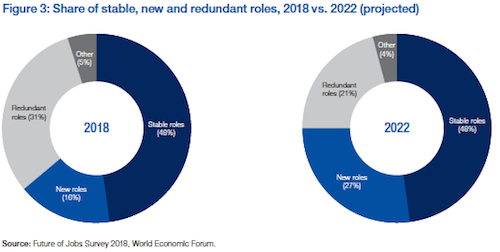
    The results of the study suggest that 16 per cent new roles and 31 per cent redundant roles existed in 2018. As the world moves towards 2022 the numbers will change. The percentage of redundant roles will reduce to 21 per cent while new roles will increase to 27 per cent. It is clear that some of the redundant roles will be automated by technology and machines, and in their place new roles will be generated. Some of the new roles which will prevail will be in the areas of AI and machine learning analytics, big data analytics, robotics and engineering.
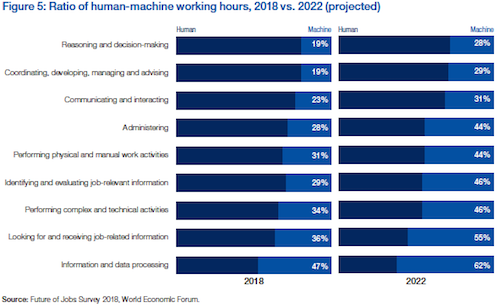
    The study also gives a comparison between the working hours of machines and humans in 2018 and 2022 in different functions. It is very evident that machines will reduce the working hours of humans in the coming years. The study reveals that in information and data processing, where machines contribute 47 per cent now, the contribution will increase to 62 per cent. When it comes to technical and complex jobs, the working hours of machines will increase from 34 per cent in 2018 to 46 per cent in 2022.
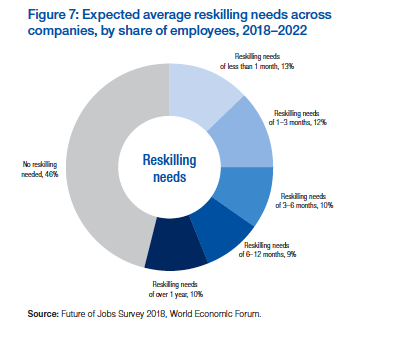
    Interestingly, the most trending and ‘in demand’ skills in 2022 will be of analytical thinking and innovation, active learning and learning strategies, technology design and programming and many more. The biggest concern in the future will be reskilling of employees. The research says that at least 54 per cent of all employees will require significant reskilling and upskilling. About 35 per cent of these are expected to need additional training of up to six months, while nine per cent will require reskilling of six to 12 months. Ten per cent will have to be trained on additional skills for over a year.
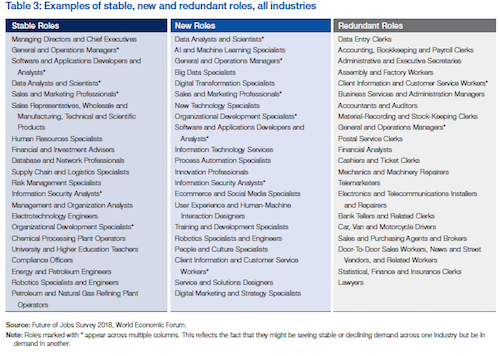
    The region wise study also reveals that the emerging job roles in India will be that of managing directors and chief executives, sales representatives for technical and scientific products, software and applications developers and data scientists, financial analysts, human resource specialists, and financial and investment advisers among others.

    Some of the emerging skills in India will include analytical thinking and innovation, active learning, creativity, originality and initiative, technology design and programming, critical thinking and analysis, complex problem-solving, leadership and social influence, reasoning, problem-solving and ideation, emotional intelligence, systems analysis and evaluation.

    While the future workforce will definitely be expected to be proficient in new technologies between the present and 2022, ‘human’ skills such as creativity, persuasion and negotiation will not lose their value. In fact, attention to detail, resilience, flexibility and complex problem-solving will be qualities that will only become more valuable. Emotional intelligence, leadership and social influence as well as service orientation will also witness dramatic increase in demand as compared to their present standing.

    Share. LinkedIn Twitter Facebook WhatsApp
    mm
    Kartikay Kashyap | HRKatha

    A mass communication graduate Kartikay is a quick learner. A fresh bake, yet a prolific writer, he is always keen to learn and discover new things. He is an easy going gallivanted and just likes to chill out when he is not chasing news. He loves watching movies as well.

    Leave A Reply Cancel Reply

    Related Posts

    26% frontline employees report negative transformation experiences, nearly 3x the senior management rate

    October 28, 2026

    India’s tech professionals have already decided before you call them

    October 21, 2026

    India’s staffing industry claims 40 to 45% of formal payroll additions. What does that mean?

    October 14, 2026

    52.3% of urban Indian workers commute by two-wheeler

    October 7, 2026
    zoha
    Editorial

    The rift between the corner office and the floor below

    A general manager at a large Indian steel conglomerate recently described an exchange with his…

    Can India become a skills-first economy while remaining a collar-conscious society?

    Consider two employees beginning their careers. One joins a technology company as a junior analyst.…

    EDITOR'S PICKS

    HR Perspectives by Arindam Chakraborty: “Succession planning must begin two to three levels below the target role”

    October 28, 2026

    26% frontline employees report negative transformation experiences, nearly 3x the senior management rate

    October 28, 2026

    Microaffirmations: The small gestures that build big trust

    October 27, 2026

    For TELUS Digital, the diversity question is no longer how many but where

    October 27, 2026
    Latest Post

    Apple cuts hardware Programme manager roles amid management restructuring

    Brief News October 28, 2026

    Apple has reportedly laid off some hardware programme managers as it moves to reduce management…

    Škoda Auto’s LGBTQ+ employee network marks 5 years amid wider inclusion efforts

    Brief News October 28, 2026

    Škoda Auto’s LGBTQ+ employee network, Škoda Proud, has completed five years, with the automaker receiving…

    HSBC Cuts 4,500 roles in six months as workforce falls to 2,04,330

    Brief News October 28, 2026

    HSBC’s global workforce declined by around 4,500 full-time equivalent employees over the six months to…

    Tamara Leisure Experiences trains next generation of hoteliers through immersive learning programmes

    Brief News October 28, 2026

    Tamara Leisure Experiences (TLE) has concluded the fourth cohort of its Responsible Hoteliers of Tomorrow…

    Asia's No.1 HR Platform

    Facebook X (Twitter) Instagram LinkedIn WhatsApp Bluesky
    • Our Story
    • Partner with us
    • Career
    • Reach Us
    • Exclusive Features
    • Cover Story
    • Editorial
    • Dive into the Future of Work: Download HRForecast 2024 Now!
    © 2026 HRKatha.com
    • Disclaimer
    • Refunds & Cancellation Policy
    • Terms of Service

    Type above and press Enter to search. Press Esc to cancel.