

Close Menu
    Facebook X (Twitter) Instagram
    • Our Story
    • Partner with us
    • Reach Us
    • Career
    Subscribe Newsletter
    HR KathaHR Katha
    • Exclusive
      • Exclusive Features
      • Perspectives
      • Friday Features
      • herSTORY
      • Rising Stars
      • Case-In-Point
      • Point Of View
      • Research
      • HR Pops
      • Dialogue
      • Movement
      • Profile
      • Beyond Work
      • By Invitation
    • News
      • Global HR News
      • Compensation & Benefits
      • Diversity
      • Events
      • Gen Y
      • Hiring & Firing
      • HR & Labour Laws
      • Learning & Development
      • Merger & Acquisition
      • Performance Management & Productivity
      • Talent Management
      • Tools & Technology
      • Work-Life Balance
    • Special
      • HR Forecast 2026
      • Cover Story
      • Editorial
      • HR Forecast 2024
      • HR Forecast 2023
      • HR Forecast 2022
      • HR Forecast 2021
      • HR Forecast 2020
      • HR Forecast 2019
      • New Age Learning
      • Coaching and Training
      • Learn-Engage-Transform
    • Magazine
    • Reports
      • Whitepaper
        • HR Forecast 2024 e-mag
        • Future-proofing Manufacturing Through Digital Transformation
        • Employee Healthcare & Wellness Benefits: A Guide for Indian MSMEs
        • Build a Future Ready Organisation For The Road Ahead
        • Employee Experience Strategy
        • HRKatha 2019 Forecast
        • Decoding and Driving Employee Engagement
        • One Platform, Infinite Possibilities
      • Survey Reports
        • Happiness at Work
        • Upskilling for Jobs of the Future
        • The Labour Code 2020
    • Conferences
      • Leadership Summit 2025
      • Rising Star Leadership Awards
      • HRKatha Futurecast
      • Automation.NXT
      • The Great HR Debate
    WhatsApp LinkedIn X (Twitter) Facebook Instagram
    HR KathaHR Katha
    Home»Exclusive Features»Research»The war for talent moves to Tier II and III cities
    Research

    The war for talent moves to Tier II and III cities

    mmBy Dr. Prajjal Saha | HRKathaMay 21, 20154 Mins Read3663 Views
    Share LinkedIn Twitter Facebook WhatsApp
    Share
    LinkedIn Twitter Facebook WhatsApp

    Organisations today are trying new methods to attract as well as retain talent. For instance, recently one of the large traditional Indian business conglomerates decided to go for a five-days-a-week because employees voted for it.

    For years, the Indian cinema has been the origin of several stereotypes that was prevalent in the society. Though, over exaggerated, these stereotypes were never far-flung from reality. For instance, we have always seen and believed that – especially those born in the 70s and before – the job seeker, irrespective of his/her caliber, was always at the receiving end and at the mercy of the employer – unless it was a government job. This employer could throw away the poor man out of the job at the drop of a hat.

    Seriously, there was a time when getting a job without a reference was at par with winning a battle. It was a major achievement in one’s life. This is why one job lasted a lifetime.

    Now this seems to be a story of the distant past. It’s no longer fashionable to have only a secured job. The table has turned and now the employer is at the mercy of top talent. They can make or break a company – they can win businesses and also make you lose clients.

    The battle of jobseekers has now transformed into the war for talent. Companies across sectors and geographies are trying to gain a competitive advantage in finding and retaining the best performers amidst acute shortage of top-class talent. Organisations have realized that there is no dearth of opportunities in the market for the talented workforce, so the ball now lies on their court. Nevertheless, it’s their prerogative to choose who they wish to work for.

    With the coming of age, candidates today are much aware of how and where they want to steer their career. Going forward, candidates today do not just research about the employer before they accept an offer; in fact, they evaluate every possibilities even before they apply for these jobs.

    This is why organisations today are bringing a change in their HR Policies and Practices in order to attract and retain talent. For instance, recently on the large traditional Indian business conglomerates decided to go for a five-days-a-week because employees voted for it.

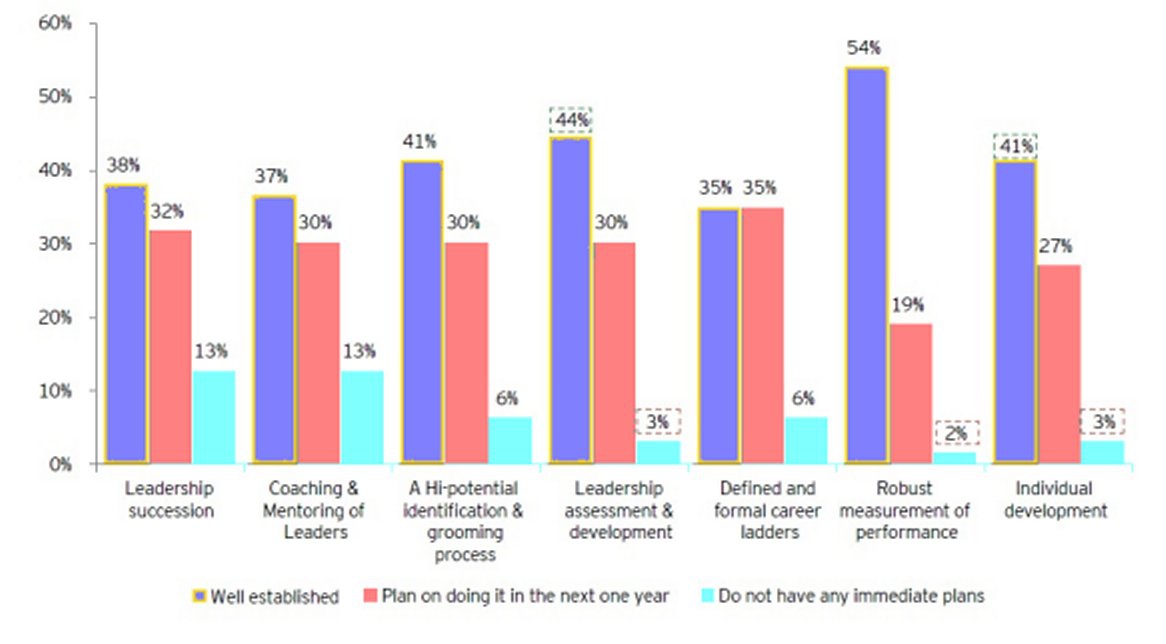
    As per a joint study by EY (Ernst & Young) and NHRDN (National Human Resources Development Network), organisations today are geared up to embrace this change. The study reveals that around 44 per cent of the respondent companies claimed that they had a well-established leadership assessment and development programme, while another 30 per cent were planning to have one in the next one year. What was encouraging was the fact that more than 54 percent of the respondent companies already had a process of robust measurement of performance in place and another 19 per cent were planning to have one in the next 12 months.

    Similarly, more than 70 per cent of the respondents claimed that they already have or plan to have within a year, a programme or policy on leadership succession, hi-potential identification and grooming process, defined and formal career ladders.

    Organisations today are looking at unconventional ways to attract and hire talent as well. No points for guessing that social media is most popular and widely used among unconventional methods with 60 per cent of respondents accepting to have tried this route. However, what’s interesting is the fact that employers are looking at Tier II and III cities for talent and 42 per cent of the respondents agreed to have tried the same. In their opinion, candidates from these cities are a unique combination of low-cost and scalable talent pool, and breadth and depth of available skills.

    The study revealed that there was a high annual turnover of employees working in customer-facing roles, followed by internal production/operation areas.

    Interestingly, there was a very low turnover at the top and senior management levels, which indicated that organisations were better at retaining employees at leadership levels than at junior and mid-level ones.

    This is predominantly because the availability of talent at the top is limited. For instance, while 75 per cent of replacement for junior and middle-level positions gets filled within two months of vacancy, for top management positions, around 14 per cent of vacancies remain open for more than 6 months, while 75 per cent take longer than two months.

    The study presents an insightful view of talent trends across 11 industries in India and HR leaders, business managers, V-Ps and CXOs of more than 60 organisations responded to the survey.

    EY (Ernst & Young) NHRDN (National Human Resources Development Network) The battle of jobseekers The war of talent Tier II and III cities
    Share. LinkedIn Twitter Facebook WhatsApp
    mm
    Dr. Prajjal Saha | HRKatha

    Dr. Prajjal Saha is a business journalist and the editor-publisher of HRKatha. He writes on the realities of work and organisations, offering a clear-eyed view of how companies translate intent into action—often revealing the gap between the two. With over 25 years of experience, he focuses on interpreting workplace trends and leadership decisions in a way that is both insightful and accessible. He founded HRKatha in 2015 to create a platform for credible, insight-driven analysis of the evolving workplace.

    1 Comment

    1. S C Narang on May 21, 2015 12:58 pm

      It is a welcome change for getting the right Talent.Succession planning should be done systematically in Government also, where presently no specific system can be identified.

      Reply
    Leave A Reply Cancel Reply

    Related Posts

    59% of employees are financially stressed. Most HR dashboards cannot see it

    September 2, 2026

    India’s engagement crisis starts with its managers

    August 26, 2026

    Getting a first job is getting harder. The economy is not even in recession

    August 19, 2026

    The workforce has stopped moving. That may not be good news for employers

    August 12, 2026
    zoha
    Editorial

    AI-native workers are forcing managers to earn their relevance

    They did not arrive announcing themselves. They joined as analysts, engineers, content writers, recruiters and…

    Employees are redesigning work before their companies do

    Nobody announced that work would change this way. There was no strategy document, pilot programme…

    EDITOR'S PICKS

    POV: Should organisations hire for culture fit or culture add?

    September 7, 2026

    AI-native workers are forcing managers to earn their relevance

    September 7, 2026

    The career lessons hiding in unfamiliar territory

    September 4, 2026

    Case-in-Point: The pregnancy disclosure dilemma

    September 3, 2026
    Latest Post

    Hi-Tech Radiators appoints Gaurav Vani as group CFO

    Movement September 7, 2026

    Hi-Tech Radiators, the global manufacturer of transformer radiators and tanks, has appointed Gaurav Vani as…

    Kanika Sharma returns to BCG as India HR manager

    Movement September 7, 2026

    After nearly five years at Bain & Company, Kanika Sharma has returned to Boston Consulting…

    Delnaz Desai joins Mahindra Group as VP– group talent head

    Movement September 7, 2026

    Delnaz Desai has joined Mahindra Group as vice president – group talent head, taking charge…

    Telangana to strengthen Employees’ Health Scheme with 354 empanelled private hospitals

    News September 7, 2026

    Telangana is set to strengthen the implementation of its Employees’ Health Scheme (EHS), with 354…

    Asia's No.1 HR Platform

    Facebook X (Twitter) Instagram LinkedIn WhatsApp Bluesky
    • Our Story
    • Partner with us
    • Career
    • Reach Us
    • Exclusive Features
    • Cover Story
    • Editorial
    • Dive into the Future of Work: Download HRForecast 2024 Now!
    © 2026 HRKatha.com
    • Disclaimer
    • Refunds & Cancellation Policy
    • Terms of Service

    Type above and press Enter to search. Press Esc to cancel.