


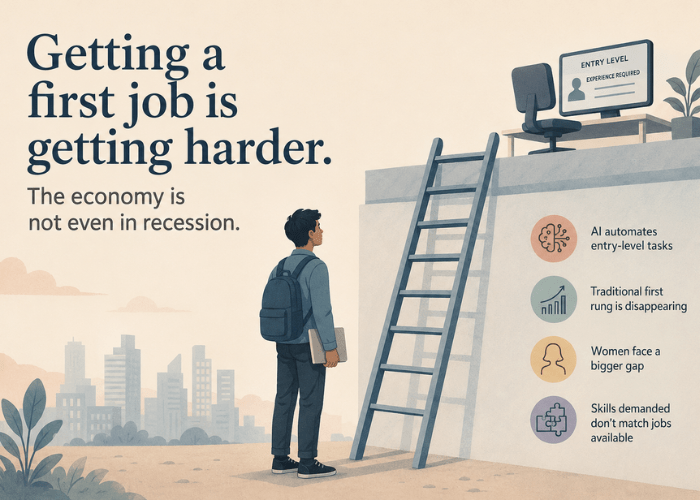
The standard explanation for rising youth unemployment is a struggling economy. The International Labour Organisation’s Global Employment Trends for Youth 2026 makes that explanation increasingly difficult to sustain.
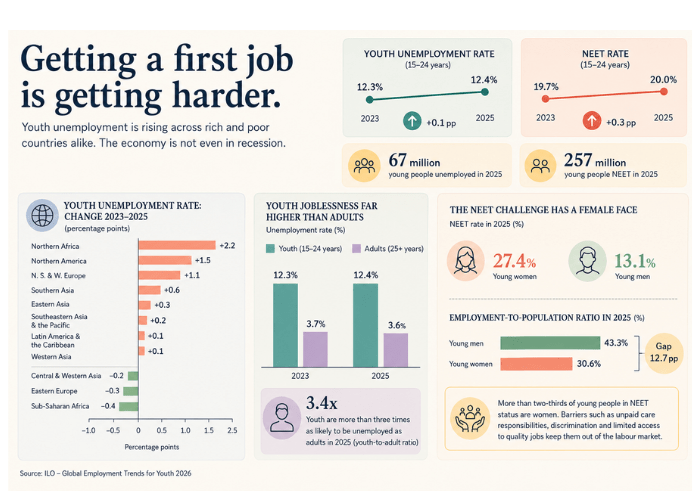
The global youth unemployment rate rose from 12.3 per cent in 2023 to 12.4 per cent in 2025, leaving around 67 million young people aged 15 to 24 without work. The share classified as NEET (not in employment, education or training) increased from 19.7 per cent to 20 per cent over the same period, adding roughly nine million people to a total that now exceeds 257 million. Youth unemployment increased in eight of the world’s 11 subregions between 2023 and 2025.
There is no single global recession explaining this. Economic growth has slowed, but remains positive. Adults have not experienced the same deterioration everywhere. What appears to be weakening is something more specific: the mechanism through which economies absorb young people into work.
For employers, that should matter as much as the unemployment number itself.
The first rung is becoming less reliable
For decades, organisations operated on an implicit bargain with young workers. Education provided qualifications. Employers provided entry-level opportunities. Young employees performed relatively routine work, learnt how organisations operated and gradually accumulated the judgement and experience required for more complex responsibilities.
That progression is becoming less predictable. In 2025, young people were more than three times as likely to be unemployed as adults. In several regions, youth employment has stagnated or deteriorated even while employment among older workers has proved more resilient.
Part of the explanation lies in the kind of work available to young people. Clerical and administrative roles, sales and service jobs, craft and trade positions, and plant and machine operations have traditionally absorbed large numbers of workers at the beginning of their careers. They were rarely prestigious jobs. But they performed a developmental function that their job descriptions did not capture.
A clerk learnt how decisions moved through an organisation. A sales associate learnt how customers behaved. An administrative assistant learnt how senior colleagues worked. An operator learnt how processes failed. Routine work was also apprenticeship by another name.
As technology absorbs more of those tasks, the productivity calculation changes. So does the career calculation.
The AI entry-level problem
The report estimates that 6.1 per cent of jobs held by young people aged 15 to 29 are in occupations with the highest exposure to generative AI. Exposure is not displacement: it measures the extent to which tasks within an occupation could be transformed by the technology, not the number of jobs that will disappear.
The distinction matters precisely because the risk is subtler than elimination.
Artificial intelligence does not need to eliminate an occupation to make entry-level hiring less attractive. It only needs to absorb enough of its junior tasks. A traditional analyst might once have spent considerable time collecting data, preparing spreadsheets, compiling reports and producing first drafts. Increasingly, machines can perform portions of that work quickly and cheaply.
The organisation becomes more productive. The awkward question is what happens to the employee who used to learn through doing it.
The same tension applies across HR, finance, marketing, customer service, legal operations and technology. Much of the routine work organisations are most eager to automate is also the work through which inexperienced employees historically became experienced ones.
That creates a problem that cannot be solved simply by hiring more experienced people. If the machine takes away some of the work that teaches the worker, where will tomorrow’s experienced talent come from?
The rich-country surprise
The deterioration among wealthy economies deserves particular attention because it complicates the idea that difficult school-to-work transitions are primarily a developing-country problem.
Youth unemployment in Northern America rose from 8.3 per cent in 2023 to 9.8 per cent in 2025. Northern, Southern and Western Europe also struggled to improve the transition of young people into decent work, despite stronger institutions, better educational access and considerably more formal labour markets.
Young people in high-income countries generally enjoy protections unavailable elsewhere. Informality is far less prevalent, and those who secure stable employment are more likely to have formal contracts and social protection.
The problem is increasingly getting through the door.
The familiar sequence of degree, entry-level role, experience and career progression has not disappeared. But its first transition has become harder to make. That matters because every subsequent stage depends on it.
Education has not closed the gender gap
The youth employment challenge also has a gender dimension that rising educational attainment has failed to resolve.
In 2025, more than two-thirds of young people in NEET status were women. The NEET rate for young women stood at 27.4 per cent, compared with 13.1 per cent for young men. Yet school enrolment differences between young men and women have narrowed considerably.
The divergence appears after education.
The employment-to-population ratio stood at 43.3 per cent for young men in 2025 and 30.6 per cent for young women, a gap of nearly 13 percentage points. Care responsibilities, discrimination and limited access to suitable employment continue to interrupt the transition from education into work.
For employers complaining of talent shortages, this represents a different kind of pipeline problem. Qualified talent exists, but a substantial proportion disappears from the labour market before organisations ever encounter it as candidates.
Recruitment cannot fix a pipeline that people have already been forced to leave.
Where the jobs are moving
Occupational growth does not automatically create mobility. Employment continues to expand in several high-skilled areas, including science, engineering, healthcare and information and communications technology, and in parts of the developing world that growth points towards a labour market changing its composition rather than simply shrinking. But a young person displaced from clerical or routine service work cannot simply step into engineering, healthcare or a specialised technology role on the strength of availability alone.
A young person displaced from clerical or routine service work cannot simply step into engineering, healthcare or a specialised technology role. The distance between declining occupations and expanding ones is often measured not merely in credentials but in experience, networks and capabilities acquired over time.
That creates another uncomfortable mismatch. Employers increasingly ask for specialised skills and experience while becoming less willing to provide the junior work through which both are developed.
The labour market can therefore have vacancies and unemployed young people at the same time without either side finding what it needs.
The experience paradox
The report ultimately describes more than a rise in youth unemployment. It exposes a growing weakness in the machinery that turns education into experience.
For organisations, a first job has always served two purposes. It produces work today and develops capability for tomorrow. Automation makes it tempting to evaluate entry-level positions only against the first of those purposes. If AI can complete the routine tasks more efficiently, the immediate business case for hiring a junior employee becomes weaker.
The longer-term calculation points in the opposite direction.
Experience cannot be recruited indefinitely if nobody is creating it. Managers, specialists and leaders do not arrive in the labour market fully formed. They are produced by years of exposure to decisions, mistakes, customers, colleagues and increasingly difficult work.
The 257 million young people currently outside employment, education and training therefore represent more than unused labour. Prolonged exclusion from work delays skill formation, earnings growth and access to the experiences on which later careers are built.
For employers, the challenge is not to preserve obsolete junior jobs simply because they once existed. It is to redesign the first years of work so that learning survives even when routine tasks do not.
The first rung of the career ladder is becoming less reliable. Organisations may discover the consequences only years from now, when they reach for experienced talent and realise they stopped creating enough of it.