


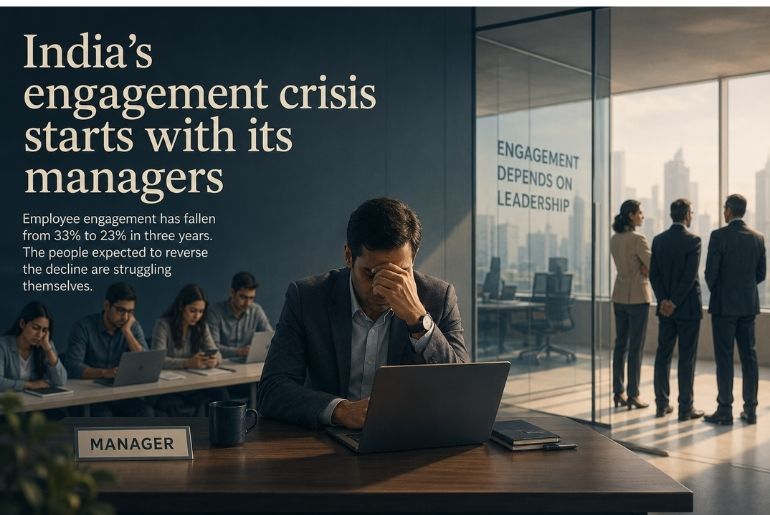
India’s workplace disengagement problem now comes with a formidable price tag. Gallup estimates that it costs the country $351 billion annually, approximately Rs 32.7 trillion, or nine per cent of GDP. The estimate, contained in Rebuilding Indian Workplaces for the Future 2026, produced with the
Institute of Directors India, turns what is usually discussed as a people-and-culture problem into something closer to an economic one.
The deterioration behind that number is equally striking. Employee engagement in India stood at 33 per cent in 2022. By 2025, it had fallen to 23 per cent. Over the same period, the share classified as “not engaged”, employees who meet basic requirements but invest little discretionary effort, rose from 46 per cent to 59 per cent.
India’s biggest workplace problem, in other words, is not a small population of actively hostile employees. It is the quietly indifferent majority that now constitutes well over half the workforce.
What makes the data more uncomfortable is where some of that disengagement sits. The employees organisations rely upon to create engagement in everyone else are struggling themselves.
The manager problem
Managers occupy an awkward position in modern organisations. They are expected to translate strategy into daily work, coach performance, manage change, preserve culture and keep employees connected to an organisation whose priorities may themselves be changing rapidly. When those managers are engaged, much else becomes easier. When they are not, engagement programmes designed elsewhere have limited room to compensate.
In 2025, only 30 per cent of Indian managers were engaged, down from 39 per cent a year earlier. Individual-contributor engagement also fell, from 24 per cent to 19 per cent. The data does not prove that one decline caused the other, but the parallel movement matters because managers are one of the strongest organisational influences on employees’ everyday experience of work.
The problem extends beyond India. Manager engagement has deteriorated across much of the world as the role itself has become harder. Managers increasingly sit between executive demands and changing employee expectations, while simultaneously navigating restructuring, hybrid work, AI adoption and tighter resources. The job has accumulated responsibilities considerably faster than organisations have redesigned it.
Training has not kept pace either. Only 44 per cent of managers globally have received formal management training. The report points to substantially better outcomes among managers who have been trained and cites evidence that coaching-focused development can improve both engagement and performance.
The contradiction is difficult to miss. Organisations routinely identify managers as the mechanism through which engagement is created, while treating the capability to manage as something people will acquire after being given the job.
The culture beneath the numbers
When members of the Institute of Directors were asked why quiet quitting is rising, 42 per cent pointed to weak organisational culture or misalignment with values. That shifts the explanation away from individual employee attitude and towards the environment in which that attitude develops.
Culture in this context is visible rather than abstract. Employees encounter it through the behaviours that get rewarded, the way difficult decisions are communicated, the consistency of recognition, the quality of their manager and the distance between what an organisation says and what it actually does.
When that distance becomes too large, discretionary effort becomes harder to justify. Engagement cannot indefinitely compensate for organisational inconsistency.
Managers sit directly inside that tension. They are expected to represent decisions they may not have shaped, explain changes they may not fully understand and maintain confidence during disruption they cannot control. An organisation can therefore have a manager-engagement problem without having bad managers.
It may simply have designed a management role that asks for accountability without providing equivalent capability, information or authority.
The promotion problem
That makes another finding particularly important. Forty-one per cent of Institute of Directors members say senior leaders need to select managers on the basis of talent and role fit rather than past performance.
It points towards one of management’s oldest structural mistakes: treating success as an individual contributor as evidence of an ability to lead other individual contributors.
The two jobs require different capabilities. Technical excellence may produce results personally; management requires producing results through other people. Coaching, judgement, feedback, conflict resolution and the ability to create accountability without destroying trust do not automatically accompany functional expertise.
Yet promotion remains the principal mechanism through which many organisations manufacture managers. A strong salesperson gets a sales team. A talented engineer gets engineers. A high-performing HR professional gets an HR team. The promotion rewards yesterday’s performance while quietly changing the nature of tomorrow’s job.
When that transition works, organisations gain a capable manager. When it does not, they lose an excellent individual contributor and gain a struggling people leader at the same time.
The consequences do not stop with that person. A poorly equipped manager shapes the experience of everyone reporting to them. Manager capability is therefore unusual among talent investments: its effects multiply through the organisation.
The cost of indifference
The $351 billion estimate makes disengagement difficult to dismiss as a cultural nicety. At nine per cent of GDP, the implied productivity loss is large enough to put workplace quality alongside more conventional economic concerns.
But the aggregate number is useful principally because of what sits underneath it. Disengagement is experienced organisation by organisation, team by team and manager by manager. It appears in lower discretionary effort, weaker productivity, greater turnover and employees doing what their jobs require without contributing much beyond it.
India’s fall from 33 per cent engagement in 2022 to 23 per cent in 2025 occurred against a backdrop of considerable workplace disruption. Hybrid work, changing employee expectations, restructuring and the arrival of generative AI have all altered the relationship between employees and organisations. None, on its own, explains the decline.
The manager data instead points towards a structural vulnerability. Organisations have placed ever more responsibility for employee experience in the middle of the hierarchy without necessarily making the corresponding investment in who becomes a manager, how they are prepared or what authority they have once they arrive there.
This is bigger than HR
The report is aimed substantially at boards and senior leadership, and appropriately so. Engagement may sit on the HR dashboard, but many of the conditions that produce it are determined elsewhere: organisational design, leadership behaviour, management selection, resource allocation and the credibility of decisions made at the top.
HR can measure engagement and develop managers. It cannot independently repair a culture that senior leadership contradicts through its actions. Nor can it give managers authority that organisational structures deny them.
That is why India’s engagement problem is better understood as a leadership problem that happens to appear in HR data.
The temptation is to respond to falling engagement with another survey, another wellbeing intervention or another programme designed to make employees feel more connected. The numbers suggest the harder question sits one level above the employee.
Who is managing the managers?
Organisations have spent years asking managers to create engaged teams. The more urgent task may be creating managers who are capable, supported and engaged enough to do it.