



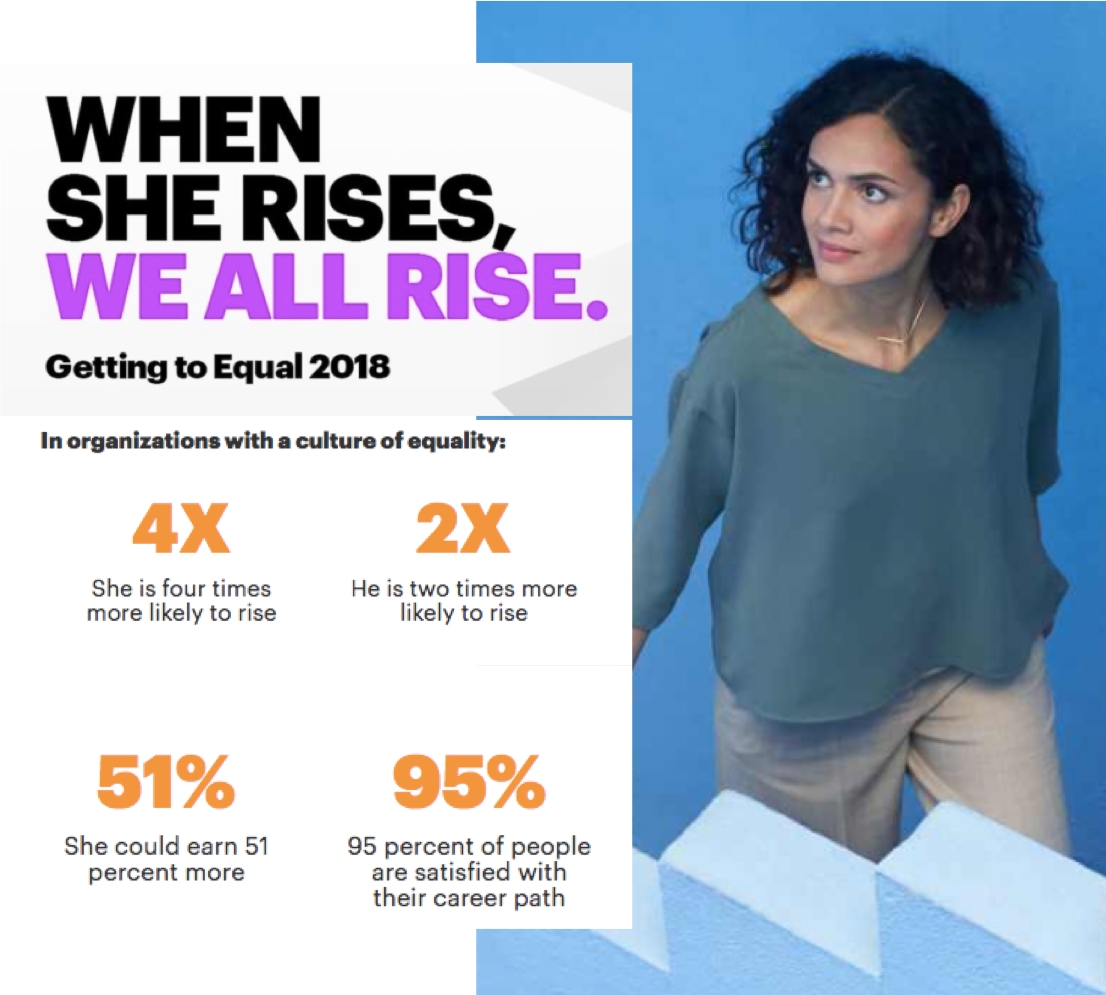
The study brings out 40 workplace factors that are statistically shown to influence advancement, including 14 that are most likely to effect change.
A new report by Accenture titled, ‘When she rises, we all rise,’ is a ready reckoner for businesses and organisations to understand what it takes to build an equal workforce. Accenture’s new research—led by Ellyn Shook, chief leadership & human resources officer, Accenture; and Julie Sweet, chief executive officer- North America, Accenture—brings encouraging and actionable news about equality in the workplace.

The survey covered more than 22,000 working men and women with university education, in 34 countries, to measure their perception of factors that contribute to the culture in which they work. Out of more than 200 personal and workplace factors—such as policies, behaviours and collective opinions of employees—it brings out 40 that are statistically shown to influence advancement, including 14 that are most likely to effect change.
As per the research, currently, there are only 34 women managers for every 100 male managers, whereas, it suggests that if all organisations were to create the environment in which the suggested 40 factors are most common, there could be up to 84 women managers for every 100 male managers. The study categorises these 40 factors into three classes and shows how organisations can take action in each.
Together, all these nurture a culture of purpose, accountability, belonging, trust and flexibility that ensures a larger impact. Within the three categories, here are the 14 factors that are particularly strong and can act as catalysts of positive cultural change:
Bold leadership
A diverse leadership team that sets, shares and measures equality targets openly.
• Prioritising of gender diversity by the management
• Sharing of a diversity target or goal outside the organisation
• Clear statement of gender pay-gap goals and ambitions by the organisation
Comprehensive action
Policies and practices that are family friendly, support both genders, and are free of bias in attracting and retaining people.
• Progress in terms of attraction, retention and development of women.
• Existence of a solid women’s network in the organisation
• Openness of the company’s women’s to men
• Encouragement of men to avail parental leave
An empowering environment
One that trusts employees, respects individuals and offers freedom to be creative and to train and work flexibly.
• No employees are ever asked to change their appearance to conform to company culture.
• Employees are free to be creative and innovative.
• Wide availability and common practice of virtual/remote working
• Regular training sessions to ensure skill relevance of all employees
• Option to employees to avoid overseas or long-distance travel via virtual meetings.
• Facility for employees to work from home when they have a personal commitment.
• Comfortable environment for employees to report sex discrimination/sexual harassment incident(s) to the company.
Currently, 41 per cent of the global workforce of Accenture comprises women and the organisation plans to take it to 50 per cent by 2025, with an aim to have 25 per cent of women managing directors by 2020. Pierre Nanterme, Accenture chairman & CEO, says, “When companies bring together people of different genders, races, cultures and perspectives, we are smarter, more creative, more innovative and more relevant. Men and women are equal … end of story. That means companies should have equal numbers of men and women. And it means pay and access to leadership opportunities should be equal.”
Explaining in a crux as to what is vital to having a balanced workforce, Shook, says, “It’s critical that companies create a truly human environment where people can be successful both professionally and personally—where they can be who they are and feel they belong, every day.”
Interestingly, the research shows that when women rise, men rise too. It reveals that in environments where the 40 factors are most common, men are 23 per cent more likely to advance to manager level and beyond, and more than twice (118 per cent) as likely to advance to senior manager/director level and beyond, than men in environments wherein the factors are less common.
“Our research shows that in companies with cultures that include the workplace factors that help women advance, men thrive too, and we all rise together,” says Sweet.
The research shows that if organisations could have an environment with these factors in place, women could have a 51 per cent salary increase. Additionally, the report suggests that there are almost three times more women on the fast track in organisations, with at least one woman senior leader, than in organisations in which all senior leaders are men (23 per cent and eight per cent, respectively).
Sharing an interesting insight into one of the most common yet misgauged practices in organisations, the report says that a host of workplace policies, practices and programmes must be created—and supported—to increase advancement for all. For instance, implementing maternity leave alone is likely to hold women back from career progression. But when companies encourage parental leave—that is, where men can also take leave—the negative impact on women’s career advancement is eliminated completely.
With more observations and recommendations, the research is a ready reckoner for organisations looking to up their gender diversity across levels, and looks like an effective mantra to achieve an equitable workforce. Validating the results of honest efforts, commitment from the leadership team and impact of the right culture on gender parity, the report shares cases of other organisations, such as Mariott, Alibaba and L’Oréal, that have been able to achieve significant numbers.