
Close Menu
    Facebook X (Twitter) Instagram
    • Our Story
    • Partner with us
    • Reach Us
    • Career
    Subscribe Newsletter
    HR KathaHR Katha
    • Exclusive
      • Exclusive Features
      • Perspectives
      • Friday Features
      • herSTORY
      • Rising Stars
      • Case-In-Point
      • Point Of View
      • Research
      • HR Pops
      • Dialogue
      • Movement
      • Profile
      • Beyond Work
      • By Invitation
    • Brief News
      • Global HR News
      • Compensation & Benefits
      • Diversity
      • Events
      • Gen Y
      • Hiring & Firing
      • HR & Labour Laws
      • Learning & Development
      • Merger & Acquisition
      • Performance Management & Productivity
      • Talent Management
      • Tools & Technology
      • Work-Life Balance
    • Special
      • Editorial
      • HR Forecast 2026
      • Cover Story
      • HR Forecast 2024
      • HR Forecast 2023
      • HR Forecast 2022
      • HR Forecast 2021
      • HR Forecast 2020
      • HR Forecast 2019
      • New Age Learning
      • Coaching and Training
      • Learn-Engage-Transform
    • Studio
      • The CHRO Playbook
      • Quick HR Insights
      • The Corner Office
    • Reports
      • Whitepaper
        • HR Forecast 2024 e-mag
        • Future-proofing Manufacturing Through Digital Transformation
        • Employee Healthcare & Wellness Benefits: A Guide for Indian MSMEs
        • Build a Future Ready Organisation For The Road Ahead
        • Employee Experience Strategy
        • HRKatha 2019 Forecast
        • Decoding and Driving Employee Engagement
        • One Platform, Infinite Possibilities
      • Survey Reports
        • Happiness at Work
        • Upskilling for Jobs of the Future
        • The Labour Code 2020
    • Forums
      • HRKatha Inner Circle
      • HRKatha Futurecast
      • Leadership Summit 2025
      • Rising Star Leadership Awards
      • HRKatha Futurecast 2025
      • Automation.NXT
      • The Great HR Debate
    WhatsApp LinkedIn X (Twitter) Facebook Instagram
    HR KathaHR Katha
    Home»Brief News»Wipro launches Office Shifts for the post-COVID workplace
    Brief News

    Wipro launches Office Shifts for the post-COVID workplace

    HRK News BureauBy HRK News BureauJune 10, 20204 Mins Read25167 Views
    Share LinkedIn Twitter Facebook WhatsApp
    Share
    LinkedIn Twitter Facebook WhatsApp

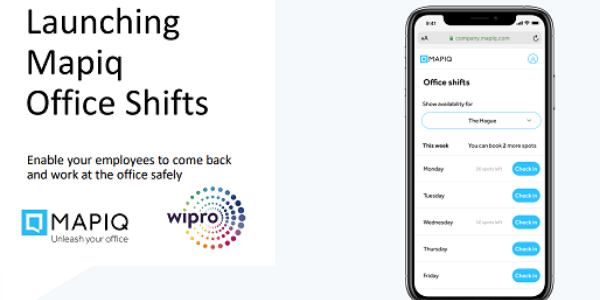
    Due to significant shifts in the ways of the workplace, in the post COVID era, organisations have had to rethink their manner of functioning and operating large establishments. To address this change, Wipro Lighting has launched Office Shifts, a smart office technology software. 

     The Company has associated with Mapiq, a Netherlands-based firm to enable more flexibility and maximum utilisation of office space for employees in a post-pandemic world. The software is available in the form of Software as a Service (SaaS) and is  flexible to suit customers’ needs. Organisations can choose to pay either per building, or per month or for the whole year according to their requirements. This customisation makes not only affordable but also less capital intensive. 

     How does Mapiq work?

     Mapiq’s Office Shifts software consists of two functionalities, one for the managers and one for the employees. The web application visible to the employees enables them to view in real time, the areas of the office or the buildings in a complex that have been booked, and by how many people. It also reveals the number of available slots for employee to make their bookings for the day. Each office building, floor and area can be assigned a maximum occupancy count and accordingly, employees can book their slots as and when they need to.  

    It may not be possible for all members of a team to travel to office on the same day, since the workforce capacity is limited. In such cases, team members can consult and collaborate with each other to decide who among them needs to travel to office on priority and book their slots accordingly. The rest of the employees can connect virtually.  

    Employees are assigned accessibility levels by their managers. Check-ins are booked weekly and employees are allocated either low priority accessibility — which means they can commute to office for a maximum of two days in a week by booking a day in advance —or high priority accessibility, wherein employees have access for four to five days in a week, if booked a week in advance.  

    The manager tool allows managers to configure the capacity of the office according to government guidelines and also change the access rights of the employee as per need.

    For instance, in the IT companies, if a project is in the testing phase and is yet to move into the development phase, employees who are working on testing will be assigned a higher priority than those who are on the development. Similarly, priority access can be changed by assigning the development team a higher priority when the project moves on to the next phase. The application of priority of access can be determined based on the role of the employee and the task at hand.  

    Team managers will have the access to determine which of their team members are coming in and when. Those who are part of the facility management team will have access across the organisation, and to information on all buildings or floors occupied, the teams that are currently working and the time of arrival of employees.. Each office area can be divided into various zones, such as the conference rooms, cafeterias and workstations.   

    Due to the new norms of social distancing, employee count has decreased in most offices. Employees are bound to have queries about their safety while going back to the ‘working from office’ mode; about the areas of the office accessible to them; about where and how they will have their meetings and so on. In many organisations, employees who are going to office are working in shifts to ensure safety and continued productivity.  

    Amidst such a scenario, organisations need to align the schedules and working patterns of their employees and teams. Communication is key, and keeping employees informed in real time and making sure that they comply with social distancing norms is essential.  

    Anuj Dhir, vice president & business head, Wipro Lighting, says, “Fundamental changes to the way organisations function and large office complexes operate have necessitated a complete rethink. Everyone has the safety and security of their people as their top priority. Social distancing, sanitising, and restrictions on meetings and gatherings have given rise to a newer and more efficient manner of functioning. This is where Mapiq’s Office Shifts technology is useful. It ensures both employee safety and productivity.”  

    Since the rules regarding maximum capacity and working hours vary across states and regions, the smart office software can be customised to scale up or upgrade to suit the needs of organisations, in line with the directives of local and state governments. 


    Mapiq Office Shifts Saas Wipro
    Share. LinkedIn Twitter Facebook WhatsApp
    HRK News Bureau

    Leave A Reply Cancel Reply

    Related Posts

    APSRTC employees demand cancellation of tenders for 1,450 electric buses

    October 16, 2026

    Accenture caps central funding for Claude AI at $29 per employee per month

    October 16, 2026

    Wipro’s workforce falls by 6,716 in September quarter as attrition eases

    October 16, 2026

    Aimtron Electronics to expand Gujarat workforce to 500 employees

    October 16, 2026
    zoha
    Editorial

    HR’s credibility is tested after the complaint is filed

    The video of what appears to be a meeting between employees and Genpact’s employee relations…

    The two-job job is becoming the new normal

    A colleague leaves. The position is not immediately filled. The work, however, does not wait…

    EDITOR'S PICKS

    The workday moment employees look forward to

    October 16, 2026

    Case-in-Point: The promotion that skipped a woman

    October 15, 2026

    herSTORY: Charu Sheel Kunwar, Managing Director & Chief HR Officer, Lighthouse Canton

    October 15, 2026

    India’s staffing industry claims 40 to 45% of formal payroll additions. What does that mean?

    October 14, 2026
    Latest Post

    APSRTC employees demand cancellation of tenders for 1,450 electric buses

    Brief News October 16, 2026

    The Andhra Pradesh State Road Transport Corporation (APSRTC) Employees’ Joint Action Committee (JAC) has demanded…

    Accenture caps central funding for Claude AI at $29 per employee per month

    Brief News October 16, 2026

    Accenture has capped centrally-funded spending on Anthropic’s Claude Enterprise at $29 per employee per month,…

    Wipro’s workforce falls by 6,716 in September quarter as attrition eases

    Brief News October 16, 2026

    Wipro’s employee headcount declined by 6,716 in the September quarter of FY27, even as voluntary…

    Aimtron Electronics to expand Gujarat workforce to 500 employees

    Brief News October 16, 2026

    Aimtron Electronics plans to increase its direct workforce in Gujarat from 175 employees to around…

    Asia's No.1 HR Platform

    Facebook X (Twitter) Instagram LinkedIn WhatsApp Bluesky
    • Our Story
    • Partner with us
    • Career
    • Reach Us
    • Exclusive Features
    • Cover Story
    • Editorial
    • Dive into the Future of Work: Download HRForecast 2024 Now!
    © 2026 HRKatha.com
    • Disclaimer
    • Refunds & Cancellation Policy
    • Terms of Service

    Type above and press Enter to search. Press Esc to cancel.