


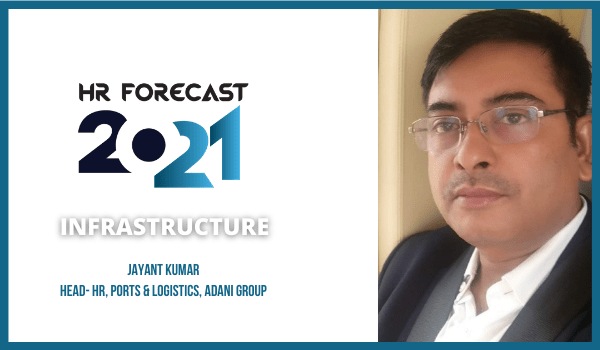
2020: What to learn – what to erase
The crisis of 2020 gave birth to several positives. One of them was the ability of leadership and the larger workforce to together come up with novel solutions to daunting challenges in managing work, health, logistics and family. Answers to many questions were not known, and hence, the best idea prevailed and everyone wanted it to succeed. This crisis has enhanced the importance of holistic wellness management, design and deployment of thought through plans, and risk management. The most impactful aspect has been the accelerated adoption and widespread usage of multiple technology applications by a cross-section of the workforce across sectors. This is permanent and will only continue to grow further.
HR has shown great agility and business acumen
This crisis brought into sharp focus the ability of the HR function to manage crises, uncertainty and disruptions. In most organisations, which were able to respond to needs better than others, HR leaders worked together very closely with business leaders to design solutions, and manage people’s health, morale and psyche. Workforce management, beyond mere resource view of people, came up in full intensity. Human resources will continue to evolve and create more impact on people, businesses and organisations in the times ahead. Proximity to business issues, ability to work together on people aspects of business and the propensity to design creative solutions for complex problems will define the way forward for HR.
Managing hybrid workforce is more challenging
Nature, type and contours of challenges vary. Challenges also provide opportunities to come up with solutions for progress and change. This disruption has changed the ways and methods of work at workplaces and in markets. Changes being brought about by new technology applications have accelerated further. The key imperative from the HR perspective is to retain skills, competencies and mindset of people — modern and contemporary. A mindset of anticipating, preparing and responding to change is critical for success. People must move ahead of changes in environment and requirements. There is a possibility of parts of the workforce moving towards obsolescence. Sharp, well-planned and timely actions may reduce the extent of such undesirable situations. In an increasingly connected world with more democratic workplaces, preparing the workforce to deal with changes around them will continue to be an imperative.
Efficiency or flexibility — what will change the organisation design in 2021
Organisation design will continue to be influenced by the strategies and objectives that different companies will set out for the short and long terms. Fluidity is the design of the future. Even if conventional models of firm lines and boxes continue for some more time in form, in effect, more fluid structures have already started working — not as a temporary alternative, but as a permanent arrangement. It provides extraordinary ability to manage people and teams. The dynamic nature of fluid structures aid organisational agility and speed of execution, and change the course when needed. Efficiency, productivity and net value-add will continue to remain prime drivers of any effective design. As an aftereffect of the 2020 economic impact, more innovative, impactful and fit-for purpose design alternatives will be experimented with.
A mindset of anticipating, preparing and responding to change is critical for success
Shift of talent calculus to more buy-and-rent and less build
Share of talent for build:buy:rent will be determined by the needs and strategies of different organisations. As in the past, different mixes and models will be apt for different sectors. Building the pipeline for future leadership positions from within, for select positions in large-scale organisations, will continue to be an important agenda.
Each of these approaches have their own relevance, use and impact. Overall, core talent will continue to attract premium for long-term stability, and every organisation will try to attract an unfair share. Even most generic and universally-applicable competencies and abilities need contextualisation.
HR to stay human in virtual workplace
Connect with people is primarily a function of priority for HR teams. Whether in-person or through digital media, it is a key aspect of people management. Mode of connect is a tactical option. Distance brings some restrictions, but also provides immense flexibility of reach and access. In multi-location as well as large-scale organisations, it has brought equalisation. HR teams have already moved to high levels of ease in connecting with people on digital platforms and being accessible to others. Transactional aspects, such as administration of benefits and management of concerns, issues and so on (which were more in-person earlier) have moved to automated platforms in most organisations. Human resources teams will have to pursue the agenda of getting to know people at deeper levels to address their aspirations and to understand drivers, irrespective of means and modes of connect.
