


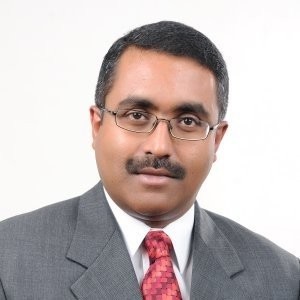
“Alstom believes that one’s differences should never be attributed as their inability to perform well or be a hindrance to their career,” says Vinod Varghese, HR Director, Alstom India & South Asia. “The first step to building an inclusive team starts with talking about our differences openly.”
The organisation recently concluded its annual ‘We are All Differently Abled’ (WADA) week, held from November 16 to 22, that celebrates their differently-abled talent. “It takes place in November every year, coinciding with the ‘European Disability Week,” informs Varghese.
Spreading happiness virtually
For the WADA week, the organisation hosts an assortment of activities to engage and upskill its persons with disabilities (PWD) employees, educate and sensitise the rest of the workforce, and raise awareness about fostering an inclusive workplace. It also gives management an opportunity to “further think of innovative ways to recruit and integrate employees with different abilities across functions and geographies,” says Varghese.
In pre-COVID-19 times, Alstom’s WADA week featured several events designed to ensure that the differently-abled workforce feels welcome even outside of work. This year, like everything else, WADA week turned virtual, which in fact proved an advantage. “We’ve been able to engage with them on an ongoing basis through virtual training of task-specific software and team-building activities through video calls,” shares Varghese.
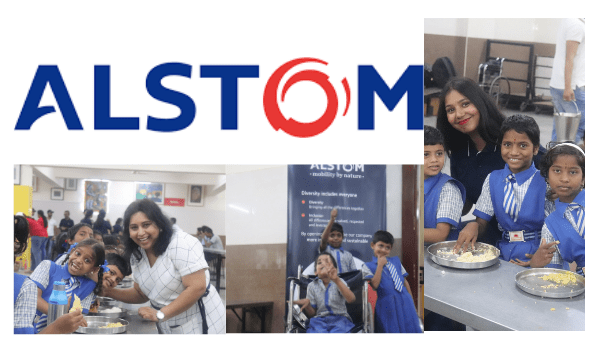
To make up for the lack of in-person events, Alstom India took the opportunity to contribute to the welfare of underprivileged children with disabilities instead. Backed by social media, the Company donated ‘happiness kits’ to a bouquet of NGOs. The care packages included hygiene and ration kits, and laptops for children, youth and elders.
“Like everybody else, this is a part of the population that has a perspective to provide and we cannot ignore their contribution.”
Skills that matter
Alstom India’s journey with differently-abled employees began about two years ago with their first hire, Chetankumar Surkod, a speech and hearing-impaired CAD designer. “The first success is always the biggest challenge,” notes Varghese but adds that inducting a PwD employee in the organisation is no different from any other new joiner. “It’s just the first month of settling in and understanding the culture, which I think is the same for any new employee,” says Varghese, and adds that “treating them like any other employee” is the most important.
The Company participates in We Are Your Voice, an annual jobs fair exclusive to PwD job seekers, to source their differently-abled talent. “That’s where we’ve really been able to find candidates. They’ve come to our stalls, and expressed interest in a team suitable to them,” says Varghese.
Considering the Company’s major requirement is for engineers, Varghese notes that it’s the right set of skills they’re after, above all else. Keeping in mind some preliminary aspects, identifying roles suitable for differently-abled candidates isn’t much of a challenge. “Safety is important, so we typically look at roles that do not require fieldwork,” explains Varghese. “The office environment has shared services so one can easily work there.”
Beyond that, “they are all intelligent, have done their basic graduation or have an engineering degree, and therefore, their capability is never in doubt,” says Varghese. In fact, he points out that the differently-abled employees are the more productive section of the workforce. “Their attitude is far better,” observes Varghese, and “They tend to take fewer coffee and cigarette breaks.”
The Company’s differently-abled employees contribute across various departments, such as digital mobility, systems & infrastructure, international finance support and installation & project engineering.
Adapting not altering
Despite the law finally formalising the rights of persons with disabilities in 2016, India Inc. remains slow not only in warming up to the differently-abled workforce, but also making workspaces accessible. An instinctive hesitation to hire is that it may hamper, delay or alter existing workflows. However, Varghese points out that changes, if any, only arise in communication.
“Typically, a manager or colleague would just call or speak to one to give some instruction,” says Varghese, “Here, the communication becomes more written and text-based.” It doesn’t take the workforce much time to warm up to each other, highlights Varghese, “Gradually, through lip reading, they are also able to understand the instructions better. There’s always an extra effort from both sides.”
Human goodness
Varghese is happy to note that the rest of the workforce has gone out of its way to make their PWD colleagues feel at home. “It was a first for many of them too, but they were really supportive and made use of various tools to communicate effectively,” he informs.
While training and sensitisation material certainly act as additional support, even without these resources, people are usually helpful, believes Varghese, “There’s a bit of a human factor.” Illustrating with the example of chancing upon a visually-impaired person trying to cross the street, he says, “One helps the person. There’s no education or awareness involved. It’s simply one human being helping another.”
Working with differently-abled talent has made apparent the inherent goodness of humans to the senior HR leader. Despite what mainstream news may have us believe, Varghese thinks, “We, as human beings, have this nature of trying to help others.”
Any initial awkwardness perhaps stems from this need to help. “There’s often a fear of hurting sentiments,” notes Varghese. “Sometimes, people don’t know how to react or approach. They’re afraid of saying something offensive.” That’s where training and sensitisation activities come handy. “It’s something, which is part and parcel of our entire diversity and inclusion agenda,” informs Varghese.
For a holistic perspective
“From the thought never occurring at all, to changes, albeit small, manifesting in the past few years, is huge progress,” says Varghese, “I remember, 20 years back, no one was even thinking about accessible toilets. At least we have those now.”
As for making room for differently-abled talent in the workforce, Varghese believes it’s the only way to optimise different perspectives. “Whether in India or globally, we live in such a diverse society today that if one really wants one’s business to benefit from different perspectives, one has to include different types of people.”
While enough literature exists on best practices for making the workplace more inclusive, Varghese boils it down to common sense. “Organisations just have to be sensitive and use their common sense. Like everybody else, this is a part of the population that has a perspective to provide and we cannot ignore their contribution.”
