



A global chemicals company has seen applications for its core engineering roles fall by 40% in two years.
The technical requirements remain unchanged. The salaries are competitive. The business is stable.
Yet interest is declining.
The issue is not compensation. It is alignment.
To many Gen Z candidates, traditional sectors appear rigid, hierarchical and environmentally conflicted. What organisations describe as stability is often interpreted as stagnation. What they call structure can feel like constraint.
This is not a short-term hiring fluctuation. It is an early indicator of a deeper shift.
By 2026, organisations designed for predictability will face mounting pressure from a workforce shaped by volatility, transparency and accelerated change.
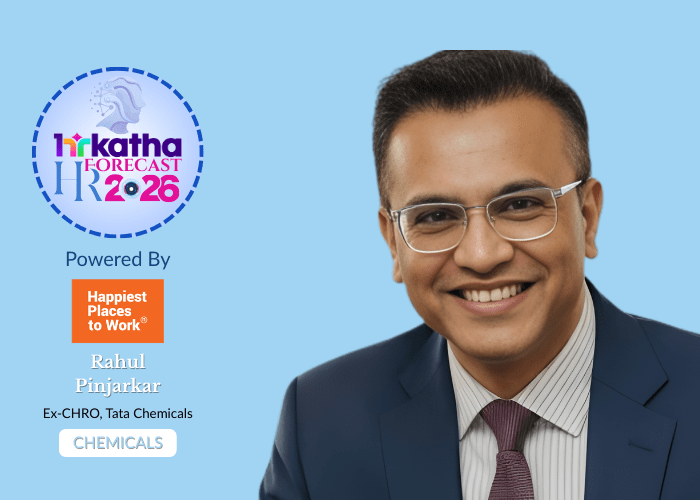
Rahul Pinjarkar, former CHRO, Tata Chemicals, believes that year marks a structural inflection point. “Gen Z won’t accept work structures designed for previous generations,” he says. “Flexibility is no longer a benefit. It is a baseline expectation.”
The organisations that recognise this as a design challenge will adapt deliberately. Those that do not will experience it as disruption.
Three structural shifts are already underway.
Signal 1: Work structures evolve from uniform to modular
For decades, employment followed a standard architecture: full-time roles, linear progression and fixed hierarchies. The assumption was that employees would adapt to organisational systems.
That assumption is weakening.
Gen Z expects work to accommodate life circumstances, not override them. Careers are viewed as dynamic rather than sequential. Authority is expected to be contextual rather than positional.
By 2026, leading organisations will operate modular employment models:
- Roles that flex between permanent and project-based structures
- Career paths that move laterally as well as vertically
- Policy-backed flexibility that ensures fairness and transparency
This introduces complexity in culture, performance management and equity.
However, maintaining rigid structures carries greater risk. As Gen Z becomes a dominant workforce cohort, inflexible systems will narrow the available talent pool.
“The divide won’t be between those who’ve changed and those who haven’t,” Pinjarkar argues. “It will be between those who redesigned proactively and those who were forced to.”
Signal 2: Purpose shifts from narrative to operational discipline
Nearly every organisation now articulates a purpose.
By 2026, articulation alone will be insufficient.
Transparency has reduced the distance between what organisations say and what they do. Carbon footprints, pay equity, supplier practices and governance decisions are increasingly visible.
Gen Z employees are particularly sensitive to inconsistencies.
Pinjarkar describes the emerging risk as a “trust recession” — a gradual erosion of belief when values and operations diverge.
Purpose, therefore, becomes operational.
It must be reflected in:
- Capital allocation
- Product and process design
- Supplier relationships
- Incentive structures
Organisations that embed purpose into core decisions will strengthen credibility. Those that rely on messaging will experience attrition and reputational strain.
By 2026, purpose will not be aspirational positioning. It will be measurable behaviour.
Signal 3: Performance management becomes continuous capability intelligence
Annual performance reviews were designed for relatively stable environments.
As skill cycles compress, annual assessments become strategically insufficient.
By 2026, leading organisations will operate with continuous capability visibility — not merely continuous feedback, but real-time understanding of evolving skill strengths and gaps.
“The issue isn’t technology,” Pinjarkar notes. “It’s managerial capability and organisational courage.”
Continuous systems require leaders who can coach consistently, differentiate clearly and address performance issues without delay.
Pinjarkar anticipates sharper performance differentiation mechanisms ahead. “Meritocracy requires clarity. Relative comparisons will return in more thoughtful forms.”
In faster-moving environments, ambiguous performance signals create strategic blind spots.
Organisations that embed performance dialogue into daily work will adapt faster. Those that preserve annual rituals with incremental changes will struggle to keep pace.
The sector-specific challenge: Reinventing traditional industries
In sectors such as chemicals, these pressures intensify.
The industry must digitise and decarbonise while preserving deep scientific capability.
It requires chemists fluent in AI-enabled modelling, engineers skilled in green process design and digital talent willing to join established sectors.
Replacing talent at scale is unrealistic. The supply is limited.
“Organisations that reskill and redeploy existing talent will gain both speed and loyalty,” Pinjarkar observes.
Across traditional industries, transformation framed as capability development strengthens resilience. Transformation framed purely as cost reduction weakens it.
By 2026, talent strategy will reveal strategic intent.
HR’s mandate: From stability management to future design
These shifts converge on a single requirement: HR must become anticipatory.
The defining question changes from:
What skills exist today?
To:
Which capabilities will be missing in eighteen months — and how do we build them before they constrain strategy?
This requires:
- Forecasting capability rather than managing headcount
- Designing flexible systems without fragmenting culture
- Embedding purpose into operational mechanisms
- Developing leaders comfortable with ambiguity and rapid change
“CHROs should be able to answer a simple question,” Pinjarkar says. “Given our strategy, which capabilities will we lack in eighteen months?”
By 2026, the ability to answer that question will distinguish adaptive organisations from reactive ones.
The capability divide
Gen Z expectations, operationalised purpose and continuous performance intelligence are not isolated developments. They are interconnected elements of a broader structural reset.
Organisations designed for stability are encountering a workforce conditioned by volatility.
By 2026, the divide will be visible.
Some organisations will operate with modular work systems, integrated purpose and forward-looking capability planning.
Others will retain rigid hierarchies, symbolic values and retrospective performance cycles.
The difference will not be philosophical.
It will be reflected in hiring velocity, retention patterns and innovation speed.
And structural gaps, once visible, are difficult to close.
Three Strategic Imperatives
Structure: Design modular employment systems that enable flexibility without undermining cohesion or fairness.
Purpose: Close the gap between stated values and operational behaviour.
Capability: Forecast and build future skills before shortages constrain strategic execution.
The redesign imperative
By 2026, the pressure created by Gen Z expectations, operationalised purpose and compressed performance cycles will no longer be manageable within legacy organisational models.
Adaptability will cease to be a source of competitive advantage and become a baseline condition for relevance.
Organisations that proactively redesign their work structures, capability systems and leadership models will enter the next phase with structural resilience.
Those that defer change will encounter higher talent acquisition costs, slower skill renewal and widening capability gaps.
The redesign of work is already in motion.
The only variable is whether organisations choose to lead that transition — or respond to it after the consequences become visible.
#HRForecast2026 is powered by ‘Happiest Places to Work’