


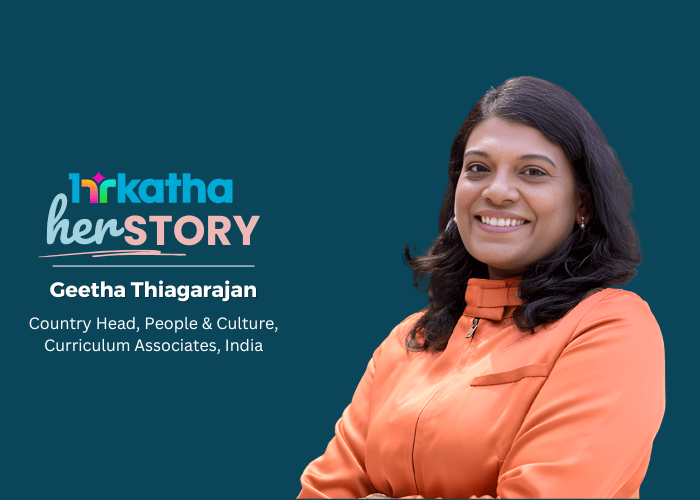
That one bold and clear decision
Geetha Thiagarajan grew up in a business family where banking was the natural path. She began her career at Deutsche Bank as a chartered accountant intern, with the intention of moving into accounting.
Then came a moment of clarity. Faced with the final-year CA textbook on direct and indirect taxes, she made an honest, albeit bold decision, to step away and pursue an MBA in HR instead.
That single decision changed the trajectory of her career.
Having entered HR almost organically, Thiagarajan began by setting up shared services at Deutsche Bank, learning the mechanics of people processes from the ground up. Over time, she realised this was a space where she could create impact at scale, not just for individuals or teams, but across entire organisations.
Looking back, she sees a pattern of continuity. Every role, every organisation, every experience built on the one before it. The willingness to remain open and take a risk on an unconventional path turned out to be the best professional decision she ever made.
“None at all. Not even a single step,” she says, reflecting on whether she has any regrets.
Today, as country head, people and culture at Curriculum Associates, India, Thiagarajan leads with a clear philosophy: stay committed to the idea, but be intentional about finding the environment where it can come to life.
Demonstrating credibility
As the only woman in a boardroom full of men, and the youngest in the room, Thiagarajan learnt early that presence alone does not guarantee a voice.
What changed that dynamic was execution. When an idea she proposed to a client delivered results, the response in the room shifted. People began to listen differently. After all, “Presence alone does not guarantee a voice; credibility is not given, it is demonstrated.”
The more complex barrier, however, was not visibility. It was pace.
In large legacy organisations, ideas are rarely rejected outright. Instead, they slow down, caught in layers of approval. In 2017, while working on introducing an HR chatbot to improve employee engagement, she encountered this firsthand. The idea was sound, the preparation thorough, but it struggled to move with the urgency it deserved.
That experience reinforced two lessons: innovation requires persistence, and the environment matters as much as the idea.
In later roles, where she had greater ownership and empowerment, she implemented similar ideas faster and saw their impact more clearly. What initially felt like a setback became one of the most defining insights of her career.
“Credibility isn’t given. It is demonstrated.”
Opting for the unconventional
Whilst building Curriculum Associates India from the ground up, Thiagarajan encountered strong advice to adopt conventional, compliance-heavy policy frameworks.
She chose a different route.
Her philosophy was straightforward: the people who join the organisation are adults, and they deserve to be treated as such.
Take the leave policy. There is no tracking, no managerial gatekeeping. Instead, individuals take ownership, ensuring their work is covered and their teams are aligned.
What may appear unconventional builds something deeper: ownership, collaboration, and trust. People support each other not because policy requires it, but because culture expects it.
“The quality of our people policies is a direct signal of how much we trust our people. When we design for the exception, we penalise the majority. When we design for the adult, you get the best of them.”
“Design for responsible adults, and you unlock their best.”
Nothing as valuable as ownership
Ownership is non-negotiable for Thiagarajan.
Even today, she personally interviews every manager and above who joins the organisation.
Across teams and functions, it is the one quality she consistently looks for.
Leaders act as conduits within organisations. They translate strategy into action for their teams and carry ground realities back into decision-making forums. When that conduit lacks ownership, the entire system feels the impact.
Alongside ownership, she looks for genuine passion and how individuals treat people—qualities she believes cannot be taught.
Measuring manager effectiveness
Thiagarajan believes the traditional annual appraisal system needs to evolve.
In its place, she advocates for continuous, real-time feedback embedded in the daily rhythm of work. Development, in her view, cannot be reduced to a yearly ritual that few fully trust.
She also emphasises the need to measure manager effectiveness rigorously—making it a critical business metric rather than treating it as a soft HR concern. Research has consistently shown that the single biggest variable in employee experience is the direct manager.
Organisations are only now beginning to act on that insight.
Quick fire round
What’s the best career advice you’ve ever received?
Taking risks is better than not attempting – because not attempting is also a risk.
One thing you wish people understood about being a woman in HR leadership?
The systems thinking behind the “people work”. The assumption is that HR is relational, and therefore tactical. What’s often missed is the parallel responsibility of managing regulatory risk, workforce planning, culture architecture, and executive alignment, whilst also being the person employees turn to in moments of vulnerability.
Morning ritual that sets you up for success?
Coffee and 15 uninterrupted minutes of reflection on the day’s priorities.
If not HR, what career path would you have pursued?
A radio jockey, artist, or voice-over professional, anything with people at the centre.
What energises you most about your work?
Impact at scale – seeing values reflected in real decisions, especially under pressure.
Best investment you’ve made in yourself?
Time invested in learning, including programmes such as The Leadership Consortium led by Prof. Francis Frei and Prof. Anne Morris.
Making AI a real partner
“At CA, the goal for every employee, everywhere, is AI first,” shares Thiagarajan.
This is not a tagline, but an operating principle. The focus is not on replacing roles, but on enabling people to work differently—partnering with AI to think, adapt, and make decisions in new ways.
“Recently, teams across CA showcased innovations at our internal event with several of them already in production. This is not aspiration. This is happening.”
For Thiagarajan, the future of work is not a technology project. It is a human project that happens to use technology.
HR’s role is not to manage this transition from the sidelines, but to actively shape it and ensuring organisations move forward without losing the human core.
Inspiration galore
“I have a whole ecosystem at home and outside from whom I derive inspiration,” says Thiagarajan.
The people she works with continue to shape how she thinks and leads. She also credits social media for connecting her to diverse perspectives across industries.
“Paired with AI that surfaces the right insight at the right moment, staying at the edge of thinking has never been more accessible.”
Learning, for her, is not incidental. It is a leadership discipline.