



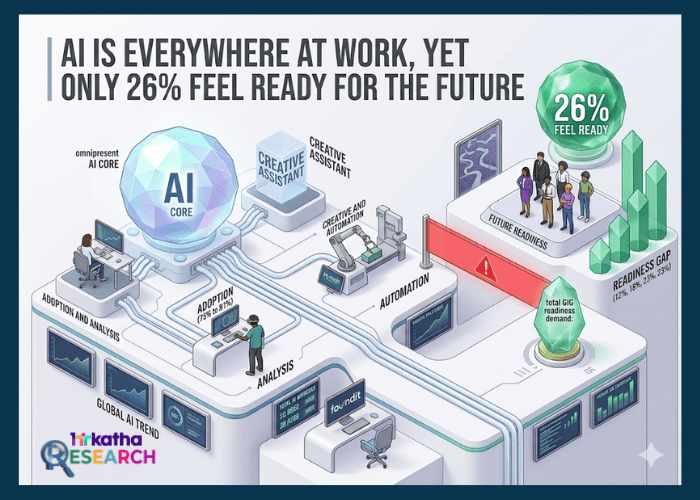
based researFamiliarity is a comfortable feeling. In 2026, most professionals have become comfortable with artificial intelligence. According to Simplilearn’s 2026 Professional Sentiment Survey, which draws on responses from professionals across geographies and industries, 85 per cent now use AI regularly at work, more than half daily. What once felt disruptive now feels routine. For many, AI no longer resembles a threat. It resembles a colleague.
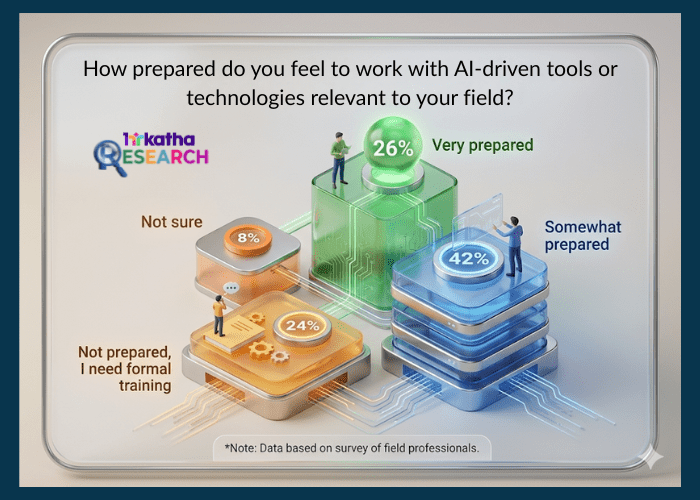
Two years ago, the question was whether workers would adopt AI at all. That question is settled. A more uncomfortable one has replaced it. Only 26 per cent feel prepared to use AI in ways that support their long-term career growth.

Familiarity is not readiness
The confusion stems from a simple error. Using AI and being ready for what AI will do to work are not the same thing. As the technology embeds itself more deeply into decision-making, role design and performance evaluation, the distinction becomes critical.
The survey’s framework for readiness draws the line clearly. At the base is tool use: prompting, spotting errors, understanding limitations. Most professionals sit here. Beyond that lies judgment: evaluating outputs, integrating AI into workflows, deciding what to automate. At the highest level sits system thinking: designing AI-enabled processes, governing their use and anticipating how roles will evolve.
The shift is from using AI to thinking with it. On that measure, the 74 per cent who do not feel prepared are identifying something real.
Productivity gains make the illusion convincing. Drafts are generated faster, documents summarised instantly, tasks completed with less effort. These gains feel like progress. What they measure is facility with today’s tools, not readiness for tomorrow’s work.
Firms have deployed AI. They have not defined it
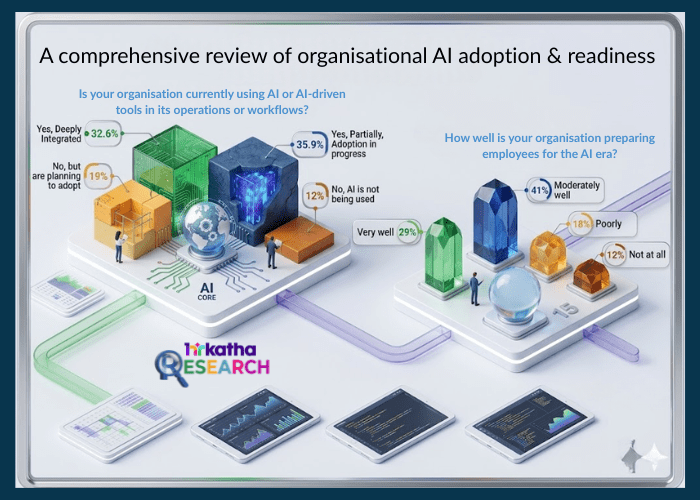
If individuals are overestimating their readiness, organisations are under-delivering on it. Around 68.5 per cent of respondents say AI is already embedded, at least partially, in their workflows. Yet 71 per cent say their employers are not preparing them adequately for the AI era.
Implementation has outpaced direction. Firms have deployed AI faster than they have defined what good use looks like.
This pattern is familiar. Companies are often quicker to buy technology than to build the capabilities needed to use it well. But the stakes are higher this time. The tools are evolving faster than skills can naturally adjust.
External evidence points in the same direction. McKinsey’s 2025 State of AI report finds that while 88 per cent of organisations now use AI in at least one function, only about 31 per cent have scaled it meaningfully beyond pilot stages. More tellingly, only about 1 per cent of companies consider their AI deployment mature. The constraint is not technical. It is human.
From the employee’s perspective, the picture is clearer still. Only 29 per cent say their organisations are preparing them well. The rest describe efforts as partial, weak or non-existent. Workers are surrounded by AI, expected to adapt, and largely left to work out what adaptation requires.
Experience does not close the gap
One might expect readiness to improve with seniority. It does not. AI usage is high across every career stage, from those with less than five years’ experience to those with more than fifteen. Yet confidence in being genuinely prepared barely shifts.
This is more troubling than it appears. The skills needed to work alongside AI are different from those accumulated through experience. Knowing a field well does not automatically translate into knowing how that field changes when decision-making is partly automated.
For younger professionals, the risk runs in the opposite direction. Early-career workers report higher confidence in their AI capabilities. That confidence reflects proximity to the tools, but proximity is not proficiency. Fluency with an interface is not the same as judgment about when to trust it, when to override it and how it reshapes the task itself.
The result is a curious imbalance. Sixty-two per cent of professionals say they are excited about the changes AI will bring. Only 26 per cent feel prepared for them. Optimism is abundant. Readiness is not.
Ambition without a map
This is not a passive workforce. Awareness of the gap is beginning to translate into intent. More than three-quarters of professionals say they are likely to invest in training or certification in 2026. AI and machine learning now rank as the most sought-after skills, well ahead of other domains.
Career ambition remains intact. Nearly six in ten professionals want to move into higher-growth or leadership roles this year. The primary motivation is economic: better pay and better roles. Staying relevant comes second.
Regional differences add nuance. In the US, professionals lean slightly towards maintaining relevance as their primary motivation. In India, the emphasis shifts towards opportunity, with many viewing AI as a route to faster career advancement. The readiness gap is global. The way it is framed is not.
In both cases, the pattern is the same. Professionals understand the stakes and are willing to act. What many lack is structure.
A labour market that will not wait
The urgency of the gap becomes clearer when set against broader labour market shifts. By 2030, close to 40 per cent of core job skills are expected to change. Other estimates suggest that as much as 70 per cent of the skills used in most roles will be reshaped.
The net effect may be positive. Millions of new roles are expected to emerge, outnumbering those displaced. But the transition will be uneven. Skill mismatches will appear faster than labour markets can absorb them.
For professionals already facing a readiness deficit, this is not an abstract forecast. It is the environment in which their careers will unfold. A worker who uses AI daily but cannot evaluate its outputs critically, govern its use responsibly or anticipate how their role will evolve is more exposed than their productivity suggests.
From adoption to adaptation
The survey’s central insight is straightforward. Access to AI is no longer scarce. Capability still is.
This marks a shift in the nature of the challenge. The question is no longer whether people are using AI. It is whether they can think with it, question it and redesign work around it.
For organisations, the implication is clear. Deploying AI without investing in people creates a brittle form of progress. For individuals, the lesson is sharper. Routine is not readiness.
Adoption was the easy part. Adaptation will be harder.