


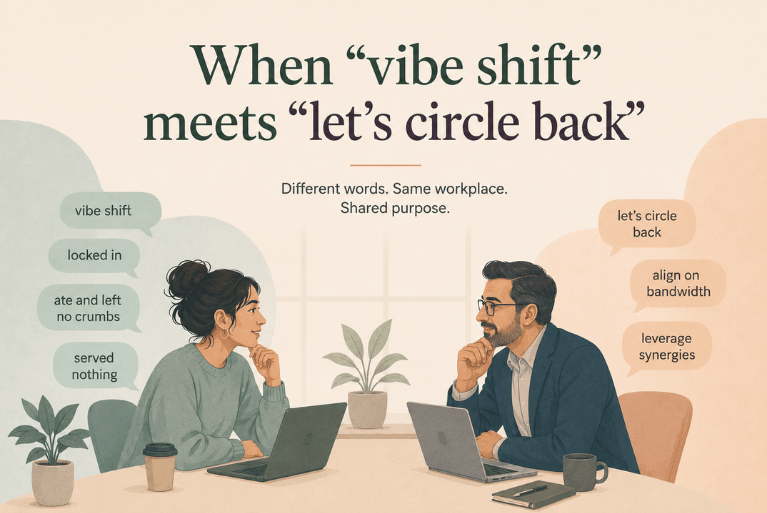
Every office has that meeting. Someone suggests “aligning on bandwidth” or “leveraging synergies”, and everyone nods with the weary recognition reserved for phrases nobody actually understands.
Now a younger generation has arrived with a vocabulary of its own. Projects are “locked in”. Bad ideas “serve nothing”. Excellent work – “ate and left no crumbs”. Somewhere across the table, a senior leader is wondering whether English has quietly evolved without permission.
The instinct in many organisations is predictable: ask younger employees to sound more professional. A more interesting question is whether organisations should spend as much effort learning a new workplace dialect as they do policing it.
Speaking fluent Gen Z
Ajay Sharma, VP HR, The Oberoi Group
Ajay Sharma has made a deliberate choice. Rather than treating Gen Z vocabulary as a problem to be managed, he treats it as a language worth learning.
His reasoning is straightforward. Gen Z has revived something corporate language often loses: directness. A vibe shift is simply a change in direction. Being locked in means complete focus. Compare that with “leveraging synergies” or “taking this offline”, phrases that often sound more sophisticated than they are.
Sharma remembers telling a younger colleague, “You’re locked in? Good. Just don’t lock the rest of us out.”
The room laughed. More importantly, it relaxed. The remark worked because it signalled something far more valuable than humour. It showed he had been paying attention.
His broader point is one many leaders overlook. Good communicators are linguistic opportunists.
They use whatever language helps ideas travel. Learning how younger colleagues express themselves is not about abandoning professionalism. It is about staying connected to the people organisations are trying hardest to retain.
Words matter less than intent
Manika Awasthi, Chief People Officer, Compass Group
Manika Awasthi recalls a demanding project review where one of the younger team members responded to a difficult update with quiet confidence.
“We’re locked in.”
The phrase was unfamiliar. The intent was unmistakable.
 That moment shaped how Awasthi thinks about generational language. Professionalism was never about vocabulary. It has always been about clarity, respect and whether people understand one another. If communication improves collaboration, the words are doing their job.
Where she adds an important nuance is around inclusion. Not everyone understands every piece of Gen Z slang, just as not everyone understands every corporate acronym. The responsibility, she believes, runs both ways. Leaders need the curiosity to understand unfamiliar language.
Employees need the awareness to adapt to different audiences.
The strongest communicators are rarely those with the largest vocabulary. They are the ones who know how to translate between generations without losing meaning.
Every generation thinks its slang is normal
Tanushree Gupta, VP Learning and Development, NAB
Tanushree Gupta offers the simplest explanation of what is happening.
Every generation leaves behind its own workplace vocabulary. Boomers gave us “touch base”. Gen X popularised “thinking outside the box”. Millennials were forever “adulting”. None of those expressions sounded timeless when they first appeared.
Gen Z is simply having its turn.
What Gupta challenges is the assumption that professionalism requires personality to be checked at the office door. No one expects a board presentation to begin with “Hey besties”.
That is not the choice organisations are actually facing.
The real choice is between leaders who ask, “What does that mean?” when they hear an unfamiliar phrase, and leaders who assume unfamiliar automatically means unprofessional.
One response builds understanding. The other quietly builds distance.
It was never really about the words
The debate over Gen Z slang is not really about vocabulary. It rarely is.
It is about who is expected to adapt.
For decades, younger employees have been expected to learn the language of organisations. It is time organisations showed the same curiosity in return.
Language has always evolved faster than workplaces. Every generation arrives with expressions that puzzle the one before it. Most eventually become ordinary.
The real question is not whether Gen Z should stop saying “locked in”. It is whether organisations are curious enough to ask what it means before deciding it doesn’t belong.
Because workplaces where people can understand both “the vibe shift is real” and “let’s circle back next week” have not lowered their standards.
They have simply become better at listening.
Does your team speak across generations or just past each other? Share your thoughts in the comments.