


A customer only spends money on the organisation, but the employees invest their time and energy. Therefore, expectations of the latter, from the organisation, are naturally higher.
Customer loyalty means the world to every business. But, do organisations feel the same about employees? And, does employee happiness imply the same kind of loyalty as seen in a happy customer? The panel members in a session during The Happiness Conclave, held by HRKatha, on the 29th of April at the Taj Vivanta, Bengaluru, tried to find answers to these and more.
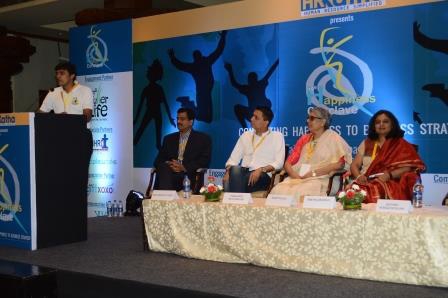
This session was moderated by Satish Venkatachaliah, head of the table, Something’s Cooking Culinary Arts. The other members were, MVS Murthy, chief people officer, nuFuture Digital (India) Limited (Future Group); Prashant Bhatnagar, senior director – people & culture, Hike Messenger; Sunitha Lal, CHRO, Matrimony.com and; Smitha Murthy, organisation development specialist and Art of Living facilitator.
In spite of being the last session, it attracted huge interest and attention, as Venkatachaliah began by asking the audience how many of them felt that happy employees and happy customers can be put on the same pedestal? Around 10–12 per cent of the audience answered in the affirmative. Then, addressing the panel, he queried, “The members of this panel are those who manage the employees, who in turn, take care of the customers of the organisation. So, while the employees work towards enhancing customer loyalty, how can the employees be managed and their loyalty enhanced as well?”
Lal took over from there, sharing that at Matrimony.com they spend a lot of effort and focus on ensuring that the customers are comfortable when they visit the site. She said, “We go an extra mile to ensure that the service is being packed well and we do a lot of research to make it possible. We slice and dice the numbers from the research to understand the customer requirements and to provide them the right solution. But the question I keep asking myself is that – are we doing enough to understand the employee as well? Apart from the everyday activities for engagement, have we made efforts to make life comfortable for the employees? Do we invest enough time and resources as an organisation?” She shared that although organisations put in a lot of effort for employee engagement activities on a daily basis, these questions still lack a perfect answer.
The number of touch points that impact people’s happiness are fewer in the case of the customer. However, for an employee who spends hours, days and months in an organisation, the touch points are many more
Bhatnagar went on to explain the fundamentals, saying “Businesses exist to fulfil a customer need, sometimes stated and sometimes unstated. And when the customers are ready to pay for the same, it is done in a manner such that the cost of delivering that service is lower than what the customers are willing to pay for”. Now, it is the people in an organisation who are actually responsible for fulfilling the needs of customers. In present times, the customer can choose to take the business elsewhere, just as the employee can choose to work with someone else. Bhatnagar said, “I feel these are two heads of the same coin and one leads to the other. If you don’t have happy employees, you can’t have happy customers. But the reverse is unfortunately not true as one can still have happy customers but not happy employees”.
As the audience were all ears, Smitha Murthy shared an experience from a wedding she attended that day, where someone sarcastically remarked that this day was the highest peak in the bride and groom’s happiness graph, which would only go downwards from thereon. While the audience laughed, she continued that happiness according to her is what one thinks they got versus what one thinks they should have got. She then asked the audience to organise themselves into groups of two. Each one had to make the partner smile in 20 seconds, while the latter had to resist. The purpose of this interesting exercise was to make people realise that it takes some effort to make people happy. “The number of touch points that impact people’s happiness are fewer in the case of the customer. However, for an employee who spends hours, days and months in an organisation, the touch points are many more” she said.
Customers and employees are two heads of the same coin and one leads to the other. If you don’t have happy employees, you can’t have happy customers. But the reverse is unfortunately not true as one can still have happy customers but not happy employees.
The customer only spends money on the organisation while employees invest their time and energy into it. Naturally, therefore, their expectations from the organisation are also much higher. The third factor she believed in is the ‘points of references’ – as employees have access to a lot of other employers in present times. An employee who is happy one day due to a promotion or a salary raise may not be happy a few days later. Hence, the reference points keep changing both internally and externally. Quoting an example she said, “There have been instances where people feel demoted because a peer got promoted. So, happiness is also relative. In such situations, it takes much more to put an employee on the same pedestal”.
MVS Murthy, believed that it’s not just about putting employees and customers on the same pedestal but bringing in a consistency, in whatever organisations do, to make employees or customers happy. “More so, it’s about doing that with sincere efforts”, Murthy (MVS) said.
On inviting queries and views from the audience, someone shared that it’s wrong to put employees and customers on the same pedestal as a customer may be an employee elsewhere and an employee may be a customer for someone else. In fact, what is required is to see if the organisation has ever taken a stance for an employee in cases where the customer is on the wrong side. Such an act has the power to create a cascading effect among the entire workforce of that organisation. This is what makes the employees valued and cared for.
This opinion was highly appreciated by the panel and the audience alike. A meaningful example came from the audience, of a new born who only knows happiness, but grows up to be a complicated individual. Bhatnagar conclude saying that, “Happiness is equal to surprise minus expectations. Increase the surprise or reduce the expectations and you’ll be happy”. Most of those present agreed to the fact that employees need to be valued and cared for, in the same way as an organisation cares for its customers.
(The Happiness Conclave organised by HR Katha was held at Taj Vivanta, Bengaluru, on April 29, 2016. The sponsors and partners for this event were The Fuller Life, NHRDN-Bengaluru Chapter, PeopleWorks, Giftxoxo and Kommune Brand Communications.)
1 Comment
Hi,
There is a very good book “Contented cows give more milk”. A must read for everyone in people management role.