

Close Menu
    Facebook X (Twitter) Instagram
    • Our Story
    • Partner with us
    • Reach Us
    • Career
    Subscribe Newsletter
    HR KathaHR Katha
    • Exclusive
      • Exclusive Features
      • Perspectives
      • Friday Features
      • herSTORY
      • Case-In-Point
      • Point Of View
      • Research
      • HR Pops
      • Dialogue
      • Movement
      • Profile
      • Beyond Work
      • Rising Star
      • By Invitation
    • News
      • Global HR News
      • Compensation & Benefits
      • Diversity
      • Events
      • Gen Y
      • Hiring & Firing
      • HR & Labour Laws
      • Learning & Development
      • Merger & Acquisition
      • Performance Management & Productivity
      • Talent Management
      • Tools & Technology
      • Work-Life Balance
    • Special
      • HR Forecast 2026
      • Cover Story
      • Editorial
      • HR Forecast 2024
      • HR Forecast 2023
      • HR Forecast 2022
      • HR Forecast 2021
      • HR Forecast 2020
      • HR Forecast 2019
      • New Age Learning
      • Coaching and Training
      • Learn-Engage-Transform
    • Magazine
    • Reports
      • Whitepaper
        • HR Forecast 2024 e-mag
        • Future-proofing Manufacturing Through Digital Transformation
        • Employee Healthcare & Wellness Benefits: A Guide for Indian MSMEs
        • Build a Future Ready Organisation For The Road Ahead
        • Employee Experience Strategy
        • HRKatha 2019 Forecast
        • Decoding and Driving Employee Engagement
        • One Platform, Infinite Possibilities
      • Survey Reports
        • Happiness at Work
        • Upskilling for Jobs of the Future
        • The Labour Code 2020
    • Conferences
      • Leadership Summit 2025
      • Rising Star Leadership Awards
      • HRKatha Futurecast
      • Automation.NXT
      • The Great HR Debate
    • HR Jobs
    WhatsApp LinkedIn X (Twitter) Facebook Instagram
    HR KathaHR Katha
    zoha
    Home»Exclusive Features»Pay raises eat into profits: Where does it stop?
    Exclusive Features

    Pay raises eat into profits: Where does it stop?

    mmBy Dr. Prajjal Saha | HRKathaJuly 11, 20164 Mins Read3444 Views
    Share LinkedIn Twitter Facebook WhatsApp
    Share
    LinkedIn Twitter Facebook WhatsApp

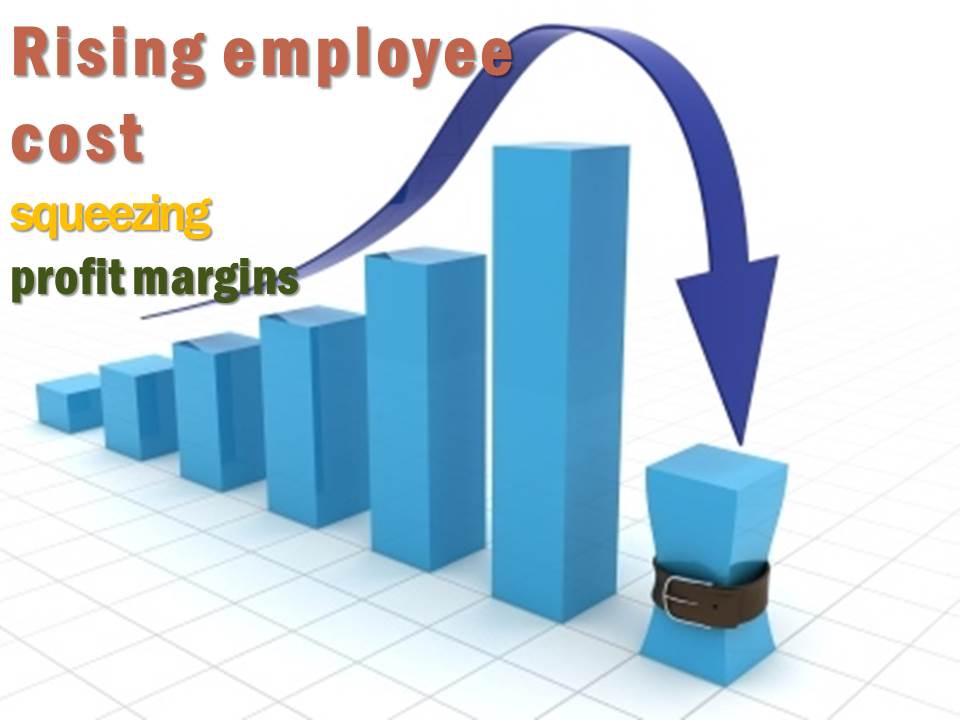
    The employee cost of organisations has increased from 7.6 per cent of the revenue in 2012, to 11.3 per cent in FY16.

    A recent study of 442 companies, that are a part of the BSE 500, revealed that their employee cost had outrun their revenue growth in the past few years. While their revenue has grown at a CAGR of 8.6 per cent between FY11 and FY16, their employee expense has risen at a CAGR of 13.4 per cent during the five-year period.

    zoha

    The race for talent has become tougher and more demanding in the past few years and the proof of the pudding lies in the fact that the employee cost of these organisations—which was 7.6 per cent of the revenue in 2012— has now grown to 11.3 per cent in FY16, consequently shrinking their margins. In fact, this year witnessed the worsening of this situation with a revenue de-growth of 4.3 per cent accompanied by a rise of 8.2 per cent in employee expense.

    Prabir Jha, global chief people officer, Cipla shares, “Unfortunately this is a rising trend. Part of it comes from the intensifying war for the right talent. A big part though is to do with the tolerance of mediocrity in several companies in India”.

    Prabir Jha

    Pradeep Mukerjee, founder and director of Confluence Coaching & Consulting, concurs, “If you look at it in the financial sense, this drift is not at all sustainable. It can be easily attributed to the war for talent – which is rather perceptive than real – as the pay packages offered to fresh graduates hired from premier institutes are more ego-driven and largely influenced by competition, than being solely calculative.”

    “Revenues will surely grow with better talent strategies in place. However, salaries in the recent past have grown more without a strong basis”, he adds.

    Looking at the situation and considering the current state of the Indian economy, one may assume that the revenues may follow as a result of high-performing talent on-board. However, organisations need to be meticulously calculative in projecting revenues and offering exorbitant pay packages or hikes.


    zoha

    “The biggest human resources spend occurs at the CEO level as the cost of hiring a CEO has blown out of proportion in the recent past.”

    In addition, a bigger challenge with organisations currently is the efficiency in capitalising on talent than solely grappling with the shortage of talent.

    The CEO salaries in fact, have also grown disproportionately in the recent few years.

    Mukerjee says, “The biggest human resources spend occurs at the CEO level as the cost of hiring a CEO has blown out of proportion in the recent past. The gap between CEO salary and the median salary in most organisations is widening significantly. This, in turn, is promoting an individualistic culture in times when so much is being talked about team work”.

    Pradeep Mukherjee

    Such pay gaps certainly send out a demotivating message to the workforce, which is also why Infosys at the time of its founder N R Narayana Murthy, was careful about the gap between the CEO salary and the median pay, until the last few years.

    Although, the industry appreciated the salary hike offered to the new CEO Vishal Sikka, Murthy’s ideals of social equity did hold significant value for the rest of the workforce.

    Experts believe that the one thing that organisations need to be more open about is differential pay practices depending on skills and performance.

    Jha opines, “While variable pay has made its way into many companies, it is still not pervasive or adequately proportioned. The reluctance to have difficult conversations and the unwillingness to get comfortable with differentiation has bred a dangerous sense of socialism. The risk to enterprise competitiveness and sustainability on account of all this is obvious”.

    “The reluctance to have difficult conversations and the unwillingness to get comfortable with differentiation has bred a dangerous sense of socialism.”

    At the same time, Mukerjee believes, “It is time, organisations start specifying critical skill sets for differentiating salaries, which some organisations have already adopted as a talent strategy. Salaries need to be competitive for only certain specific skills and not for all”.

    No doubt, revenue growth follows great performing talent, which is why it is critical that while assessing talent, companies consider how revenue-per-hire has changed over the last few years, and how well it supports the business today and tomorrow.

    CEO salaries Cipla Employee cost Pay raises Prabir Jha Pradeep Mukerjee Profit Margins Vishal Sikka
    Share. LinkedIn Twitter Facebook WhatsApp
    mm
    Dr. Prajjal Saha | HRKatha

    Dr. Prajjal Saha is a business journalist and the editor-publisher of HRKatha. He writes on the realities of work and organisations, offering a clear-eyed view of how companies translate intent into action—often revealing the gap between the two. With over 25 years of experience, he focuses on interpreting workplace trends and leadership decisions in a way that is both insightful and accessible. He founded HRKatha in 2015 to create a platform for credible, insight-driven analysis of the evolving workplace.

    Leave A Reply Cancel Reply

    Related Posts

    HRForecast 2026: HR will become the architect of business sustainability, says Shailesh Singh, ex – CPO, Axis Max Life Insurance

    July 3, 2026

    The leadership upgrade that begins with unlearning

    July 3, 2026

    Case-in-Point: When managers game the system to protect their teams

    July 2, 2026

    herSTORY: Niyathi Madasu, CHRO, Premier Energies

    July 2, 2026
    Editorial

    Every IPO tells two stories

    Someone I know spent eight and a half years building the research function at a…

    The two cultures inside the same multinational

    Someone I know works with one of the world’s largest technology and consulting firms. Based…

    EDITOR'S PICKS

    HRForecast 2026: HR will become the architect of business sustainability, says Shailesh Singh, ex – CPO, Axis Max Life Insurance

    July 3, 2026

    The leadership upgrade that begins with unlearning

    July 3, 2026

    Case-in-Point: When managers game the system to protect their teams

    July 2, 2026

    herSTORY: Niyathi Madasu, CHRO, Premier Energies

    July 2, 2026
    Latest Post

    TeXim.in onboards Abhishek Shrivastava as director & chief strategy & people officer

    Movement July 3, 2026

    Trade-automation platform TeXim.in has appointed Abhishek Shrivastava as its new director and chief strategy and…

    EPF wage ceiling remains below Centre’s minimum salary under new EPF Scheme 2026

    News July 3, 2026

    The notification of the Employees’ Provident Fund (EPF) Scheme, 2026 has once again highlighted the…

    Nike cuts employee bonus payouts as turnaround efforts continue

    News July 3, 2026

    Nike employees across global operations will receive lower-than-target annual bonus payouts after the sportswear giant…

    Tesla introduces weekly AI spending cap for employees to control rising costs

    News July 3, 2026

    Tesla has introduced a weekly cap on employee spending for artificial intelligence (AI) tools, marking…

    Asia's No.1 HR Platform

    Facebook X (Twitter) Instagram LinkedIn WhatsApp Bluesky
    • Our Story
    • Partner with us
    • Career
    • Reach Us
    • Exclusive Features
    • Cover Story
    • Editorial
    • Dive into the Future of Work: Download HRForecast 2024 Now!
    © 2026 HRKatha.com
    • Disclaimer
    • Refunds & Cancellation Policy
    • Terms of Service

    Type above and press Enter to search. Press Esc to cancel.