



The modern workplace has become fluent in the language of exits. First came the Great Resignation, followed by quiet quitting, rage applying, bare minimum Mondays and career cushioning. Each trend attempted to explain why employees disengage before they leave. Now something more unsettling is surfacing: not employees quietly walking away, but employees deliberately ensuring their departure leaves a scar.
Revenge quitting is not simply resigning after a bad experience. It is leaving with the intention to disrupt: delaying knowledge transfer, withholding critical information, damaging client relationships, attacking employers publicly, deleting files, or creating chaos during the notice period. Social media has amplified such stories, often portraying them as acts of courage against toxic employers.

Behind every dramatic exit, however, lies a more uncomfortable question. Does revenge quitting really begin on the last working day? Or does it begin much earlier, when an employee quietly decides the relationship has already broken beyond repair?
The visibility shift
Sriharsha Achar, a senior HR leader, does not believe the behaviour itself is new. What has changed, he says, is its visibility.
 “I don’t believe revenge quitting is entirely new. What is new is that social media has made dramatic exits visible, celebrated and, in some cases, glorified.”
Bitter departures once remained confined to conversations with close friends or former colleagues. Today they become public performances. LinkedIn posts, Glassdoor reviews and viral stories can transform one employee’s grievance into a widely shared narrative within hours. The audience has expanded. The emotions behind these exits have not changed nearly as much.
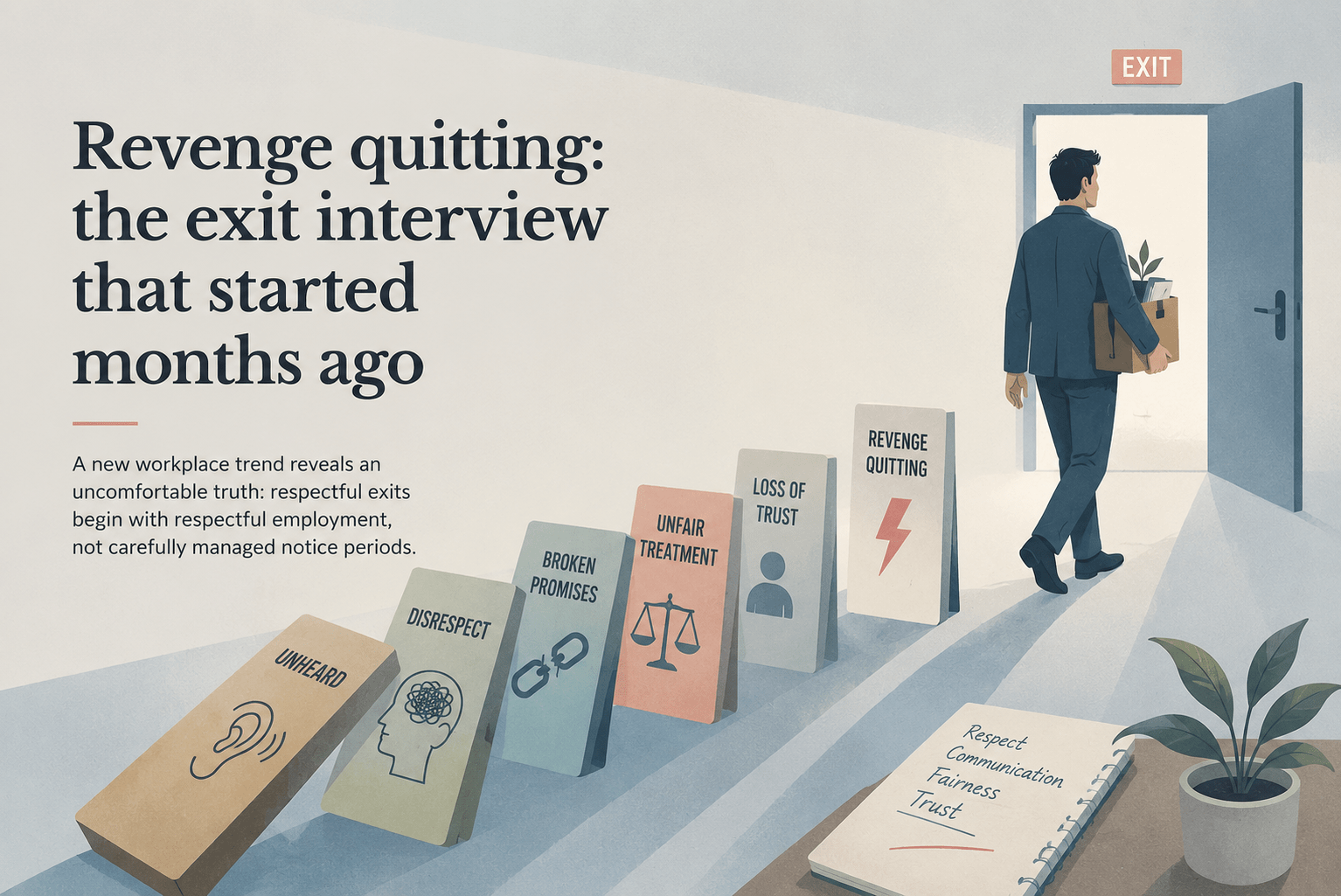
What makes revenge quitting significant is that it rarely stems from a single incident. Organisations often search for one trigger: a denied promotion, an appraisal dispute or a disagreement with a manager. The reality is usually more gradual. Employees who retaliate often describe months of accumulated disappointment: feeling unheard despite repeatedly raising concerns, perceived unfairness in recognition, disrespectful leadership behaviour, broken promises around career opportunities or humiliation during performance conversations. Individually, each incident may appear manageable. Together, they create a powerful narrative of betrayal.
Achar draws a clear distinction between understanding the emotion and accepting the behaviour. “Employees have every right to resign; however, they do not have the right to damage people, systems or the organisation in the process.” Institutions, he argues, are always larger than individuals, and frustration cannot justify deliberate harm.
The resignation misconception
That said, organisations would be equally mistaken if they viewed revenge quitting purely as employee misconduct.
 One of the biggest mistakes employers make, says Praveer Priyadarshi, another senior HR leader, is “treating resignation as the first indication of disengagement. In reality, resignation is often the final confirmation of something that has been developing for months.”
The earliest warning signs rarely announce themselves dramatically. They appear through small but meaningful behavioural shifts. Employees who once contributed actively begin withdrawing from discussions. Curiosity gives way to cynicism. Collaboration declines.
Conflicts become more frequent. Discretionary effort fades. Conversations increasingly revolve around wanting to leave.
None of these signals, in isolation, predicts revenge quitting. Together, however, they often reveal an employment relationship that has already started to unravel.
For HR, this changes the conversation entirely. Instead of asking how to manage a difficult exit, organisations should be asking why the relationship deteriorated to that point in the first place.
Stay interviews over exit interviews
That shift requires organisations to focus less on exit interviews and more on what Achar describes as one of HR’s most underused tools: stay interviews.
Exit interviews often arrive when the outcome is irreversible. Stay interviews create opportunities to understand why employees continue to stay, what motivates them and what frustrations, if left unresolved, might eventually drive them away. They allow difficult conversations to happen while there is still time to rebuild trust.
This responsibility cannot rest with HR alone.
As Priyadarshi points out, “Managers often determine whether employees experience fairness, respect and psychological safety on a daily basis. Difficult conversations around performance, promotions, role changes or disciplinary issues cannot simply be administratively correct; they must also preserve dignity.”
Employees rarely remember only the decision. They remember how it was communicated.
Revenge quitting also exposes another organisational vulnerability: excessive dependence on individuals.
Many organisations treat notice periods as administrative formalities rather than business continuity exercises. Knowledge transfer becomes a checklist completed during the final week instead of an ongoing discipline. Documentation is incomplete. Cross-training is limited. Institutional knowledge sits inside individual employees rather than within systems.
When the departure of one employee creates operational chaos, the problem extends beyond that individual. It also reflects how the organisation has chosen to manage knowledge, capability and succession.
Proportionate response, not paranoia
Recognising these risks does not mean every resignation should be viewed with suspicion.
Treating every departing employee as a potential threat creates a culture of distrust that punishes the overwhelming majority who leave professionally. The response should remain calm, consistent and procedural: secure company assets, protect critical systems, complete documentation, ensure policy compliance and maintain business continuity. Emotional reactions or public confrontations rarely improve the situation.
Organisations should also conduct an honest review whenever such incidents occur. Rather than focusing only on assigning blame, leaders should ask a more valuable question: what allowed the employment relationship to deteriorate to this point?
The answers often reveal systemic weaknesses that deserve more attention than the individual incident itself.
The reputation calculus
Revenge quitting carries consequences that extend beyond the employer.
Professional reputations increasingly outlast individual jobs. Industries are closely connected, particularly at leadership levels, where former colleagues frequently become future clients, hiring managers or business partners. A dramatic exit may feel satisfying in the moment, but its longer-term cost is often underestimated. People remember not only how someone performed, but also how they chose to leave.
That is why revenge quitting deserves to be viewed as more than another workplace buzzword alongside quiet quitting or rage applying. It acts as a mirror, reflecting what happens when organisational trust collapses and emotion overtakes professionalism.
For employees, it is a reminder that dignity builds stronger careers than retaliation ever can.
For organisations, it reinforces a simpler truth: respectful exits begin long before the resignation letter reaches HR. They begin with respectful leadership, fair processes, honest conversations and workplaces that address grievances before they harden into resentment.
As Achar puts it: “An employee’s last working day should reflect the professionalism they brought to their first. Revenge may satisfy emotion for a moment, but dignity builds a reputation for life.”
Revenge quitting is not really a story about leaving. It is a story about relationships that stopped working long before anyone submitted their resignation. By the time the exit becomes dramatic, the warning signs have usually been visible for months. The real question is whether anyone chose to notice them.