


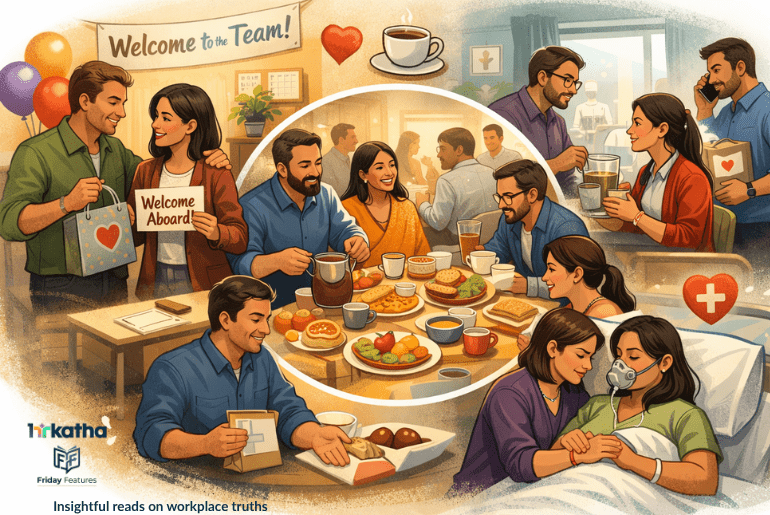
Recall your first day at work?
In all likelihood, you may not remember what the induction deck looked like or which HR policy was explained first. However, you probably remember the colleague who walked you to the cafeteria, the team that insisted you join them for lunch, or the manager who made sure you didn’t spend your first day eating alone.
Workplaces have changed dramatically. Offices have become hybrid, meetings have moved to screens, and conversations often happen through emojis rather than across desks. Yet, somehow, it isn’t the technology or policies that people reminisce about years later. It’s the little rituals that quietly made work feel human.
The best workplace traditions aren’t elaborate engagement programmes. They’re the everyday moments that remind employees they’re part of something bigger than a payroll database. And while organisations continue to reinvent the future of work, some rituals deserve to survive every transformation.
The breakfast table that replaces the boardroom
For Anurag Verma, chief people success officer, Wooqer, the workplace tradition worth preserving begins before the workday officially starts.
Not with a meeting but with breakfast.

Every morning, colleagues gather over coffee, poha, idlis, parathas, homemade sandwiches or whatever someone has decided to bring from home. There is no formal invitation, no attendance sheet and certainly no HR agenda. People simply arrive because someone has brought their mother’s special chutney or because another colleague has promised fresh cookies.
The conversations rarely begin with work. They wander through weekend stories, cricket scores, movies, children’s antics and holiday plans. Somewhere between the second cup of coffee and the last bite of paratha, someone casually mentions a client challenge or a product idea. Another colleague jumps in with a solution.
By the time everyone reaches their desks, collaboration has already begun.
It’s an ordinary ritual that quietly does something extraordinary. Relationships are built long before projects demand them. When difficult conversations arise later, people aren’t talking to job titles—they’re talking to someone whose homemade food they’ve already complimented.
Perhaps that’s why some of the strongest workplace cultures aren’t built in workshops. They’re built around breakfast tables.
The welcome that lasts far beyond Day One
Ask anyone about their first day at a new job, and chances are they’ll remember exactly how they were made to feel.

Vivek Mukherjee, CHRO, Benetton India, believes that first impression is one workplace tradition that should never disappear.
Not because onboarding is a process but because belonging begins there.
A warm welcome, a buddy waiting to guide you through the office, a thoughtful welcome note or even a small gift bag may seem like minor gestures. Yet, these are often the moments employees carry with them for years. Long after they’ve forgotten password-reset instructions or organisational charts, they remember who helped them find the coffee machine.
Mukherjee believes these rituals send a powerful, unspoken message: You matter here.
In an era where joining a company can sometimes feel like logging into another software platform, a genuinely warm welcome reminds employees they’re joining a community instead.
Technology may automate paperwork. It can never automate the feeling of being included.
When showing up matters more than any policy
Some workplace traditions don’t happen every day. They reveal themselves only when life falls apart.

For Anju Jumde, CHRO, Aditya Birla Money, the workplace tradition worth protecting is a culture where people show up for one another during life’s toughest moments.
She recalls how, during the uncertainty of the COVID-19 pandemic, teams came together to arrange hospital beds, oxygen cylinders, medicines and vaccinations—not only for employees but also for their families across cities and smaller towns.
There wasn’t a handbook explaining what to do.
There were simply people refusing to let colleagues face a crisis alone.
Years later, employees may not remember every benefit listed in their compensation package. But they remember the phone call asking, “How can we help?” They remember medicines arriving at their doorstep or someone from work checking in long after office hours.
Those moments quietly redefine what a workplace means.
Sometimes, the strongest culture isn’t built through celebrations but through compassion.
The traditions worth carrying forward
Every generation believes work is changing faster than ever before. And perhaps it is.
Artificial intelligence will reshape jobs. Offices will continue to evolve. Hybrid work may become even more flexible.
Yet, people will still want the same things they have always wanted—to feel welcomed on their first day, to laugh over breakfast with colleagues, and to know someone will stand beside them when life becomes difficult.
Policies may create organisations but it is the traditions that create memories.
And if workplaces want people to stay connected and not just employed, it may be worth holding on to the rituals that never appeared in any HR handbook, but somehow became the reason people loved coming to work.