



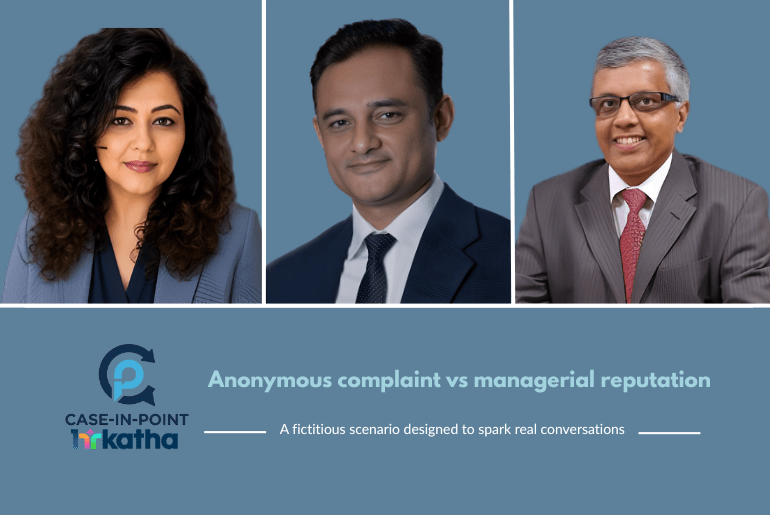
Company: Urban Logistics, a supply chain company (fictitious)
Background
An anonymous email addressed to HR alleges that a senior manager is having an affair with a direct report, creating favouritism and an uncomfortable work environment. No name is provided for the direct report. The manager denies everything. There is no corroborating evidence.
The dilemma
Should HR investigate an anonymous, unverified complaint that could be malicious gossip — risking reputational damage to the manager? Or should it be dismissed as hearsay, potentially ignoring a real and ongoing workplace issue?
What’s really at stake
Whether anonymous complaints are credible enough to act on — or whether the absence of accountability makes them tools for workplace sabotage.
For the company, mishandling such complaints can erode employee confidence in HR processes, create legal risks, and harm workplace culture. For the accused manager, the harm to his reputation can be lasting even if the claim is false, affecting career progression and relationships.
Shouldn’t the HR protect both employees and managers? After all, isn’t it the HR’s responsibility to ensure fairness while safeguarding the company’s integrity?
This is what our HR leaders had to say:
Ekta Kaveeshwar, CHRO, Neilsoft
If an anonymous complaint lands on my desk, I would not dismiss it simply because the sender has chosen to stay unnamed. When allegations involve a senior manager and a potential abuse of power, anonymity is often less about cowardice and more about fear—fear of retaliation, career damage, or not being believed.
That said, anonymity alone does not make an allegation true. It is HR’s responsibility to separate facts from speculation. My approach would be to investigate, but with restraint and discipline.

The first step is to assess credibility. Has the manager been the subject of similar concerns in the past? Are there informal complaints, patterns of behaviour, or signals that warrant attention? I would then discreetly gauge team sentiment and workplace dynamics without revealing the nature of the allegation. If there is perceived favouritism, exclusion, or unusual decision-making, patterns tend to emerge.
I would also review objective data—performance ratings, promotions, rewards, project allocations and career-progression decisions over the past year or more. Finally, I would have a professional conversation with the manager around team climate, workplace boundaries and conflict-of-interest expectations.
The key is to investigate the issue, not the rumour. This has to be done with utmost care, without damaging a person’s reputation based on hearsay and without ignoring a potentially-serious workplace concern. Anonymous complaints deserve attention, but they also require evidence before conclusions are drawn.
Anonymous complaints should neither be accepted at face value nor ignored outright. HR’s role is to conduct a discreet, evidence-based inquiry that protects both the complainant and the accused.
Tanmay Chauhan, Director-HR, Dover Fueling Solutions India
The real question begins much before an anonymous complaint arrives. Organisations should have clear policies, awareness programmes and disclosure mechanisms that guide employees on workplace relationships, especially where reporting lines or conflicts of interest may exist.

Many organisations today require employees to declare relationships that could create bias or influence workplace decisions. Post disclosure, the company can take appropriate measures—such as changing reporting structures or ensuring there is no conflict of interest. When such frameworks are clearly communicated and consistently followed, situations are less likely to escalate into anonymous complaints.
However, if a complaint does surface, every organisation must have a defined process for handling it. I would never dismiss a complaint simply because it is anonymous. At the same time, I would not jump straight into a formal investigation based on an unverified allegation.
The first step is to assess whether the complaint carries substance. This involves speaking to relevant stakeholders, understanding the context, reviewing facts and determining whether the matter falls within the scope of organisational policy. A complaint should be evaluated objectively, using established procedures rather than personal judgement.
Ultimately, strong policies make these situations easier to navigate. They provide consistency, fairness and clarity on how concerns are assessed and addressed.
Every complaint deserves attention, but HR’s response should be guided by policy, process and evidence—not assumptions. Prevention through clear relationship-disclosure policies is equally important.
Ramesh Shankar, Senior HR Leader
I have seen situations where employees were afraid to report misconduct because they feared losing their jobs. In one instance, I learnt through informal channels that a manager was behaving inappropriately with young female employees. Nobody had formally complained, but that did not mean nothing was wrong.

Instead of waiting for a complaint, I met the team without the manager present and held an open discussion about their work environment. During that conversation, one employee became visibly emotional. Later, in a private conversation, she shared what had been happening. She also revealed that others in the team had faced similar experiences but were too afraid to speak up.
That experience reinforced an important lesson for me: silence is not evidence that a problem does not exist. Often, employees remain silent because they believe the risks of speaking up outweigh the benefits.
In the Urban Logistics case, I would not treat the anonymous complaint as proof, but I would certainly treat it as a signal. If the allegation is serious, HR has a responsibility to conduct discreet fact-finding. This may involve informal conversations, team interactions, observing workplace dynamics or gathering information through trusted channels.
Of course, anonymous complaints can sometimes be motivated by personal grudges or dissatisfaction with a manager. Therefore, not every anonymous allegation should trigger a full-scale investigation. However, when the issue involves possible harassment, abuse of authority, favouritism or ethical misconduct, HR cannot afford to look away.
I often compare this to how courts occasionally take suo moto cognisance of serious matters. They do not presume guilt, but they recognise that certain allegations are important enough to warrant examination even without a formal complaint.
Anonymous complaints should be viewed as indicators, not evidence. When allegations involve potential abuse of power or employee wellbeing, HR must proactively explore the facts rather than wait for someone to come forward formally.
If you were the CHRO at Urban Logistics, what would you do?
Would you:
- Open an investigation into the anonymous complaint despite the lack of evidence?
- Wait until more concrete information surfaces?
- Protect the manager’s reputation even while ensuring that employees feel safe and heard, especially if the allegation points to favouritism or abuse of power?
Or is the deeper question this:
Why the anonymity? This may not be a one-off case. Are employees afraid of retaliation? Is it time to question the culture of the organisation? Does the organisation require policies, safeguards and processes in place to handle such sensitive matters?