



The nature of work is not just changing. It is being redefined.
As artificial intelligence moves from assisting tasks to executing them, the question is no longer what technology can do, but what remains uniquely human.

For decades, organisations were built on knowledge—what employees knew, how efficiently they applied it, and how quickly they could scale it.
That foundation is shifting.
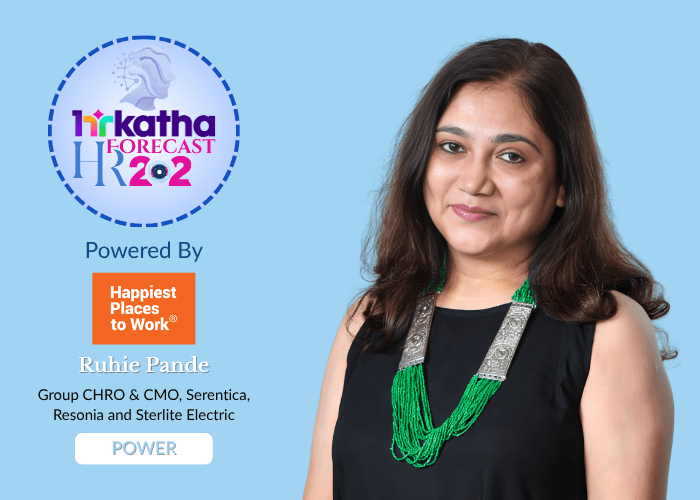
Ruhie Pande, group CHRO & CMO at Serentica, Resonia and Sterlite Electric, believes the next phase of the workplace will be defined not by knowledge, but by wisdom, the ability to apply judgment, navigate ambiguity and balance business logic with human impact.
“As we automate the ‘doing,’ we free up cognitive space for the ‘being,’” she says.
Several signals point to how this transition may unfold.
Signal 1: Human capability will shift from knowledge to judgment
As AI takes over data processing, analysis and execution, the value of technical knowledge alone is diminishing.
What remains, and becomes more critical, is human judgment.
“While technology can scale efficiency, only human empathy can scale culture,” Pande notes.
This shift is already visible. Demand for advanced technical skills continues to rise, but so does demand for social-emotional capabilities, critical thinking and complex decision-making.
AI can generate insights. It cannot resolve ambiguity, detect ethical risk or interpret human context.
“The most valuable professionals will be those who can detect algorithmic bias, challenge automated assumptions and lead with a human-first lens.”
This marks a deeper transition from a knowledge economy to what Pande describes as a “wisdom economy.”
Organisations that recognise this early will invest not just in skills, but in judgment, context and ethical reasoning.
Signal 2: Gen Z will force a redesign from careers to growth systems
Gen Z is not just entering organisations. It is reshaping how work is defined.
Traditional markers of success, such as titles, tenure and salary progression, are losing relevance. What matters instead is continuous capability building.
“By 2026, the shift from ‘job-hopping’ to ‘growth-hunting’ will become a strategic reality,” Pande says.
For many young professionals, a new skill is more valuable than a promotion.
This is forcing organisations to rethink how careers are structured.
Annual performance cycles are giving way to shorter, more transparent growth pathways. Employees expect clarity on how they can progress, not over years, but within months.
Transparency is emerging as a defining expectation, not just in careers, but in governance, data usage and decision-making.
The implication is clear: organisations must move from managing careers to designing growth systems.
Those that do will retain talent. Those that do not will struggle to remain relevant to the workforce they are trying to attract.
To meet this head-on, organisations such as Serentica are rethinking career frameworks through programmes such as IGNITE, attracting diverse talent from top institutes and investing in their growth journey from day one.
Signal 3: Purpose-led sectors will redefine talent advantage
In industries such as power transmission and renewables, the biggest constraint is not capital or technology, it is talent.
Pande identifies the emerging challenge as the “green-collar skills gap.”
As renewable capacity expands, demand for specialised talent is outpacing supply.
Yet within this challenge lies a unique opportunity.
Purpose is becoming a differentiator in talent attraction, particularly for Gen Z and Millennials.
“We offer something younger talent is actively seeking, a direct role in the planet’s decarbonisation.”
This is reshaping hiring strategies.
Purpose-led recruitment, combined with inclusive workforce design, is enabling organisations to access talent pools that were previously overlooked.
Initiatives such as Resonia’s Shakti programme, recruiting local women for field roles such as right-of-way work, are not just diversity interventions but operational advantages. These women bring cultural fluency and community insight that improves stakeholder engagement in ways outsiders cannot match.
The insight is critical: in emerging sectors, purpose is no longer branding. It is a talent strategy.
Signal 4: Learning will become a business-critical function, not a support system
The traditional view of learning and development as a support function is rapidly becoming obsolete.
In a world where skills are constantly evolving, the ability to reskill at speed is emerging as a core organisational capability.
“Time-to-competency is the new lead indicator of business success,” Pande observes.
This is elevating the role of the Chief Learning Officer.
No longer confined to training programmes, the CLO is becoming an architect of capability, designing ecosystems that integrate AI-driven learning, peer coaching and immersive simulations.
The implication is structural.
When learning is directly aligned with business strategy, it shifts from a cost centre to a competitive advantage.
Organisations that can build capabilities faster than the market evolves will outpace those that cannot.
Signal 5: HR will own the human side of AI
As AI adoption accelerates, its impact is no longer limited to productivity.
It is reshaping trust, identity and the employee experience.
“Ethical implications, bias prevention and trust building cannot be outsourced,” Pande says.
This places HR at the centre of the AI transition.
The challenge is not just deploying technology, but ensuring that people trust how it is used.
Employees need clarity on data usage, confidence in fairness and assurance that technology is augmenting, not replacing, their contribution.
At the same time, reskilling becomes critical.
A growing number of employees prefer to build new capabilities within their current organisation rather than move externally.
Organisations that enable this transition will convert AI from a source of anxiety into a driver of engagement.
The role of HR, therefore, expands from managing people to mediating the relationship between humans and technology.
The wisdom shift
These signals, human judgment, growth-driven careers, purpose-led talent strategies, learning as capability and HR ownership of AI, point to a deeper shift.
Work is moving away from knowledge accumulation towards wisdom application.
In this environment, success depends less on what organisations know, and more on how they think, decide and adapt.
The organisations that recognise this will design systems that prioritise judgment, learning agility and human context.
Those that continue to optimise purely for efficiency risk building workforces that are technically capable but strategically limited.
Three Strategic Imperatives
Build for Judgment, Not Just Skills: Prioritise empathy, critical thinking and ethical reasoning as core capabilities, ensuring employees can interpret and challenge AI-driven insights.
Design Growth Systems, Not Career Paths: Move from linear progression models to transparent, continuous development frameworks aligned to capability building.
Make Learning a Strategic Lever: Treat capability building as business-critical, reducing time-to-competency through integrated, AI-enabled learning ecosystems.
The Wisdom Advantage
The future of work will not be defined by how much organisations know.
It will be defined by how effectively they apply what they know.
AI can generate knowledge at scale.
It cannot replace judgment.
It can process data.
It cannot navigate ambiguity.
In 2026, the divide will not be between organisations that use AI and those that do not.
It will be between those that elevate human capability alongside technology, and those that allow it to atrophy.
Because in a world where knowledge is abundant, wisdom becomes the true competitive advantage.