


What does it mean?
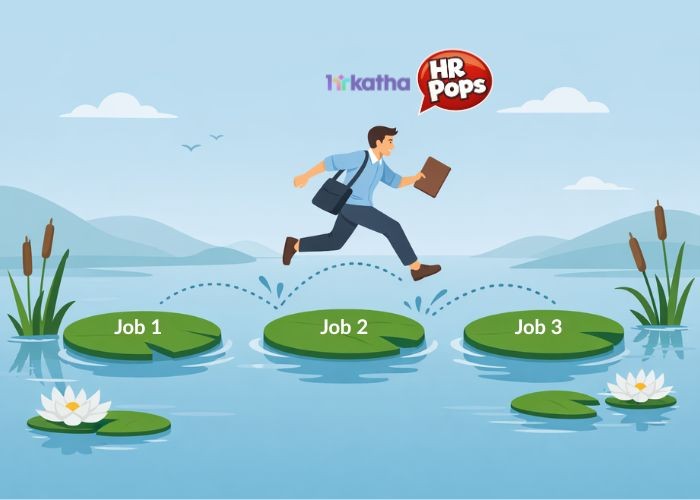
Lily padding is a career strategy in which professionals – particularly younger workers – move deliberately from one role to another to build skills, exposure, and opportunity.
The metaphor comes from a frog moving across a pond, hopping from one lily pad to the next. Each move is intentional and forward-looking.

This is not a rejection of commitment. It is a response to a changing world of work.
Unlike traditional careers, which followed a linear progression – entry-level to mid-level to senior roles – lily padding is non-linear. Each move is designed to expand capabilities, broaden perspective, and remain relevant in shifting markets.
Where did the idea come from?
The term gained traction in the 2020s as Generation Z entered the workforce.
Earlier generations tended to value stability and long-term association with a single employer.
In contrast, younger workers – shaped by economic uncertainty, rapid technological change, and shifting social expectations – view careers as a series of strategic moves rather than a single upward climb.
The rise of remote work, gig platforms, and global opportunities accelerated this shift. Waiting several years for a promotion is no longer seen as necessary when similar or better opportunities may exist elsewhere.
Lily padding also reflects changing priorities. Many workers now place greater emphasis on learning, meaning, and flexibility than on tenure or hierarchy.
Why is it relevant for HR?
For HR leaders, lily padding challenges traditional assumptions about loyalty, retention, and career progression.
Its implications are significant:
- Retention strategies need rethinking: Employees may leave not because they are dissatisfied, but because they seek new experiences
- Internal mobility becomes critical: Organisations must offer visible, flexible pathways across roles, functions, and geographies
- Learning must be continuous: Employees expect ongoing development, not periodic training
- Culture must evolve: Flexibility, autonomy, and purpose increasingly matter more than hierarchy
- Employer branding gains importance: Growth opportunities, wellbeing, and transparency are key attractors
In effect, organisations must compete not just on pay, but on the quality and variety of experience they offer.
The uncomfortable question
Lily padding is often framed as empowering, but it comes with trade-offs.
For individuals, frequent movement can limit the development of deep expertise. Breadth increases, but depth may suffer. There is also the fatigue of constant transition be it job searches, onboarding, and the need to prove oneself repeatedly.
For organisations, the costs are equally real. High turnover disrupts continuity, erodes institutional knowledge, and increases hiring costs. Long-term projects can suffer when key contributors move on.
There is also a more complex concern: frequent movement can make it difficult to distinguish between high performers and those who move before their limitations become visible.
A rational response?
Is lily padding a rejection of commitment, or a rational response to organisations that no longer guarantee stability or clear progression?
In many cases, it is both.
Some professionals move strategically, building diverse and valuable skill sets. Others may be reacting to frustration, lack of feedback, or limited growth opportunities.
For HR, the challenge lies in understanding the difference, and in creating conditions where those with high potential choose to stay.