

Close Menu
    Facebook X (Twitter) Instagram
    • Our Story
    • Partner with us
    • Reach Us
    • Career
    Subscribe Newsletter
    HR KathaHR Katha
    • Exclusive
      • Exclusive Features
      • Perspectives
      • Friday Features
      • herSTORY
      • Rising Stars
      • Case-In-Point
      • Point Of View
      • Research
      • HR Pops
      • Dialogue
      • Movement
      • Profile
      • Beyond Work
      • By Invitation
    • News
      • Global HR News
      • Compensation & Benefits
      • Diversity
      • Events
      • Gen Y
      • Hiring & Firing
      • HR & Labour Laws
      • Learning & Development
      • Merger & Acquisition
      • Performance Management & Productivity
      • Talent Management
      • Tools & Technology
      • Work-Life Balance
    • Special
      • HR Forecast 2026
      • Cover Story
      • Editorial
      • HR Forecast 2024
      • HR Forecast 2023
      • HR Forecast 2022
      • HR Forecast 2021
      • HR Forecast 2020
      • HR Forecast 2019
      • New Age Learning
      • Coaching and Training
      • Learn-Engage-Transform
    • Magazine
    • Reports
      • Whitepaper
        • HR Forecast 2024 e-mag
        • Future-proofing Manufacturing Through Digital Transformation
        • Employee Healthcare & Wellness Benefits: A Guide for Indian MSMEs
        • Build a Future Ready Organisation For The Road Ahead
        • Employee Experience Strategy
        • HRKatha 2019 Forecast
        • Decoding and Driving Employee Engagement
        • One Platform, Infinite Possibilities
      • Survey Reports
        • Happiness at Work
        • Upskilling for Jobs of the Future
        • The Labour Code 2020
    • Conferences
      • Leadership Summit 2025
      • Rising Star Leadership Awards
      • HRKatha Futurecast
      • Automation.NXT
      • The Great HR Debate
    WhatsApp LinkedIn X (Twitter) Facebook Instagram
    HR KathaHR Katha
    Home»Exclusive Features»HR Pops»Resenteeism: When staying feels worse than leaving
    HR Pops

    Resenteeism: When staying feels worse than leaving

    How economic anxiety and post-pandemic shifts created a workforce that is present in body but absent in spirit—and why HR cannot ignore it
    mmBy Liji Narayan | HRKathaMarch 24, 2026Updated:March 24, 20263 Mins Read9855 Views
    Share LinkedIn Twitter Facebook WhatsApp
    Resenteeism
    Share
    LinkedIn Twitter Facebook WhatsApp

    What  is resenteeism 

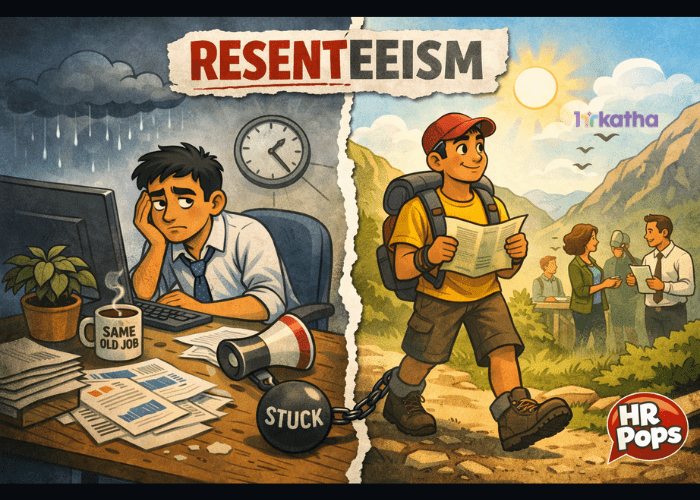
    Resenteeism describes a workplace pattern in which employees stay in roles they find unfulfilling, leading to growing resentment and disengagement.

    The term blends two ideas: resentment and presenteeism. Presenteeism refers to being physically present at work but not fully productive. Resenteeism goes a step further—employees are not just disengaged; they are actively dissatisfied but unwilling or unable to leave.

    The result is low motivation, reduced collaboration, and a quiet but persistent negativity towards the organisation.

    Where did the idea come from? 

    Resenteeism gained traction in the aftermath of the COVID-19, particularly during and after the Great Resignation.

    During this period, many employees reassessed their careers and priorities. While some chose to leave in search of better opportunities, others stayed—often reluctantly—due to financial pressure, uncertainty, or limited alternatives.

    As economic conditions tightened, rising inflation and layoffs—especially in sectors such as technology—reduced employees’ willingness to take risks. Many who might have exited instead remained, even as dissatisfaction deepened.

    In this sense, resenteeism is a more emotionally charged counterpart to “quiet quitting”. It is not passive disengagement, but frustrated persistence.

    Why is it relevant for HR?

    For HR leaders, resenteeism is difficult to detect but costly to ignore. Unlike absenteeism or attrition, affected employees are still present—making the problem less visible but no less damaging.

    Its impact shows up in multiple ways:

    • Productivity: Employees do the minimum required, affecting both output and quality
    • Team dynamics: Resentment spreads, normalising cynicism within teams
    • Retention risk: Employees stay temporarily but are ready to exit when conditions improve
    • Employee wellbeing: Prolonged dissatisfaction leads to stress, burnout, and declining mental health

    The uncomfortable truth

    Resenteeism rarely emerges in isolation. It is often the result of accumulated organisational experiences.

    Unclear career progression, perceived pay inequity, inconsistent recognition, or ineffective management can all contribute to a sense of stagnation. Over time, unmet expectations turn into frustration.

    When external conditions—such as a weak job market—limit mobility, that frustration does not disappear. It intensifies.

    For HR, this leads to a difficult but necessary question:

    Are employees staying because they want to—or because they feel they have no choice?

    What HR can do

    Addressing resenteeism requires both structural and cultural responses.

    • Clarify career pathways so employees can see realistic growth opportunities
    • Ensure fair and transparent rewards to reduce perceptions of inequity
    • Invest in learning and development to counter stagnation
    • Encourage open dialogue so concerns are surfaced early
    • Strengthen manager capability, as day-to-day experience is shaped at the team level

    Most importantly, organisations must align what they promise with what employees actually experience. The gap between the two is often where resentment begins.

    The takeaway

    Resenteeism reflects a shift in the employment relationship. Employees are no longer leaving at the first sign of dissatisfaction—but staying with diminished engagement.

    For organisations, this creates a hidden risk: a workforce that is present in body but absent in spirit.

    Addressing it requires more than retention strategies. It requires rebuilding trust, ensuring fairness, and creating conditions where employees choose to stay—not because they must, but because they see value in doing so.

    Because once resentment sets in, retaining employees is no longer the problem.

    Re-engaging them is.

    Absenteeism Attrition burnout costly to ignore cynicism diminished engagement disengaged employees dissatisfaction emotionally charged counterpart Employee employer financial pressure frustration Great Resignation hidden risk HR HR Pops HRPops Human Resources or limited alternatives. persistent negativitym present in body but absent in spirit resenteeism resentment resentment and presenteeism unable to leave Uncertainty unfulfilling roles unwilling to leave Workforce
    Share. LinkedIn Twitter Facebook WhatsApp
    mm
    Liji Narayan | HRKatha

    HRKatha prides itself in being a good journalistic product and Liji deserves all the credit for it. Thanks to her, our readers get clean copies to read every morning while our writers are kept on their toes.

    Leave A Reply Cancel Reply

    Related Posts

    Manish Dwivede joins Allana Group as group CHRO

    July 31, 2026

    BP proposes 700 job cuts in non-frontline roles amid restructuring push

    July 31, 2026

    SELLABILITY appoints Sneha Sahasrabudhe as CHRO

    July 31, 2026

    Government to bring gig workers under social security net through new labour codes

    July 31, 2026
    zoha
    Editorial

    What Jantar Mantar told us about the generation now entering India’s workplaces

    A senior television journalist, who now runs his own YouTube channel, was speaking to a…

    India’s IT services industry built the talent. Its biggest clients are now hiring it directly through GCCs

    Something significant is happening to India’s technology workforce in 2026. Most people are describing the…

    EDITOR'S PICKS

    The five-minute rituals that make the workday better

    July 31, 2026

    HR leadership lessons from the military

    July 30, 2026

    herSTORY: Beena Dixit, Country Head, People & Organisation, Siemens Energy India

    July 30, 2026

    Case-in-Point: The internal informant

    July 30, 2026
    Latest Post

    Manish Dwivede joins Allana Group as group CHRO

    Movement July 31, 2026

    Manish Dwivede has been appointed as group chief human resources officer at Allana Group, a…

    BP proposes 700 job cuts in non-frontline roles amid restructuring push

    Global HR News July 31, 2026

    British Petroleum (BP), a multinational oil and gas company headquartered in London is planning to…

    SELLABILITY appoints Sneha Sahasrabudhe as CHRO

    Movement July 31, 2026

    SELLABILITY, an Indian real estate sales and marketing mandate consultancy has named Sneha Sahasrabudhe as…

    Government to bring gig workers under social security net through new labour codes

    News July 31, 2026

    Millions of delivery agents, cab drivers and other platform workers could soon have access to…

    Asia's No.1 HR Platform

    Facebook X (Twitter) Instagram LinkedIn WhatsApp Bluesky
    • Our Story
    • Partner with us
    • Career
    • Reach Us
    • Exclusive Features
    • Cover Story
    • Editorial
    • Dive into the Future of Work: Download HRForecast 2024 Now!
    © 2026 HRKatha.com
    • Disclaimer
    • Refunds & Cancellation Policy
    • Terms of Service

    Type above and press Enter to search. Press Esc to cancel.