



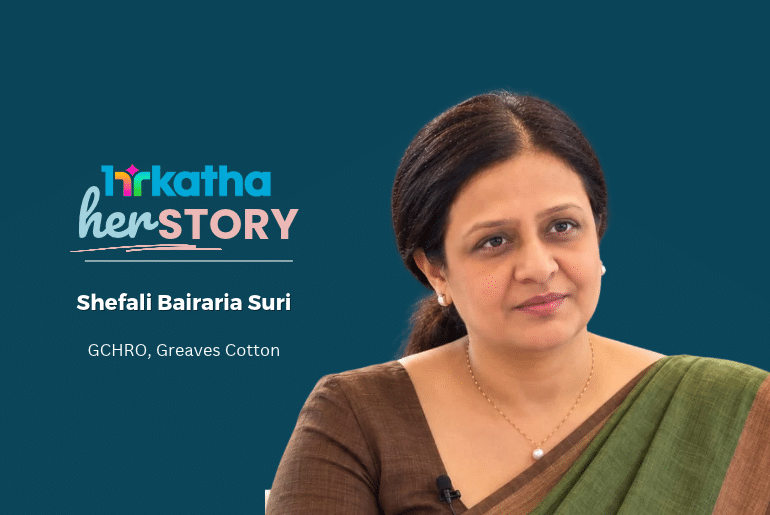
The gearbox
If HR were a machine part, what would it be? For Shefali Bairaria Suri, group chief human resources officer at Greaves Cotton, the answer is immediate: the gearbox.
“Not the engine, not the lubricant,” she says. “The gearbox. It is HR that connects people, capabilities and business priorities and helps the organisation move in the right direction.”
It is a metaphor that reflects how her understanding of HR has evolved over the years.
Early in her career, Suri viewed the function largely through people processes, policies and employee engagement. Experience taught her that almost every significant business decision, whether involving growth, expansion, transformation or new capabilities, has a people dimension.
“HR is fundamentally a function of balance,” she says. “It requires a deep understanding of what the business is trying to achieve while creating an environment where people can perform, grow, adapt and build meaningful careers.”
At Greaves Cotton, which has evolved from a single-fuel, single-product manufacturer into a diversified, fuel-agnostic engineering company, that balance is constantly being tested.
“In every tough decision, I evaluate three non-negotiables: Is it right for the business? Is it fair to our people? Will it build the capabilities needed for tomorrow?”
Challenging assumptions
One experience that particularly shaped Suri’s thinking was the effort to increase women’s participation across Greaves Cotton’s manufacturing facilities.
The resistance was rarely explicit. Instead, there was an underlying assumption that women would need significantly more training or support to perform manufacturing roles, and that bringing them into these positions would be difficult.
Suri believed the larger barrier was not capability, but access to opportunity.
The organisation focused on structured training, skilling programmes and creating a more inclusive environment on the shop floor. Women began moving from assembly lines into more complex roles and eventually into leadership positions.
“It was a powerful reminder that inclusion is not just about creating opportunities,” she reflects. “It is about challenging assumptions, building confidence and giving people the space to demonstrate what they are capable of.”
The experience reinforced her belief that talent thrives when opportunity is accessible, support is available and growth is based on merit.
For Suri, however, representation is only the beginning. The next challenge is to create workplaces where women can build long-term careers, influence business outcomes and develop their own leadership identities.
“The next phase of inclusion is about building an ecosystem where women can lead and create opportunities for others without having to fit rigid, traditional moulds of what leadership looks like,” she says.
“The next phase of inclusion is about building an ecosystem where women can lead and create opportunities for others without having to fit rigid, traditional moulds of what leadership looks like.”
Three non-negotiables
Some of the toughest decisions in Suri’s career have come during large-scale transformations, when immediate business requirements must be balanced against employee expectations and the organisation’s long-term needs.
In such situations, she returns to three questions.
“Is it right for the business? Is it fair to our people? Will it build the capabilities needed for tomorrow?”
These are her three non-negotiables.
She believes HR should resist the temptation to solve every immediate problem with a short-term fix. When business requirements change, reskilling and redeploying existing employees can often create more sustainable value than automatically looking outside the organisation.
That philosophy has particular relevance at Greaves Cotton, where diversification has changed the capabilities required across functions.
Suri and her team have focused on developing talent from within. Programmes such as Chalo Aage Badhe help employees strengthen managerial, technological and functional skills for future leadership roles. DEEP, which stands for Development, Education, Empowerment and Progress, along with CSR skilling initiatives, supports career preparation, particularly for people from underprivileged communities.
Technology is another part of the transition. Suri sees AI as an opportunity to make HR more responsive by reducing repetitive administrative work.
“The more we automate repetitive work, the more time HR can spend on people, capability and business priorities,” she says.
She would also question processes that continue simply because they have always existed. Her preference is for fewer processes with greater accountability, rather than bureaucracy that adds little value to employees or the business.
Quick fire round
If HR were a machine part, would it be the engine, the gearbox or the lubricant?
Gearbox. It is HR that connects people, capabilities and business priorities and helps the organisation move in the right direction.
Machines or mindsets: which is tougher to transform in your industry?
Mindsets. Technology can be upgraded. Changing the way people think, adapt and work takes time and trust.
If you could automate one HR process tomorrow, what would it be?
Routine administration. The more we automate repetitive work, the more time HR can spend on people, capability and business priorities.
Most underrated leadership trait in heavy industries: patience, empathy or risk-taking?
Patience. Transformation takes time, particularly when you are changing skills, mindsets and established ways of working.
One workplace trend you’d happily send to the scrapyard forever?
Making assumptions about potential instead of giving people the opportunity to demonstrate it.
From delivering to enabling
Suri describes her leadership style as people-centric, collaborative and outcome-oriented.
But her understanding of leadership has changed with experience.
Earlier in her career, she concentrated primarily on delivering outcomes herself. Today, she is more interested in creating the conditions in which others can succeed.
That means building capable teams, giving people clarity and trust, and creating opportunities for them to take ownership.
She has also learnt that leadership is not about having all the answers. It is about asking the right questions, listening carefully and helping people develop the confidence to take on greater responsibilities.
Her advice to young women reflects that philosophy.
“The stronger your understanding of the business, the more effectively you can influence decisions,” she says. “Keep learning, be curious and actively seek opportunities that take you outside your comfort zone.”
She also encourages women to create opportunities for others rather than allowing assumptions about what they can or cannot do to determine their careers.
“Credibility is built through capability, consistency and the willingness to keep learning,” she says.
Changing mindsets
For Suri, the most difficult part of organisational transformation is rarely the technology.
Machines can be upgraded and processes redesigned. Changing established beliefs about people, capabilities and ways of working is considerably harder.
That is why she considers patience one of the most underrated leadership qualities, particularly in manufacturing.
Transformation requires people to develop new skills, adapt to unfamiliar expectations and
sometimes abandon assumptions they have held for years.
Such change cannot always be accelerated simply by setting more ambitious deadlines.
It requires time, trust and the willingness to give people an opportunity to demonstrate what they can do.
For Suri, that is also the larger lesson from her efforts to bring more women into manufacturing. Organisations cannot discover the full extent of their talent if they continue to make assumptions about potential before giving people the chance to prove it.