



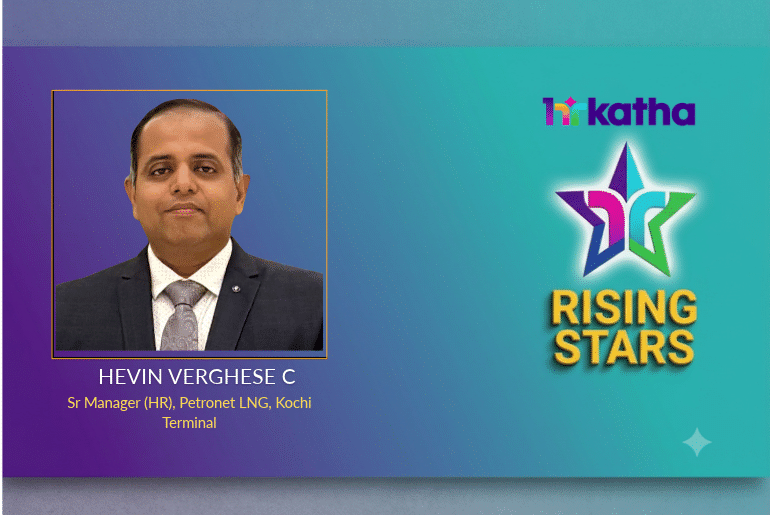
Finalist, Young HR Turk | Second Runner-Up, Happiness Ambassador | HRKatha Rising Star Leadership Awards 2025
Every HR initiative Hevin Verghese supports must answer three questions: What problem are we solving? What are we doing differently? How will we know it worked?
The questions appear straightforward, but they reflect a distinction Verghese considers important. Introducing a programme is not the same as improving an outcome, and HR must be able to demonstrate the difference.
As senior manager, human resource at Petronet LNG’s Kochi Terminal, Verghese brings that approach to a function spanning employee engagement, learning and development, wellbeing, statutory compliance, contractor management and HR technology.
With around 18 years of HR experience, an MBA in HR and Marketing and an LL.B., he has worked across the operational and people dimensions of the function.
Verghese is a finalist in the Young HR Turk category and second runner-up in the Happiness Ambassador category of the HRKatha Rising Star Leadership Awards 2025.
Measuring what HR changes
For Verghese, measurement is not something added after an HR initiative has been implemented. It should influence how the initiative is designed in the first place.
He looks at several levels of evidence: participation, process effectiveness, employee outcomes and, ultimately, business outcomes.
At Petronet LNG, the PLL Swasthya initiative brings together health talks, preventive healthcare, medical programmes and awareness sessions. Learning and development is similarly supported by defined training requirements, including a minimum of five training man-days for employees.
But Verghese is conscious that conducting programmes and achieving participation targets are only the beginning.
The more difficult question is whether these activities contribute to a healthier, more capable and more engaged workforce.
He points to a notable change in one broader people indicator. Employee attrition declined from 4.62 per cent in FY 2022-23 to 0.82 per cent in FY 2025-26.
Verghese does not attribute that reduction to any single HR programme. Attrition is influenced by several factors, many of which extend beyond the people function.
For him, the figures are useful because they allow HR to examine whether its broader approach is moving in the intended direction.
The distinction matters. A favourable outcome does not automatically establish what caused it, but without measuring outcomes, HR has even less basis for judging whether its interventions are useful.
People, purpose and performance
Working in a technically intensive organisation has shaped Verghese’s understanding of what HR needs to contribute.
He summarises his philosophy through three ideas: people, purpose and performance.
People should feel respected, supported and heard. HR initiatives should address identifiable organisational needs. And the function’s contribution should ultimately be visible in how the organisation performs.
The challenge lies in connecting the three rather than treating them as separate priorities.
Verghese believes HR professionals need to understand the business as thoroughly as they understand employee expectations. That means developing familiarity with operations, productivity, costs, risks, technology and organisational objectives.
His perspective has also been shaped by the variety of people he has worked with, including contract workmen, managers, senior leaders, external partners and training institutions.
Despite their different responsibilities, he has found a common expectation: HR should be accessible, fair, responsive and capable of understanding the realities of the business.
For Verghese, that is how the function moves beyond responding to requests and begins anticipating what the organisation needs.
Leadership begins with ownership
Verghese does not associate leadership exclusively with seniority.
“Leadership does not begin with a designation. It begins with ownership,” he says.
For younger HR professionals, he believes credibility develops through relatively ordinary behaviours: taking responsibility, listening carefully, being dependable and following through when problems arise.
These habits become particularly important in a function where formal authority is often limited.
An HR professional may identify a people problem without having direct control over the business decisions needed to resolve it. Influence then depends on the quality of the recommendation, the ability to understand competing priorities and the trust established over time.
Verghese encourages professionals to develop a people perspective and a business perspective together.
The first helps them understand employee concerns and aspirations. The second allows them to recognise the operational consequences of different decisions.
Neither is sufficient on its own.
Inclusion beyond policies
Verghese believes inclusion has to be experienced rather than merely stated in organisational policy.
At Petronet LNG, employee engagement takes several forms, including wellbeing programmes, learning opportunities, family engagement, recognition, health initiatives and knowledge-sharing activities.
These provide opportunities for employees to participate and connect with the organisation.
But participation alone cannot establish whether people feel included.
For Verghese, HR must continue listening, identifying gaps and examining whether initiatives are reaching employees in ways that matter to them.
That requires looking beyond the number of programmes conducted to questions of accessibility, fairness and employee experience.
His approach is informed by a principle he often returns to: “People may forget what you said, but they will remember how you made them feel.”
HR encounters employees at consequential moments, from joining and learning to receiving recognition, facing difficulties or managing personal circumstances.
Even when the function cannot provide the answer someone wants, Verghese believes the individual should feel that the concern was heard and handled fairly.
Empathy, however, does not mean agreeing to every request. It means making decisions that can be explained honestly and applied consistently.
Connecting the employee journey
Verghese’s longer-term interest is in bringing together the different systems that shape an employee’s experience.
Recruitment, learning, performance, career development, wellbeing and recognition are often managed through separate processes, even though employees experience them as parts of one working life.
He envisages an integrated employee-experience and wellbeing ecosystem that connects these activities more closely.
HR technology, employee feedback and learning analytics could help identify changing needs across career stages, while AI could assist in recognising patterns and suggesting relevant development opportunities.
The objective would not simply be another technology platform. It would be to make the organisation more responsive to employees as their circumstances and capabilities evolve.
Verghese nevertheless believes such systems require clear boundaries.
Sensitive employee information, questions of privacy and the risk of biased recommendations cannot be treated as secondary considerations.
For him, AI should support better-informed decisions, not remove human responsibility for making them.
That is why he sees business acumen and digital and data literacy as increasingly important HR capabilities. Professionals need not become technology specialists, but they must understand enough to evaluate the tools they use and recognise their limitations.
His own test for any new idea remains practical: can it solve a real problem in the organisation?
Quick Takes
One word colleagues would use for his leadership style: Approachable.
An HR superpower for a day: Empathy, particularly the ability to understand what employees may be experiencing even when they struggle to express it.
A surprising skill that makes him better at HR: Event management. Coordinating people, timelines, vendors, communication and unexpected changes has taught him to remain calm and keep things moving.
Coffee chat or boardroom debate: Coffee chat. Some of the most useful HR insights emerge from informal conversations.
If an employee walks in upset about a salary slip: Listen first, verify the details and then explain. If there is an error, ensure it is corrected. The priority is to establish the facts rather than immediately defend the system.
Why he is a Rising Star
Verghese brings a useful discipline to HR: every initiative should be judged by what it changes, not merely by whether it was implemented. His three questions and his attention to outcomes reflect that approach, while his refusal to attribute falling attrition to a single programme shows an understanding of measurement’s limits. Equally important is his insistence that employees should feel heard and treated fairly, even when decisions are difficult. He combines accountability for results with attentiveness to employee experience.
Rising Stars is HRKatha’s editorial series profiling the next generation of HR leaders shaping the future of the profession. The series also features winners and finalists of the HRKatha Rising Star Leadership Awards alongside emerging professionals whose work, ideas and leadership potential deserve wider recognition.
