


Close Menu
    Facebook X (Twitter) Instagram
    • Our Story
    • Partner with us
    • Reach Us
    • Career
    Subscribe Newsletter
    HR KathaHR Katha
    • Exclusive
      • Exclusive Features
      • Perspectives
      • Friday Features
      • herSTORY
      • Rising Stars
      • Case-In-Point
      • Point Of View
      • Research
      • HR Pops
      • Dialogue
      • Movement
      • Profile
      • Beyond Work
      • By Invitation
    • News
      • Global HR News
      • Compensation & Benefits
      • Diversity
      • Events
      • Gen Y
      • Hiring & Firing
      • HR & Labour Laws
      • Learning & Development
      • Merger & Acquisition
      • Performance Management & Productivity
      • Talent Management
      • Tools & Technology
      • Work-Life Balance
    • Special
      • HR Forecast 2026
      • Cover Story
      • Editorial
      • HR Forecast 2024
      • HR Forecast 2023
      • HR Forecast 2022
      • HR Forecast 2021
      • HR Forecast 2020
      • HR Forecast 2019
      • New Age Learning
      • Coaching and Training
      • Learn-Engage-Transform
    • Magazine
    • Reports
      • Whitepaper
        • HR Forecast 2024 e-mag
        • Future-proofing Manufacturing Through Digital Transformation
        • Employee Healthcare & Wellness Benefits: A Guide for Indian MSMEs
        • Build a Future Ready Organisation For The Road Ahead
        • Employee Experience Strategy
        • HRKatha 2019 Forecast
        • Decoding and Driving Employee Engagement
        • One Platform, Infinite Possibilities
      • Survey Reports
        • Happiness at Work
        • Upskilling for Jobs of the Future
        • The Labour Code 2020
    • Conferences
      • Leadership Summit 2025
      • Rising Star Leadership Awards
      • HRKatha Futurecast
      • Automation.NXT
      • The Great HR Debate
    WhatsApp LinkedIn X (Twitter) Facebook Instagram
    HR KathaHR Katha
    Home»Exclusive Features»HR Pops»The Pike Effect: The invisible barrier in organisations
    HR Pops

    The Pike Effect: The invisible barrier in organisations

    Why past failures can quietly stop employees from trying again
    mmBy Liji Narayan | HRKathaMarch 17, 2026Updated:March 17, 20264 Mins Read38943 Views
    Share LinkedIn Twitter Facebook WhatsApp
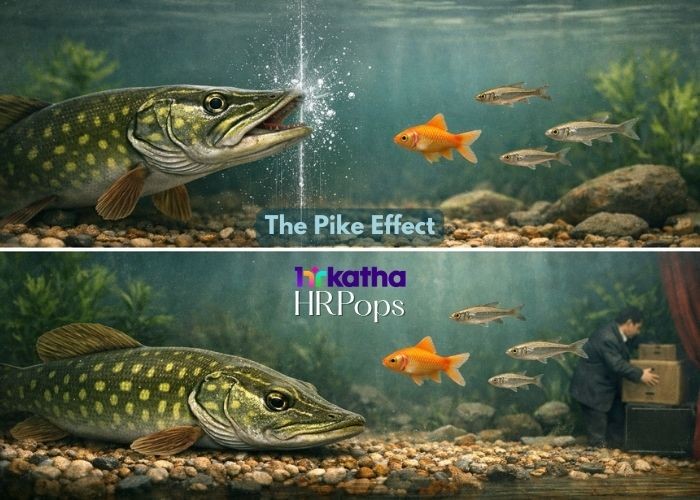
    *Image generated by AI
    Share
    LinkedIn Twitter Facebook WhatsApp

    What is the Pike Effect?

    The Pike Effect describes a psychological pattern in which repeated failure discourages individuals from trying again—even when circumstances improve.

    In organisational settings, it helps explain why capable employees sometimes stop applying for promotions, sharing ideas, or volunteering for challenging assignments. After repeated setbacks, people may come to believe that success is impossible, even when opportunities exist.

    In simple terms, the Pike Effect is a metaphor for learned helplessness in the workplace.

    Where did the idea come from?

    The concept draws its name from a well-known behavioural experiment involving a predatory fish known as a pike.

    In the experiment, the pike was placed in a tank with smaller fish separated by a transparent barrier. The predator repeatedly attempted to catch its prey but failed each time because of the invisible obstruction. After several unsuccessful attempts, the fish eventually stopped trying.

    When the barrier was later removed, the pike still did not attack the prey. It had learned that attempting to do so was futile.

    The story illustrates the broader psychological phenomenon known as learned helplessness, first identified by psychologist Martin Seligman in the late 1960s. His research showed that individuals exposed to repeated failure or lack of control may stop trying to change their situation—even when change becomes possible.

    Over time, the pike metaphor has been used in management and organisational psychology to explain similar behaviour in workplaces.

    Why is it relevant for HR?

    In modern organisations, the Pike Effect often appears when employees experience repeated disappointment, bias, or lack of recognition. Over time, they may withdraw from opportunities that could advance their careers.

    Several HR challenges reflect this pattern.

    Career progression – Employees who repeatedly miss promotions may eventually stop applying, assuming the outcome will not change—even if they later become qualified.

    Performance and engagement – Workers whose ideas are ignored or criticised may stop contributing, reducing innovation and collaboration.

    Diversity and inclusion – Members of underrepresented groups may withdraw from leadership opportunities if they repeatedly encounter bias or limited representation at senior levels.

    Change management – Employees who have witnessed multiple failed initiatives may resist new programmes, assuming they will fail like the previous ones.

    In each case, the barrier is not always structural. It is psychological.

    The invisible barrier problem

    The Pike Effect persists because organisations often remove formal barriers whilst leaving invisible ones intact.

    A company may announce that it supports diversity, and yet, if leadership remains homogeneous and promotion decisions appear opaque, employees may still believe advancement is unlikely.

    Similarly, organisations frequently claim to encourage innovation. However, if employees who previously challenged ideas were ignored or penalised, they may remain silent even when leadership asks for fresh thinking.

    In these cases, the barrier may be gone on paper. But in employees’ minds, it remains firmly in place.

    This also explains why superficial interventions rarely work. A single training session or policy announcement cannot undo years of discouraging experiences. Employees need consistent and visible proof that the rules have genuinely changed.

    What HR should do

    For HR leaders, the Pike Effect is a reminder that behaviour is shaped as much by history as by policy.

    Breaking the cycle requires more than removing formal barriers. It requires rebuilding trust. HR can play a key role by ensuring transparent promotion and evaluation systems, recognising contributions consistently and visibly, encouraging experimentation without punishing failure, creating mentorship and sponsorship programmes for underrepresented groups, and holding leaders accountable for inclusive decision-making.

    Most importantly, organisations must demonstrate change through action—by promoting overlooked talent, implementing employee ideas, and rewarding those who take initiative.

    The takeaway

    The Pike Effect highlights a simple but powerful truth: people’s behaviour is shaped by their past experiences.

    If employees have repeatedly encountered invisible barriers, they may stop trying long after those barriers disappear.

    For HR, the challenge is therefore not only to remove obstacles but also to convince employees that the tank is finally open.

    a metaphor behaviour in workplaces bias career progression change management Diversity and Inclusion Employee employer formal barriers HR HR Pop HR Pops HR should remove obstacles Human Resources invisible barrier invisible barrier in organisations lack of recognition LEAD learned helplessness Martin Seligman Pike Effect psychological pattern psychological phenomenon rebuilding trust repeated disappointment repeated failure smaller fish superficial interventions Workforce
    Share. LinkedIn Twitter Facebook WhatsApp
    mm
    Liji Narayan | HRKatha

    HRKatha prides itself in being a good journalistic product and Liji deserves all the credit for it. Thanks to her, our readers get clean copies to read every morning while our writers are kept on their toes.

    Leave A Reply Cancel Reply

    Related Posts

    Richa Malik joins Hero MotoCorp as head HR – corporate & enabling functions

    September 4, 2026

    Amazon India creates over 1.6 lakh seasonal work opportunities ahead of festive season

    September 4, 2026

    Volkswagen plans another 50,000 job cuts globally

    September 4, 2026

    Nearly 1 in 4 CHROs expect AI to cut workforce by up to 20%: Study

    September 4, 2026
    zoha
    Editorial

    Employees are redesigning work before their companies do

    Nobody announced that work would change this way. There was no strategy document, pilot programme…

    “My door is always open” is an expensive sentence in leadership

    Walk into almost any organisation and you will hear some version of it. In town…

    EDITOR'S PICKS

    The career lessons hiding in unfamiliar territory

    September 4, 2026

    Case-in-Point: The pregnancy disclosure dilemma

    September 3, 2026

    herSTORY: Sejal Haribhakti Mody, CHRO, Akasa Air

    September 3, 2026

    59% of employees are financially stressed. Most HR dashboards cannot see it

    September 2, 2026
    Latest Post

    Dhananjay Singh, DG, NHRDN, moves on; Nidhi Vashishtha appointed executive director, NHRDN

    Movement September 4, 2026

    The National HRD Network (NHRDN) has announced that Dhananjay Singh, director general, NHRDN has moved…

    Richa Malik joins Hero MotoCorp as head HR – corporate & enabling functions

    Movement September 4, 2026

    Hero MotoCorp has announced the appointment of Richa Malik as head HR – corporate &…

    Amazon India creates over 1.6 lakh seasonal work opportunities ahead of festive season

    News September 4, 2026

    Amazon India has created more than 1.6 lakh seasonal work opportunities across its operations network…

    Volkswagen plans another 50,000 job cuts globally

    News September 4, 2026

    Volkswagen Group is planning to eliminate another 50,000 jobs globally as part of a major…

    Asia's No.1 HR Platform

    Facebook X (Twitter) Instagram LinkedIn WhatsApp Bluesky
    • Our Story
    • Partner with us
    • Career
    • Reach Us
    • Exclusive Features
    • Cover Story
    • Editorial
    • Dive into the Future of Work: Download HRForecast 2024 Now!
    © 2026 HRKatha.com
    • Disclaimer
    • Refunds & Cancellation Policy
    • Terms of Service

    Type above and press Enter to search. Press Esc to cancel.