

Close Menu
    Facebook X (Twitter) Instagram
    • Our Story
    • Partner with us
    • Reach Us
    • Career
    Subscribe Newsletter
    HR KathaHR Katha
    • Exclusive
      • Exclusive Features
      • Perspectives
      • Friday Features
      • herSTORY
      • Case-In-Point
      • Point Of View
      • Research
      • HR Pops
      • Dialogue
      • Movement
      • Profile
      • Beyond Work
      • Rising Star
      • By Invitation
    • News
      • Global HR News
      • Compensation & Benefits
      • Diversity
      • Events
      • Gen Y
      • Hiring & Firing
      • HR & Labour Laws
      • Learning & Development
      • Merger & Acquisition
      • Performance Management & Productivity
      • Talent Management
      • Tools & Technology
      • Work-Life Balance
    • Special
      • HR Forecast 2026
      • Cover Story
      • Editorial
      • HR Forecast 2024
      • HR Forecast 2023
      • HR Forecast 2022
      • HR Forecast 2021
      • HR Forecast 2020
      • HR Forecast 2019
      • New Age Learning
      • Coaching and Training
      • Learn-Engage-Transform
    • Magazine
    • Reports
      • Whitepaper
        • HR Forecast 2024 e-mag
        • Future-proofing Manufacturing Through Digital Transformation
        • Employee Healthcare & Wellness Benefits: A Guide for Indian MSMEs
        • Build a Future Ready Organisation For The Road Ahead
        • Employee Experience Strategy
        • HRKatha 2019 Forecast
        • Decoding and Driving Employee Engagement
        • One Platform, Infinite Possibilities
      • Survey Reports
        • Happiness at Work
        • Upskilling for Jobs of the Future
        • The Labour Code 2020
    • Conferences
      • Leadership Summit 2025
      • Rising Star Leadership Awards
      • HRKatha Futurecast
      • Automation.NXT
      • The Great HR Debate
    • HR Jobs
    WhatsApp LinkedIn X (Twitter) Facebook Instagram
    HR KathaHR Katha
    Home»Exclusive Features»Research»Increments to stay stable at 10.3%
    Research

    Increments to stay stable at 10.3%

    mmBy Dr. Prajjal Saha | HRKathaFebruary 18, 20164 Mins Read3264 Views
    Share LinkedIn Twitter Facebook WhatsApp
    Share
    LinkedIn Twitter Facebook WhatsApp

    Startups and companies in their early stages will continue to provide maximum increments in order to retain and attract talent. 

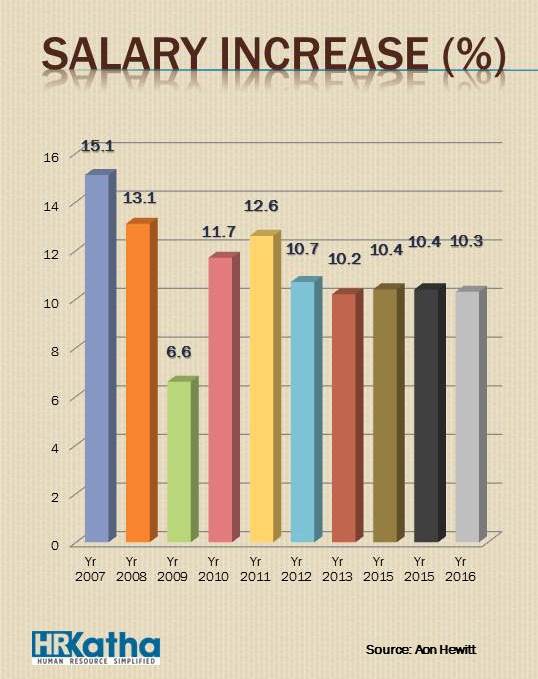
    Salary increase in India Inc. will stay put above 10 per cent in 2016 too, as predicted by Aon Hewitt in its latest survey. This trend has been consistent since 2010.

    In 2010 and 2011, the salary increase was around 11.7 per cent and 12.6 per cent, respectively. However, since then the increments have been hovering around plus 10 per cent. In 2016, the projected salary increase is 10.6 per cent. The plateauing of ‘double digit’ salary increases in India is a sign of market maturity and a cautious approach to stay competitive in the APAC region.

    Anandorup Ghose, partner, Aon Hewitt India, says, “At an average pay increase budget of 10.3 per cent across India, HR managers will be pushed to ensure more innovativeness and thoughtfulness in the way their top performers are rewarded and retained. At the same time, they will have to ensure that the rest of the organisation stays motivated as well.”

    Salary increases in India are the highest in the Asia Pacific region —ahead of China, Philippines, Malaysia, Singapore, Hong Kong, Australia and Japan. Companies in India are still willing to afford the largest pay increases across Asia and most of the world, in spite of reduced inflation numbers.

    Startups and companies in early stages, will continue to provide maximum increments in order to retain and attract talent. The salary increase in this sector is projected to be around 15.6 per cent.

    The other promising sectors are life sciences, media, hi-tech, consumer products, automotive, retail and chemicals. In each of these sectors, the salary increase will be higher than the market average.

    In the ITES, engineering manufacturing and engineering services, the increments will be at par with the national average. For other sectors, it will be below the median with the lowest being in the financial institutions sector. However, even the lowest increase in India at 8.8 per cent is higher than China’s average of 6.9 per cent — the second highest market for salary increase in the Asia Pacific region, after India.

    What seems to be a positive trend is that the manufacturing–services divide is narrowing with each passing year. Not only are the budgets closer, the bell curve and the ‘pay for performance’ divide is also getting narrower.

    In terms of the level of employees, the highest increase will be in the clerical and junior management grades, and this holds true for both the manufacturing as well as services sectors.

    Top and senior managements have been consistently below the India average. Organisations today use various ‘pay at risk tools’ at these levels in lieu of high fixed increases.

    The attrition rate in India is dropping. At 16.3 per cent attrition, it is the lowest that corporate India has observed since the 2009 financial crisis. The overall attrition in the services sector is 19.3 per cent, out of which 5.4 per cent is involuntary, which means these were people who were asked to leave.

    In the manufacturing sector, the attrition  was comparatively low, at 12. 2 per cent and the contribution of involuntary increment was 3.4 per cent. The attrition level will be highest in the hotel, retail and life sciences industry at 26.4 per cent, 22.6 per cent, and at 19.1 per cent, respectively. The lowest attrition will be in the metals, automobiles and transport sectors at 5.8, 9 and 10 per cent, respectively.

    While attrition was controlled at a broader level, key talent attrition increased from 5.9 per cent in 2014 to 7.3 per cent in 2015. Increasingly, organisations are developing separate retention plans and policies for their top talent.

    Rewards continue as a retention tool to ring-fence top talent, programmes around leadership opportunities and coaching, overseas assignments and fast-track programmes for hi–potentials are gaining prominence.

    The key reasons for attrition continue to be disparity in pay, — both external as well as internal— limited growth opportunities, higher education and role stagnation.

    The study has analysed data across 700 companies.

    Aon Hewitt Increment Salary Hike Salary hike in 2016
    Share. LinkedIn Twitter Facebook WhatsApp
    mm
    Dr. Prajjal Saha | HRKatha

    Dr. Prajjal Saha is a business journalist and the editor-publisher of HRKatha. He writes on the realities of work and organisations, offering a clear-eyed view of how companies translate intent into action—often revealing the gap between the two. With over 25 years of experience, he focuses on interpreting workplace trends and leadership decisions in a way that is both insightful and accessible. He founded HRKatha in 2015 to create a platform for credible, insight-driven analysis of the evolving workplace.

    Leave A Reply Cancel Reply

    Related Posts

    Cybersecurity doesn’t have a hiring problem. It has a capability problem!

    July 1, 2026

    Global talent mobility in retreat: AI is the exception

    June 24, 2026

    757 candidates compete for every VP HR role. HR Technologists face just five rivals.

    June 17, 2026

    Accenture splits salary hikes into base pay and one-time bonus

    June 12, 2026
    Editorial

    Every IPO tells two stories

    Someone I know spent eight and a half years building the research function at a…

    The two cultures inside the same multinational

    Someone I know works with one of the world’s largest technology and consulting firms. Based…

    EDITOR'S PICKS

    HRForecast 2026: HR will become the architect of business sustainability, says Shailesh Singh, ex – CPO, Axis Max Life Insurance

    July 3, 2026

    The leadership upgrade that begins with unlearning

    July 3, 2026

    Case-in-Point: When managers game the system to protect their teams

    July 2, 2026

    herSTORY: Niyathi Madasu, CHRO, Premier Energies

    July 2, 2026
    Latest Post

    TeXim.in onboards Abhishek Shrivastava as director & chief strategy & people officer

    Movement July 3, 2026

    Trade-automation platform TeXim.in has appointed Abhishek Shrivastava as its new director and chief strategy and…

    EPF wage ceiling remains below Centre’s minimum salary under new EPF Scheme 2026

    News July 3, 2026

    The notification of the Employees’ Provident Fund (EPF) Scheme, 2026 has once again highlighted the…

    Nike cuts employee bonus payouts as turnaround efforts continue

    News July 3, 2026

    Nike employees across global operations will receive lower-than-target annual bonus payouts after the sportswear giant…

    Tesla introduces weekly AI spending cap for employees to control rising costs

    News July 3, 2026

    Tesla has introduced a weekly cap on employee spending for artificial intelligence (AI) tools, marking…

    Asia's No.1 HR Platform

    Facebook X (Twitter) Instagram LinkedIn WhatsApp Bluesky
    • Our Story
    • Partner with us
    • Career
    • Reach Us
    • Exclusive Features
    • Cover Story
    • Editorial
    • Dive into the Future of Work: Download HRForecast 2024 Now!
    © 2026 HRKatha.com
    • Disclaimer
    • Refunds & Cancellation Policy
    • Terms of Service

    Type above and press Enter to search. Press Esc to cancel.