



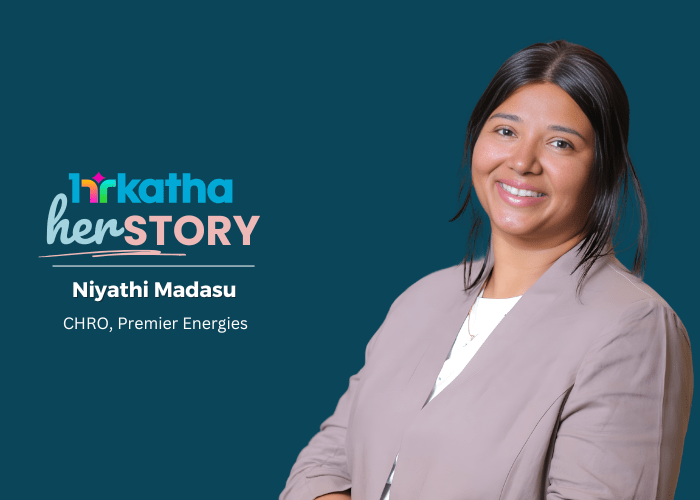
Pursuing a sense of purpose
Niyathi Madasu did not enter HR because she was drawn to policies or processes. She was fascinated by people, behaviour and the way organisations functioned.
An early influence was a professor who helped her see HR as far more than an administrative function. It was where business strategy and human behaviour intersected.

Although she was initially more interested in organisational psychology, her curiosity about workplace dynamics, leadership and culture gradually drew her towards HR. Before long, what had begun as an academic interest evolved into a genuine sense of purpose.
Today, as chief human resources officer at Premier Energies, Madasu continues to be guided by that belief: HR sits closest to the questions that matter most in any organisation.
Leading with cultural intelligence
Working across geographies exposed Madasu to different leadership cultures and expectations.
One challenge that surprised her was how leadership presence for women was often judged through perception rather than capability. In some settings, she found that assertiveness was more readily misinterpreted when it came from women leaders, particularly in HR, a function that is still often perceived as “soft”.
Rather than changing who she was, she chose to adapt how she communicated. That decision, without compromising her conviction, strengthened her ability to lead with greater cultural intelligence.
The experience strengthened her ability to lead with greater cultural intelligence, balancing empathy with clarity while continuing to deliver business outcomes.
Pull quote: Adapt your communication, never your conviction.
Empathy with objectivity
Leadership often requires decisions that may not be immediately popular.
“I believe respect built on fairness, consistency and transparency has far greater long-term value than being universally liked,” she observes. Over time, she has learnt that this kind of respect lasts far longer than approval gained by avoiding difficult conversations.
That belief shapes her leadership style. She strives to remain empathetic without losing objectivity because, while people may disagree with a decision, they should never question the integrity behind it.
Lessons from India and abroad
Psychological safety is one value Madasu refuses to compromise on.
For her, people perform at their best only when they feel respected, heard and trusted enough to speak openly.
Working in India as well as overseas has reinforced that while cultures may differ, the fundamentals of trust, dignity and accountability remain universal.
“India offers incredible agility, resilience and energy, while global workplaces often bring stronger systems and process maturity,” she says.
Experiencing both environments has broadened her perspective and shaped her leadership in complementary ways.
Pull quote: India brings agility and energy. Global workplaces bring systems and maturity.
HR as a transformation partner
Madasu believes HR has moved well beyond being a support function.
Its role today is to help organisations transform by building future-ready capabilities, strengthening leadership, accelerating digital adoption and creating employee experiences that enable business growth.
At Premier Energies, that means constantly rethinking how work gets done through data-driven, employee-centric practices that prepare the organisation for future challenges.
Stepping outside the comfort zone
The biggest professional risk Madasu took was moving from learning and development (L&D) into high-intensity HR operations.
While L&D aligned naturally with her strengths, operations, on the other hand, demanded a very different capability: speed, execution and operational rigour.
The move stretched her in ways she had not anticipated.
It also gave her a far deeper understanding of how different parts of HR connect, strengthening both her credibility and her strategic perspective.
Looking back, she believes that experience was instrumental in preparing her for the broader responsibilities of a CHRO.
Thinking from the head, leading from the heart
Among the leaders who influenced Madasu the most was a former manager whose approach continues to shape her own leadership philosophy.
She taught Madasu to think from the head while leading from the heart, combining business discipline with empathy.
Perhaps more importantly, she challenged the stereotype that HR is a soft function.
Through her example, Madasu saw that great HR leadership often means making difficult decisions, influencing business strategy, shaping culture and holding organisations together through periods of both growth and uncertainty.
Those lessons continue to guide her today.
Quick fire round
Best investment you’ve made in yourself?
Continuously challenging my comfort zone and building depth across different areas of HR rather than staying in one lane.
One skill you’re currently working on developing?
Translating people data and organisational insights into clear, compelling narratives that influence senior leadership decisions.
Your definition of success today versus 10 years ago?
Ten years ago, success was about achievement, progression and climbing the corporate ladder. Today, it’s about impact, balance and building something meaningful.
Your mantra for difficult days?
Breathe and respond, don’t react.
If not HR, what career path would you have pursued?
Probably psychology, organisational consulting or teaching. Definitely something centred around understanding and developing people.