


Close Menu
    Facebook X (Twitter) Instagram
    • Our Story
    • Partner with us
    • Reach Us
    • Career
    Subscribe Newsletter
    HR KathaHR Katha
    • Exclusive
      • Exclusive Features
      • HR Pops
      • herSTORY
      • Perspectives
      • Point Of View
      • Case-In-Point
      • Research
      • Dialogue
      • Movement
      • Profile
      • Beyond Work
      • Rising Star
      • By Invitation
    • News
      • Global HR News
      • Compensation & Benefits
      • Diversity
      • Events
      • Gen Y
      • Hiring & Firing
      • HR & Labour Laws
      • Learning & Development
      • Merger & Acquisition
      • Performance Management & Productivity
      • Talent Management
      • Tools & Technology
      • Work-Life Balance
    • Special
      • Cover Story
      • Editorial
      • HR Forecast 2024
      • HR Forecast 2023
      • HR Forecast 2022
      • HR Forecast 2021
      • HR Forecast 2020
      • HR Forecast 2019
      • New Age Learning
      • Coaching and Training
      • Learn-Engage-Transform
    • Magazine
    • Reports
      • Whitepaper
        • HR Forecast 2024 e-mag
        • Future-proofing Manufacturing Through Digital Transformation
        • Employee Healthcare & Wellness Benefits: A Guide for Indian MSMEs
        • Build a Future Ready Organisation For The Road Ahead
        • Employee Experience Strategy
        • HRKatha 2019 Forecast
        • Decoding and Driving Employee Engagement
        • One Platform, Infinite Possibilities
      • Survey Reports
        • Happiness at Work
        • Upskilling for Jobs of the Future
        • The Labour Code 2020
    • Conferences
      • Leadership Summit 2025
      • Rising Star Leadership Awards
      • HRKatha Futurecast
      • Automation.NXT
      • The Great HR Debate
    • HR Jobs
    WhatsApp LinkedIn X (Twitter) Facebook Instagram
    HR KathaHR Katha
    Home»Exclusive Features»Research»The confident Indian workforce will demand better pay & roles
    Research

    The confident Indian workforce will demand better pay & roles

    mmBy Prajjal Saha | HRKathaJune 11, 20155 Mins Read2010 Views
    Share LinkedIn Twitter Facebook
    Share
    LinkedIn Twitter Facebook

    This optimism implies that organisations will have to give in to the bargain or alter their policies, to retain and attract talent.

    The mood in the Indian job market seems to be truly upbeat. Given the improving market conditions, employees and jobseekers have emerged to be a more confident lot. They are seeking better packages and roles.

    This means, organisations will find it challenging to not only retain but also attract talent in the future. They may have to just give in to the bargain or bring in a radical change in their retention and talent acquisition policies.

    An independent survey by Michael Page, a global recruitment specialist, reveals that around 82 per cent of the respondents intend to look for new jobs in the next 12 months and around 75 per cent of respondents are expecting a raise in their current job.

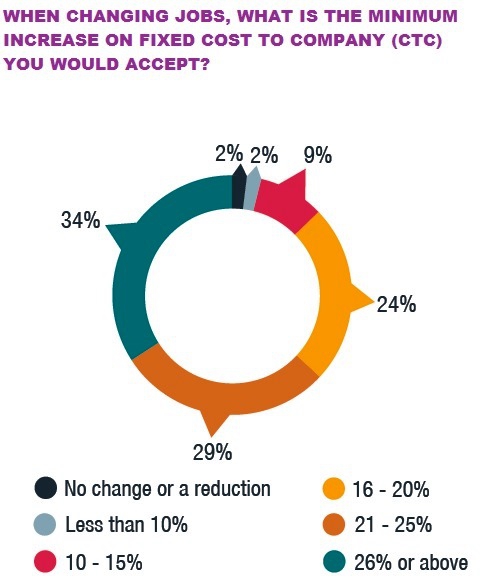
    Among those looking for new jobs, around 63 per cent expect a raise of more than 21 per cent in their new jobs. And more than one-third of the respondents expect a raise of 26 per cent and above.

    Among jobseekers, the men seem to be more financially motivated than the women. Around 35 per cent of the male respondents want more than 26 per cent raise while 45 per cent of the women want a raise of 21–25 per cent.

    However, higher salary is not the main reason for seeking a new job. While men and women seem to agree on most factors for changing jobs, they differ on two points. For instance, workplace flexibility is high on priority for women, but for men, better title and promotion is a key parameter.

    For 65 per cent men and 64 per cent women, the primary reason for shifting jobs is career progression, followed by the quest for better packages. Around 57 per cent men and 48 per cent women sight this as a key influencer.

    The third most important factor is the brand and reputation of the company and 52 per cent men and 46 per cent women voted for this. This is followed by learning and development.

    International opportunities are also very important for employees in India, with 76 per cent indicating they would consider looking for overseas career opportunities in the next 12 months. The primary reason for this outlook is to broaden experience and learn from international organisations. 

    For those who wish to stay back in India, the good market conditions, positive outlook and solid retention strategies are the key motivators.

    In the quest for a new job, Indians are most likely to use recruitment consultants followed by their professional network. This is followed by job boards and social media. Traditional channels, such as local newspapers, are of low interest for jobseekers.

    When it comes to using the online platform for searching new jobs, LinkedIn is the most preferred destination, followed by Naukri and IIM Jobs.

    Though career progression is the major influencer for shifting jobs, financial rewards emerged as the most popular motivating factor for staying in the same job. This was followed by leadership and a motivating manager, company culture, overseas career opportunities and additional career development supported by training, in that order.

    Employees no longer wish to remain at the mercy of their bosses and the survey reveals that they are going to be very demanding. Around 75 per cent of the employees indicate that they are likely to ask for higher remuneration and 70 per cent of employees plan to ask for a promotion in the next 12 months.

    However, fewer employees feel that their demand will be fulfilled. Only 46 per cent of employees expect to receive a promotion.

    What is most interesting is that, satisfaction in the current job does not ensure retention in the current employee set. Although 50 per cent of respondents have received a promotion in the past two years, around 73 per cent of respondents still attended an interview in the past 12 months, and 82 per cent of respondents believe they are likely to change roles within the next 12 months.

    The changing market conditions have also put pressure on the employees.

    Working hours have increased for 42 per cent of employees in the past 12 months, due to business growth. Staff attrition and promotions are the other reasons for extended work hours. Out of these, 13 per cent of the total respondents are now working an extra 10 hours or more, a week.

    This is most prevalent among finance and sales & marketing professionals, where 46 per cent and 45 per cent of employees claim an increase in work hours, respectively. Among HR professionals, work hours have increased only for 31 per cent of the respondents and for employees in the financial services sector, the same has increased only for 34 per cent.

    In terms of mood, employees from the financial services sector portrayed the highest confidence level with 75 per cent of the respondents opining that the job market will improve. For HR executives, the count was 72 per cent, while, for finance, accounting, sales and marketing professionals, the figure was 65 and 64 per cent, respectively.

    The 2015–2016 Michael Page India Employee Intentions Report is based on the online survey responses of more than 300 employees in India, and is supported by insight gleaned from conversations with thousands of professionals. Survey participants represent a broad range of professional occupation groups and hold positions ranging from entry level to senior management.

    Share. LinkedIn Twitter Facebook
    mm
    Prajjal Saha | HRKatha

    Dr. Prajjal Saha, editor and publisher of HRKatha since 2015, leverages over 25 years of experience in business journalism, writing, and editing. He founded HRKatha to provide insightful analysis on the evolving workplace. With expertise spanning HR, marketing, distribution, and technology, Saha has a deep understanding of business dynamics. His authorship of the acclaimed Marketing White Book highlights his versatility beyond HR. A trusted voice across industries, his clear and thoughtful commentary has earned him a reputation for thought leadership, making him a reliable source of knowledge and insights for professionals navigating the complexities of the business world.

    1 Comment

    1. Vinod Bidwaik on June 15, 2015 6:03 am

      Very well explained.

      Reply
    Leave A Reply Cancel Reply

    Related Posts

    India’s Succession Paradox: Plans Double in Success, Yet 91% Ignore AI

    December 10, 2025

    The 85% invisibility: Why India’s neurodiverse talent stays hidden

    December 3, 2025

    India’s Employability Paradox: Women surge ahead as polytechnics collapse

    November 26, 2025

    Only 8.9% average pay hike across India Inc. in 2026

    November 19, 2025

    EMPLOYEE FINANCIAL WELLNESS HUB

    Beyond the bonus: Why financial literacy matters more than pay rises

    A Rs 10,000 disappears with alarming speed in urban India: transport, meals, utilities, occasional entertainment.…

    The hidden cost of financial anxiety

    A young software engineer in Bengaluru earns Rs 12 lakhs annually—double what her parents made…

    EDITOR'S PICKS

    POV: Should AI be allowed to make final hiring decisions without human intervention?

    December 15, 2025

    India’s right to disconnect: The harsh reality behind the social media buzz

    December 14, 2025

    The “No” that saves HR Leaders their sanity

    December 12, 2025

    herSTORY: Padmaja Palekar, people experience global mobility manager-Asia, Unilever

    December 11, 2025
    Latest Post

    Employee alleges lack of empathy over period pain; Reddit post sparks debate

    News December 15, 2025

    A woman has alleged workplace insensitivity at a Mumbai-based mental health non-governmental organisation (NGO) after…

    Delhi govt restricts late office hours for women employees

    News December 15, 2025

    The Delhi government has issued fresh guidelines restricting late office hours for women employees, allowing…

    PIB debunks claim on DA, pay commission benefits for retired Central govt employees

    News December 15, 2025

    A viral WhatsApp message claiming that retired Central government employees would no longer be eligible…

    OpenAI removes equity vesting cliff for employees

    News December 15, 2025

    OpenAI has ended its policy requiring employees to complete a minimum tenure before their equity…

    Asia's No.1 HR Platform

    Facebook X (Twitter) Instagram LinkedIn WhatsApp Bluesky
    • Our Story
    • Partner with us
    • Career
    • Reach Us
    • Exclusive Features
    • Cover Story
    • Editorial
    • Dive into the Future of Work: Download HRForecast 2024 Now!
    © 2025 HRKatha.com
    • Disclaimer
    • Refunds & Cancellation Policy
    • Terms of Service

    Type above and press Enter to search. Press Esc to cancel.