



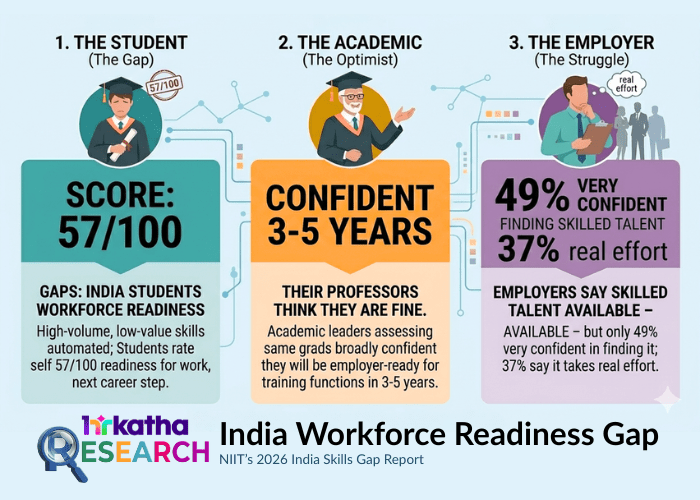
There is a number in NIIT’s 2026 India Skills Gap Report that should unsettle every vice-chancellor, HR director and policymaker in the country.
Students rate their own readiness for the next career step at 57 out of 100.

Academic leaders, assessing the same graduates, are broadly confident they will be employer-ready within three to five years.
Employers, meanwhile, say skilled talent is available – but only 49 per cent are very confident in finding it, and 37 per cent say it takes real effort.
Three groups. Three entirely different readings of the same reality. That is not a skills gap. It is a signalling failure – and it may be the more dangerous problem.
The same talent market. Three irreconcilable accounts of it.
Each part of the system is working. The system as a whole is not.
NIIT’s Skills in Demand Index, based on 3,500 respondents across students, professionals, recruiters and academic leaders, offers a rare multi-sided view of India’s talent ecosystem.
What it reveals is not a shortage of willingness to learn, nor a shortage of employer investment. What it reveals is that everyone in the system is optimising for a different definition of ready – and nobody has noticed.
The confidence ladder
The report’s most striking finding is structural. Readiness confidence rises almost perfectly with experience: senior professionals score 82 out of 100, mid-level managers 75, early-career workers 68, and students 57. The interpretation that flows naturally from this – that confidence simply accumulates with time – is almost certainly wrong.
What the data actually captures is an exposure gap. Confidence at work rises not with age but with encounter: with real tools, real deadlines, real consequences. Students are not less capable than their predecessors. They are less practised. The system that is meant to prepare them – formal education – is still largely oriented around curriculum outcomes rather than demonstrated capability in real roles.
Academic leaders appear not to have registered this. Some 51 per cent believe graduates will be employer-ready within three to five years. Only 35 per cent of students feel very optimistic about their own prospects over the same horizon. Nearly one in four students – 24 per cent – say they are simply unsure. When the people producing the output and the people receiving it disagree this sharply about its quality, the problem is not individual. It is institutional.
 The mid-career bottleneck
If students represent one pressure point in the talent system, mid-career professionals represent another – and arguably the more immediately costly one.
Professionals with six to fifteen years of experience are simultaneously the most sought-after and the hardest to replace. They account for 47 per cent of all recruitment activity yet are cited as the scarcest talent pool by 38 per cent of recruiters. Employers are responding by hiring earlier – 46 per cent now recruit a balanced mix of entry-level and experienced candidates, against 29 per cent who focus primarily on fresh graduates – but this is a displacement strategy rather than a solution. Hiring earlier moves the shortage forward without resolving it.
The constraint, as the report correctly identifies, is no longer hiring. It is capability progression. The question is how workers move from early competence to mid-career mastery – how judgement, domain depth and execution capability are built deliberately, not left to time.
When progression slows, delivery suffers first. This is the mechanism by which India’s skills challenge translates into an economic one.
The credential shift
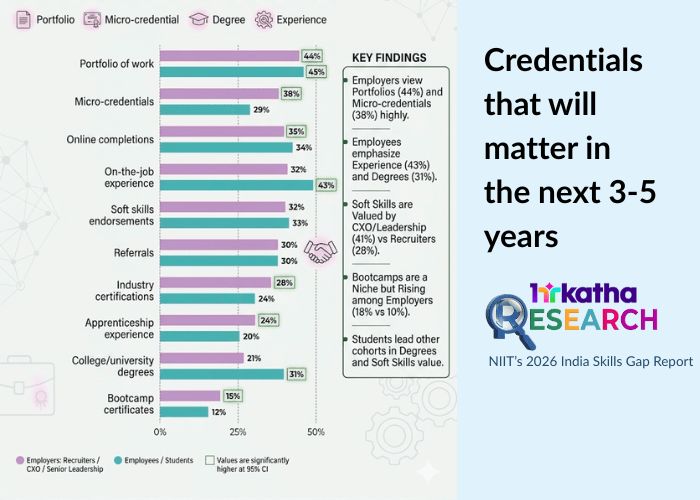
Perhaps the report’s most consequential finding for hiring managers is the accelerating divergence between what candidates consider proof of readiness and what employers actually trust.
A portfolio of demonstrated work ranks first among both groups – 45 per cent of employers and candidates place it in their top three credentials. But beyond this single point of alignment, the two sides diverge sharply. Candidates continue to favour on-the-job experience (43 per cent place it in their top three) and university degrees (31 per cent). Employers have moved on. Only 32 per cent value on-the-job experience and 21 per cent cite degrees. Instead, employers are increasingly drawn to micro-credentials (38 per cent), industry certifications (28 per cent), apprenticeship experience (24 per cent) and bootcamp qualifications (15 per cent).
This is not merely a generational preference shift. It reflects a structural change in how employability is evaluated: from credentials earned to capability proven. Employers are asking not what have you studied but what can you do. Candidates, particularly students, are still answering the wrong question. The gap between what signals readiness in the classroom and what signals it in the boardroom has rarely been wider.
 The access problem
The report’s most counterintuitive conclusion is also its most important. India does not face a motivation problem. Intent to upskill is high: 36 per cent of respondents are actively exploring learning options and 27 per cent are already enrolled. Time expectations are aligned – 47 per cent of learners are willing to spend two to five hours a week on upskilling, a figure matched almost precisely by employer expectations.
What is missing is reach.
Some 35 per cent to 40 per cent of respondents cite cost as the primary barrier to upskilling.
Around 25 per cent of students and early-career professionals report simply not knowing what programmes are available. The upskilling bottleneck in India is structural – a problem of affordability, discoverability and scalable delivery, particularly for first-generation learners and those outside the major metros.
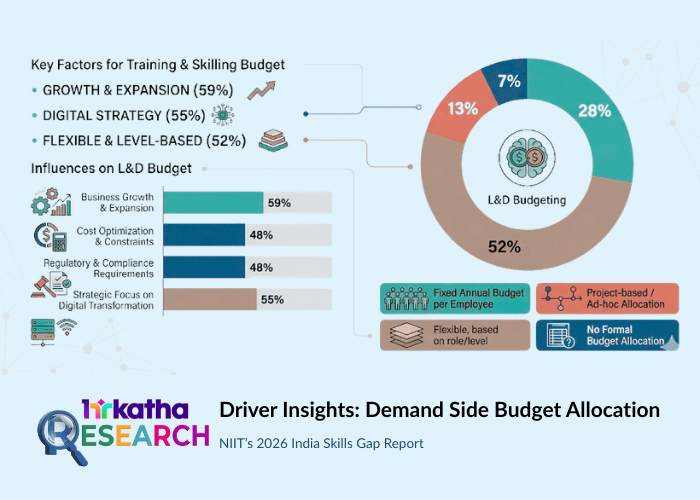
The spending data makes this more troubling, not less. Some 69 per cent of organisations increased their learning and development budgets last year, with 49 per cent reporting consistent year-on-year growth. Yet 62 per cent of those same organisations report that their programmes still reach fewer than half of their workforce. Investment is rising. Impact is not scaling with it.
The explanation lies partly in strategy. Some 37 per cent of organisations continue to prioritise external hiring over reskilling when facing new skill requirements, while only 23 per cent focus primarily on reskilling existing employees. The instinct to buy rather than build talent is expensive, cyclical and – in a market where mid-career talent is already scarce – increasingly self-defeating.
The AI blind spot
Running beneath all of this is the AI dimension, and it is where the system’s fragmentation is most visible.
Around 40 per cent of employers and academic leaders anticipate a moderate impact from AI on workforce roles over the next three to five years. The qualifier “moderate” is doing considerable work in that sentence. Some 51 per cent of employers view AI primarily as a tool for cost savings and productivity. Only 34 per cent of academic leaders report actively integrating AI and digital skills into their curricula.
Meanwhile, students are already arriving with AI literacy scores – 62 out of 100 – that are closer to early-career professionals (67) than the gap might suggest. The divergence is not in awareness. It is in application. Understanding that AI exists and knowing how to use it purposefully in a real role are different capabilities, and the system is currently building the former while assuming the latter will follow.
The assumption that awareness will translate into application is one of the most persistent – and costly – mistakes in talent development.
It will not follow automatically. And as AI adoption accelerates across Indian enterprise, the organisations that delay integrating it into their learning strategies will find that capability gap arriving precisely when execution readiness is most required.
What the system must do differently
The report’s prescription is usefully blunt. Employers must treat skills as a progression challenge, not just a hiring one. Institutions must connect learning to real roles, not just curriculum outcomes. Learners must build proof of ability, not just proof of completion.
Each of these demands a different mental model from the one currently operating. Employers who define their talent problem as a supply shortage will keep hiring into a thinning market. Institutions that define success as graduate placement rates will keep missing the confidence gap their students are living with. Learners who define achievement as degree completion will keep arriving at interviews where the credential they earned is no longer the one being valued.
India’s demographic dividend is real. So is the window in which it can be converted into productive capacity. The country is producing enough people. The question the NIIT report forces onto the table is whether it is producing enough readiness – and whether the institutions responsible for that readiness have yet understood the scale of what is being asked of them.
The answer, at 57 out of 100, is not yet.