


Close Menu
    Facebook X (Twitter) Instagram
    • Our Story
    • Partner with us
    • Reach Us
    • Career
    Subscribe Newsletter
    HR KathaHR Katha
    • Exclusive
      • Exclusive Features
      • Perspectives
      • Friday Features
      • herSTORY
      • Rising Stars
      • Case-In-Point
      • Point Of View
      • Research
      • HR Pops
      • Dialogue
      • Movement
      • Profile
      • Beyond Work
      • By Invitation
    • News
      • Global HR News
      • Compensation & Benefits
      • Diversity
      • Events
      • Gen Y
      • Hiring & Firing
      • HR & Labour Laws
      • Learning & Development
      • Merger & Acquisition
      • Performance Management & Productivity
      • Talent Management
      • Tools & Technology
      • Work-Life Balance
    • Special
      • HR Forecast 2026
      • Cover Story
      • Editorial
      • HR Forecast 2024
      • HR Forecast 2023
      • HR Forecast 2022
      • HR Forecast 2021
      • HR Forecast 2020
      • HR Forecast 2019
      • New Age Learning
      • Coaching and Training
      • Learn-Engage-Transform
    • Magazine
    • Reports
      • Whitepaper
        • HR Forecast 2024 e-mag
        • Future-proofing Manufacturing Through Digital Transformation
        • Employee Healthcare & Wellness Benefits: A Guide for Indian MSMEs
        • Build a Future Ready Organisation For The Road Ahead
        • Employee Experience Strategy
        • HRKatha 2019 Forecast
        • Decoding and Driving Employee Engagement
        • One Platform, Infinite Possibilities
      • Survey Reports
        • Happiness at Work
        • Upskilling for Jobs of the Future
        • The Labour Code 2020
    • Conferences
      • Leadership Summit 2025
      • Rising Star Leadership Awards
      • HRKatha Futurecast
      • Automation.NXT
      • The Great HR Debate
    WhatsApp LinkedIn X (Twitter) Facebook Instagram
    HR KathaHR Katha
    Home»Exclusive Features»Research»Not ‘technology’ but ‘culture’ a roadblock in digital transformation of organisations
    Research

    Not ‘technology’ but ‘culture’ a roadblock in digital transformation of organisations

    mmBy Dr. Prajjal Saha | HRKathaJune 9, 20174 Mins Read2490 Views
    Share LinkedIn Twitter Facebook WhatsApp
    Share
    LinkedIn Twitter Facebook WhatsApp

    When it comes to digital transformation of organisations, employees and the leadership are on different tangents.

    It’s well established by now that digital transformation is the need of the hour as consumers have gone digital and organisations need to catch up soon. So, what’s slowing down this entire process of transformation in organisations?
     
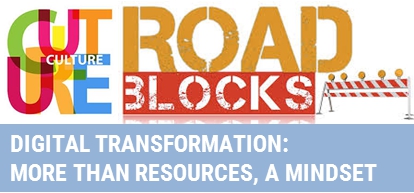
    Surprisingly, a study reveals that it’s the very culture that’s acting as a roadblock and the leadership team is to be blamed for this. The leadership neglects, underestimates or misunderstands the importance of culture in their digital transformation planning.
     
    The study conducted by Capgemini, where 1700 professionals including senior business executives, managers and employees from 340 organisations across eight countries and five sectors were interviewed, reveals that organisational culture acts as a hurdle in digital transformation – 62 per cent of respondents from advanced economies feel so. Cultural issues continue to block digital transformation and it’s a problem that’s worsening. The existing culture and regular way of doing things is so deeply ingrained that it refuses to change.

    Digital illiteracy among leadership leads to a disconnect and that hampers the transformation. Even if the change happens, it becomes ineffective as employees are not empowered to take on new challenges, not compensated for learning new expertise, and not incentivized to break new ground and build new models.

    It is understood that employees will tend to resist any change because they still see the old behaviours as critical to their success and central to who they are, perceiving new norms as risky. However, what’s surprising is the leadership being averse to this change, and their failure to communicate a digital vision that is concrete enough for employees to internalise.
     
    Respondents of this study point out that it’s the leadership that neglects, underestimates or misunderstands the importance of culture in digital transformation planning. Without laying a strong foundation for culture and aligning employees to a digital vision, it will be extremely difficult to make any meaningful progress towards digital transformation.

    Employees are being side lined and disenfranchised in the culture change journey, and the gap between leadership and employee perceptions is stark. This explains why there is a significant perception gap between employees and leadership – the two important stakeholders of this change. The fact is that employees do not share their top executives’ enthusiasm for the organisations’ digital proficiency.

    Apparently, the leadership team either likes to stay in denial or has failed to communicate a clear vision to the employees. The very status of digital transformation in their respective organisations is the biggest point of contention between the leadership and the employees. Leaders believe they have a digital vision, employees disagree. Globally, 40 per cent of senior executives said they believed their organisation has a digital culture, while only 27 per cent of the employees felt the same way.

    Let’s take another case for instance – the study revealed that 85 per cent of the leadership like to believe that there is easy collaboration between different functions and business units of organisations. Interestingly, among employees, only 41 per cent agreed to that. Evidently, traditional hierarchical norms and operational silos are still very much a reality in most organisations.

    Similarly, 75 per cent of the leadership said they believed that in their organisations, there prevails a culture of innovation, experimentation and risk-taking. Not surprisingly, only 37 per cent of the employees agreed to this.
     
    Creating a digital culture is a mammoth task. It’s a multi-year endeavour that requires patience, tenacity and constant vigilance.

    To put things into perspective, corporate culture can be simply defined by how a company works and operates whereas a digital culture is based on several parameters such as customer centricity, innovation, data-driven decision-making, collaboration, open culture, digital first mindset and flexibility.
     
    A true digital culture leader will perform consistently well across the seven dimensions of digital culture and their leadership will largely succeed in aligning the wider organisation to the desired culture.

    Capgemini Culture Digital Transformation Technology
    Share. LinkedIn Twitter Facebook WhatsApp
    mm
    Dr. Prajjal Saha | HRKatha

    Dr. Prajjal Saha is a business journalist and the editor-publisher of HRKatha. He writes on the realities of work and organisations, offering a clear-eyed view of how companies translate intent into action—often revealing the gap between the two. With over 25 years of experience, he focuses on interpreting workplace trends and leadership decisions in a way that is both insightful and accessible. He founded HRKatha in 2015 to create a platform for credible, insight-driven analysis of the evolving workplace.

    Leave A Reply Cancel Reply

    Related Posts

    Marriott International launches Project Prarambh to skill 500 youth for hospitality careers

    September 11, 2026

    V2 Retail opens 24 stores in August, adds nearly 1,000 jobs across 11 states

    September 11, 2026

    The career decisions employees shouldn’t make in a hurry

    September 11, 2026

    Arun Nair is now VP-HR, IKS Health

    September 11, 2026
    zoha
    Editorial

    AI-native workers are forcing managers to earn their relevance

    They did not arrive announcing themselves. They joined as analysts, engineers, content writers, recruiters and…

    Employees are redesigning work before their companies do

    Nobody announced that work would change this way. There was no strategy document, pilot programme…

    EDITOR'S PICKS

    The career decisions employees shouldn’t make in a hurry

    September 11, 2026

    Case-in-Point: The cost of flexibility

    September 10, 2026

    herSTORY: Beena Jacob, CHRO, Blue Dart

    September 10, 2026

    AI now shapes hiring at 85% of Indian firms. Only 35% report new early-career roles or skill needs

    September 9, 2026
    Latest Post

    What DBS Bank’s CEO transition says about building successors

    Quick HR Insights September 11, 2026

    A successor may be announced at the end of a leadership transition, but the preparation…

    Ford Motor Company appoints Samir Singh as director, talent acquisition – APAC

    Movement September 11, 2026

    Ford Motor Company has appointed Samir Singh as director talent acquisition – APAC, placing him…

    Turtlemint appoints Monica Anshul Mishra as CHRO

    Movement September 11, 2026

    Turtlemint Fintech Solutions has appointed Monica Anshul Mishra as chief human resources officer, strengthening its…

    Guidewire appoints Sharon Narang to lead people function for India and APAC product development

    Movement September 11, 2026

    Guidewire Software, the property and casualty insurance company has appointed Sharon Narang as its people…

    Asia's No.1 HR Platform

    Facebook X (Twitter) Instagram LinkedIn WhatsApp Bluesky
    • Our Story
    • Partner with us
    • Career
    • Reach Us
    • Exclusive Features
    • Cover Story
    • Editorial
    • Dive into the Future of Work: Download HRForecast 2024 Now!
    © 2026 HRKatha.com
    • Disclaimer
    • Refunds & Cancellation Policy
    • Terms of Service

    Type above and press Enter to search. Press Esc to cancel.