



Two significant changes have taken place within the business ecosystem. One is the influx of sophisticated technologies to empower the decision-making capacity of humans, and second is the admission that talent is primarily the most important resource of an organisation. These two together are responsible for innovation in the recruitment process, making it more dynamic and holistic.
Moreover, CEOs are leading the change like never before, demonstrating a need for the recruitment process to be instant, precise and accurate. In addition, they want it to provide a fulfilling experience to all stakeholders of the process.
HRKatha speaks to Bipul Vaibhav, an alumnus of IIT Guwahati 2014 and CEO of Skillate and asks him to throw some light on how a company that outsources its recruitment process chooses a partner basis the technology on offer.
“Companies first need to fix the basic problem, which is, to structure the process and handle the scale. The legacy systems have a few challenges, which can be broadly identified as:
- Complex UI and UX
- Processing time
- Lack of flexibility
- Lack of new-edge technologies
At Skillate, we integrate seamlessly our AI model with that of an organisation’s existing products, thus adding value to their existing systems and making them more efficient by leveraging technology. We have a suite of solutions, from sourcing the profiles to engagement with the candidates.”
“Recruitment has become similar to the sales function today where you have to convince an external person about the company, work, culture and a lot more”
One may think that digitisation has made the process complex, but only at the backend. For the end-users, that is the recruiters, it is all about a few simple clicks. In the absence of a digitised recruitment process, finding the perfect matching candidate to join the company is challenging.
Vaibhav says, “If implemented properly, ATS makes the process structured and solves these problems.”
Some of its advantages are the following:
- Defined stakeholders and good communication platform between recruiters, hiring managers and candidates.
- Manages agencies, employee referrals, careers page, all in a single dashboard.
- Tracks, reports and analyses the entire recruitment process and guides the management regarding the scope of improvements.
At Skillate, artificial intelligence (AI) is thought of as an enabler to solve various business problems, such as reducing hiring time. The solutions offered have been able to reduce the resume screening time by about 95 per cent so that recruiters can focus on quality candidates. Skillate bots help interact with the candidates automatically as per their convenience and capture details that are beyond resumes but very important for the role. The system is cost efficient as it is helping companies leverage the resume database to close the positions faster, making the process less dependent on agencies and job boards.
“Recruitment has become similar to the sales function today where you have to convince an external person about the company, work, culture and a lot more,” opines Vaibhav.
“One size does not fit all!” Recruiters are adopting creative strategies and each vacancy is considered as a separate project and requires a unique plan.“The recruiting process is modified with respect to each generation, function, remote/contractual workers or the industry in question,” shares Vaibhav.
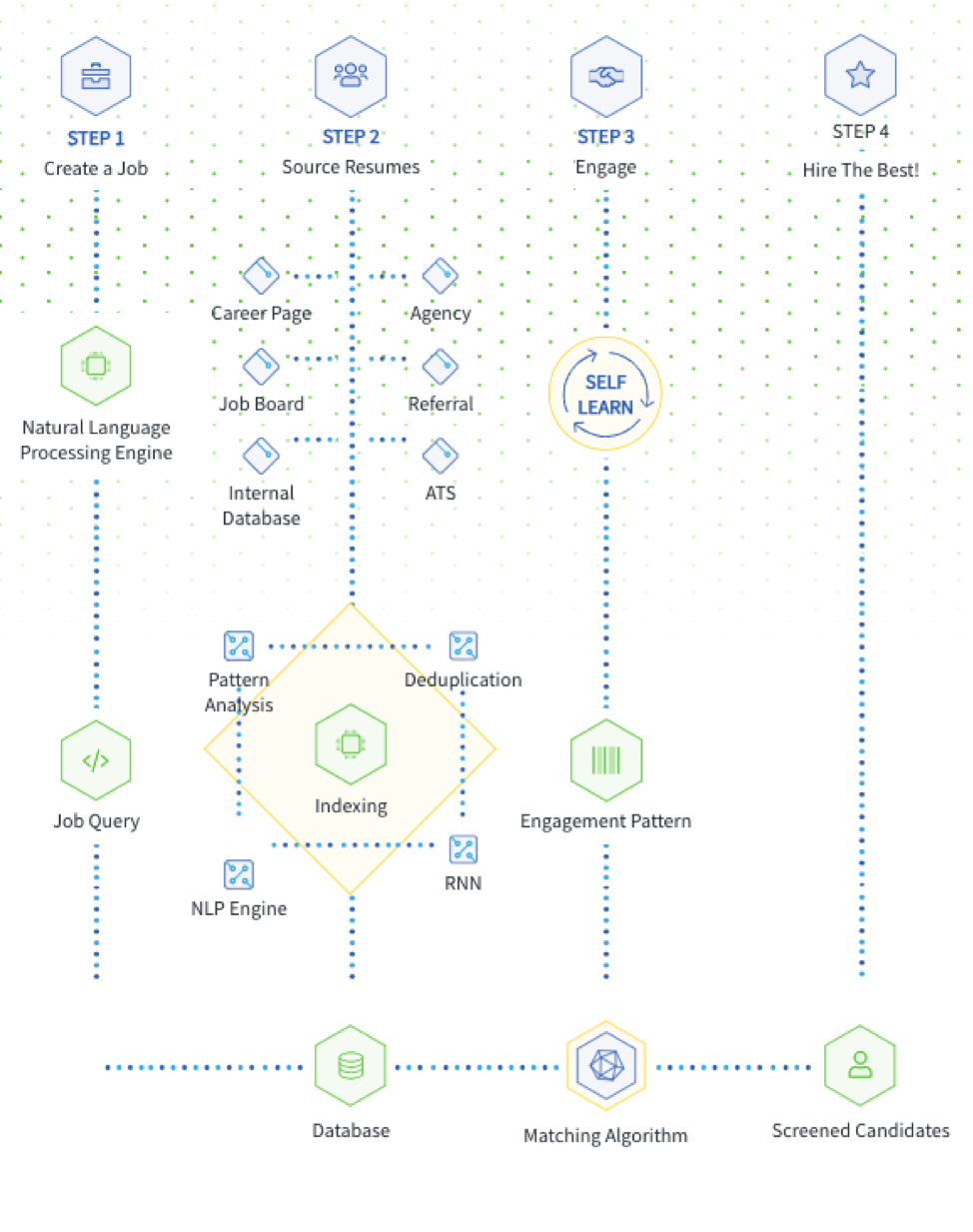 The new process engages candidates on LinkedIn and establishes relationships with a long-term perspective. Profiles, such as data scientists, and UI/ UX designers are in demand in the market and good profiles get attracted very soon.
Chatbot engages with the candidates to make the system transparent, and engage them automatically even after the offer letter. The bot interacts with the candidates and tells them about the company, incentive, culture, and so on.
For experienced profiles (above 10 years of experience), Naukri and Referrals are the main sources of hiring. Voice bot chats with the candidates and sends the information back to the platform automatically.
Recruitment has become candidate-centric, and organisations are competing to attract the best talent.
In Vaibhav’s words, “It starts with the job description, as that is a candidate’s first impression about the organisation’s culture, work, responsibility and people. Skillate has released an important feature called JD Assistant. It analyses the entire job, and gives a score between 0-100, which shows its robustness. It also recommends the pointers that recruiters or hiring managers can use to modify and enhance the JD. We have trained this model with about three lakh jobs and is working fine across industries.”
Skillate uses AI-enabled chat bots at various stages of the recruitment cycle to enhance the experience of candidates. Be it auto-screening of candidates, auto-interview scheduling or candidates’ status updates, there are extensive offerings to enhance the employer branding and ensuring a great candidate experience. Previously, a recruiter’s job was done when a candidate accepted an offer, but not anymore.
One of the major problems that the industry faces today is that of the ‘Offer to Joining Ratio’. In some industries, such as IT services and BFSI, it is as high as 60 per cent, but in others not so. The challenge is to comprehend the intent and desire of the candidate. One way to do the same is to engage with the candidates regularly. It is possible via a bot, which will interact with the candidates at certain intervals and will figure out the intent of the candidate for the job and the company— whether the candidate is happy with the offer, looking for a better opportunity, and so on.
Research shows that there is a gap in skill-sets that candidates possess and what is required for the job. Though one cannot negate the fact that expectations have gone up on the part of business leaders, but they are also doing their share to nip the problem in the bud.
“They are setting up R&D units inside the colleges at their own expense. Even with all this, hardly the top one per cent of the people are getting the opportunity they deserve. We need to do much more in terms of collaboration between academia and business organisations, to bridge the gaps,” says Vaibhav.
The recruitment industry is maturing in an all-new avatar and there is no stopping here. In the Fourth Industrial Revolution, the rules will change but the game will remain the same. Some jobs will become redundant, but hundreds of new jobs will be created. Moreover, with the Internet penetrating into tier-II and tier-III cities, the industry is all set to become bigger.

2 Comments
You covered much of the information in detail and it is a fact that to boost the recruitment process, the technology always played a vital role to eliminate the time-consuming activities and boost your recruitment process.
Effective way and saving a good amount of time.