



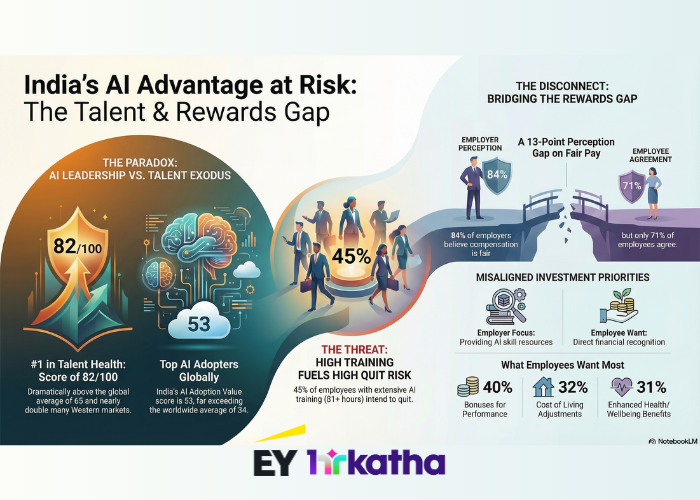
India leads the world in AI adoption at work. Its talent health score stands at 82 out of 100—dramatically above the global average of 65 and nearly double that of Italy and Finland’s 43. Indian employees’ AI Adoption Value score hits 53, the highest globally, compared to 34 worldwide. Yet beneath these impressive figures lies a troubling disconnect: 84 per cent of Indian employers believe their total compensation is fair and equitable, whilst only 71 per cent of employees agree—a 13-percentage-point perception gap that threatens to undermine India’s talent advantage
According to EY’s Work Reimagined 2025 survey of 15,000 employees and 1,500 employers across 29 countries, this mismatch reveals a broader pattern. Whilst 88 per cent of employees globally now use artificial intelligence at work, only 28 per cent of organisations have positioned employees to achieve transformational business impact from AI. Companies investing billions in AI whilst neglecting human systems shouldn’t be surprised when 95 per cent see no measurable return, according to MIT research.
India’s dual reality: excellence and exodus
India’s leadership position is undeniable. At 82, its talent health score towers above every other market surveyed—ahead of Indonesia’s 50, China’s 45, and the UAE’s 44. Mature Western markets lag dramatically: Canada scores 17, Sweden 16, and Finland just 12.
Shadow AI usage—employees bringing personal AI tools to work—reaches 58 per cent in India, more than double Sweden’s 23 per cent. This signals sophistication: Indian workers aren’t waiting for enterprise tools to catch up.
Yet, 29 per cent of employees globally intend to quit within 12 months. In India, where AI skills development is the highest, flight risk concentrates amongst the most valuable employees. Those receiving 81-plus hours of AI training annually—the threshold that unlocks 14 hours of weekly productivity gains versus three hours for those with minimal training—show 45 per cent quit intent, compared to 21 per cent for employees with fewer than four training hours.
This creates a brutal paradox: the investment that makes employees most productive also makes them most likely to leave. Only 12 per cent of employees globally receive 81-plus hours of AI training, explaining why the global AI adoption value score sits at just 34.
The rewards disconnect
The 13-percentage-points gap between what Indian employers believe they’re providing and what employees experience extends across multiple dimensions. Eighty-eight per cent of employers feel total compensation reflects employees’ skills and experience, yet only 84 per cent of employees agree. Eighty-six per cent of employers believe they offer flexibility in meeting individual needs, whilst only 83 per cent of employees concur.
When asked to identify improvement areas, employees prioritise compensation enhancements, whilst employers focus on AI skill-building resources—despite this being a lower priority for employees. Forty per cent of employees want bonuses to recognise performance. Only 35 per cent of employers plan to provide them.
Thirty-two per cent want compensation reflecting cost of living—critical in India’s rapidly inflating urban centres. Thirty-one per cent seek enhanced health and wellbeing benefits, yet only 29 per cent of employers plan them. Thirty per cent want more paid time off, but just 28 per cent of employers intend to provide it.
Meanwhile, 34 per cent of Indian employers plan to invest in AI skills resources. For employees, this ranks lower than direct compensation improvements. The mismatch suggests employers are solving for capability development whilst employees focus on tangible financial recognition.
The talent advantage formula
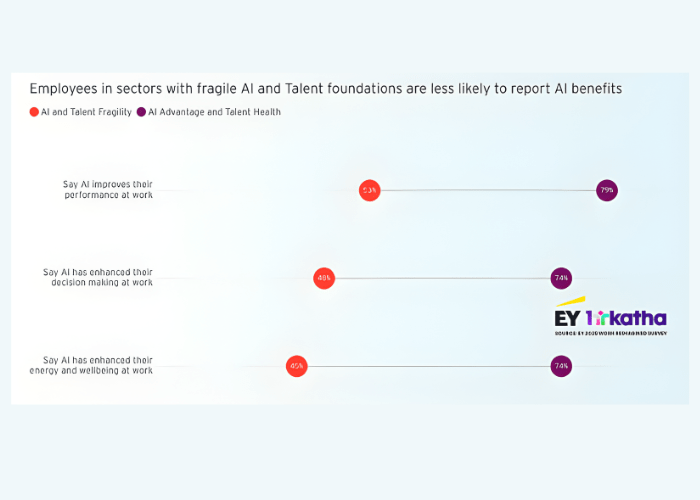
What separates the 28 per cent of organisations achieving transformational AI results from the 72 per cent seeing modest gains? EY’s research identifies five interconnected capabilities: talent health and flow, AI adoption excellence, learning and development, culture transformation, and strategic rewards.
Get these right simultaneously, and productivity benefits compound. Get them wrong, and organisations lose over 40 per cent of potential productivity gains—even when using identical AI tools. The gap isn’t in technology but in human systems surrounding it.
Talent health, measured by employees’ likelihood to recommend their employer, drives everything else. Only 20 per cent of employees in organisations with weak talent foundations promote their companies. In organisations with strong foundations? Eighty-nine per cent! This creates network effects: employee promoters become talent magnets.
Culture accounts for 44 per cent of talent health, rewards contribute 32 per cent, and development 24 per cent. Globally, 60 per cent of employees now say culture is significantly better than 12 months ago, up from 48 per cent in 2021. Yet, disparities remain: 63 per cent at leading organisations report improved culture versus just three per cent at lagging ones.
The skill-retention dilemma
Employees receiving 81-plus hours of AI training annually save 14 hours weekly—unlocking nearly two full workdays. Those with fewer than four hours save just three. Yet, highly-skilled employees are 55 per cent more likely to leave. Their motivations shift: those with extensive training prioritise access to cutting-edge technology and flexibility over traditional compensation.
The proportion receiving at least 80 hours of AI learning annually jumps from 15 per cent in organisations with weak talent systems to 42 per cent in those with strong ones. Leading organisations don’t prevent attrition—they make internal opportunities so compelling that external options lose appeal. They create internal talent marketplaces, design skill certifications tied to tenure, and build learning cohorts that develop peer networks.
Critically, they calibrate rewards to reflect what AI-skilled workers actually value: technology access, flexibility, and continuous development—not just pay increases.
Shadow AI: innovation or governance challenge?
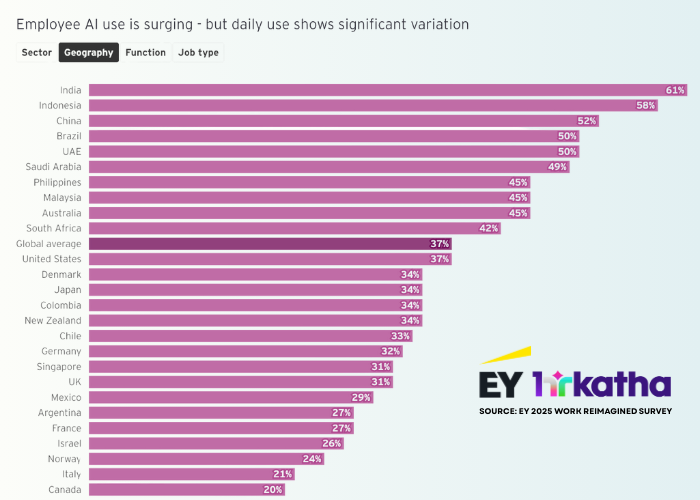
Between 23 per cent and 58 per cent of employees globally bring personal AI tools to work. In India, shadow AI usage reaches 58 per cent—the highest surveyed. Wealth management (54 per cent), technology (52 per cent), and banking (49 per cent) show the highest global rates.
This represents untapped innovation but also governance challenges. Enterprise tools lag behind consumer AI, and employees won’t wait for approval. Leading organisations survey their workforce to understand what personal tools they’re using and why, incentivising disclosure rather than punishing it. They create governed experimentation programmes that fast-track promising solutions whilst establishing clear boundaries.
The productivity trap
Artificial intelligence delivers tangible time savings—employees report an average of eight hours saved weekly. Advanced users in sectors such as wealth management, technology and banking save 10 to 12 hours. Yet many organisations struggle to translate efficiency into transformation.
The critical question is, ‘How should this capacity be deployed?’ Organisations fixated solely on hours saved miss dimensions such as improved accuracy and enhanced decision-making. Without deliberate role redesign—determining what employees should stop doing and what high-value activities they should pursue—saved time gets absorbed by expanded workloads rather than channelled toward transformation.
Organisations must establish clear expectations about allocating time savings between strategic growth initiatives and creating space for innovation and learning. Otherwise, productivity gains become productivity traps: employees work faster but not more strategically.
The anxiety-innovation gap
Whilst organisations struggle to find talent, 38 per cent of employees globally fear job loss due to AI. The same proportion worries about overreliance eroding human skills. This fear coexists with innovation demands—organisations need employees to experiment and reimagine their work.
Workforce anxiety creates hesitation and defensive behaviour that protects current roles rather than transforming them. Leading organisations embrace emotions rather than ignore them. They articulate clear AI visions addressing workforce concerns. They communicate not just what AI will do, but what humans will do that’s more valuable. They give employees voice in implementation, allowing those closest to the work to help shape its future.
India’s opportunity and imperative
India’s talent health score of 82 and AI-adoption value of 53 demonstrate that success isn’t confined to Western markets. Indian organisations have built strong foundations for AI transformation. Yet the 13-percentage-point rewards perception gap threatens to undermine this advantage.
When 88 per cent of employers believe that compensation reflects skills whilst only 84 per cent of employees agree; when 34 per cent of employers plan AI skills investment whilst employees prioritise bonuses and cost-of-living adjustments; the disconnect reveals misaligned priorities. Employees want tangible financial recognition. Employers are investing in capability development. Both matter, but sequencing and balance require recalibration.
Indian organisations risk repeating global patterns: investing billions in AI technology whilst neglecting the rewards, culture and development systems that determine whether those investments generate value. The 40 per cent productivity gap between organisations with strong versus weak talent foundations quantifies the cost. For every hour of productivity AI could unlock, organisations on fragile foundations realise just 36 minutes.
India leads the world in AI adoption and talent health. The question is whether it will maintain this advantage by addressing the rewards gap before the 45 per cent of highly-trained employees with quit intent exercise it—taking their AI expertise to competitors who better align compensation with contribution. The data makes clear that India can either write the future, or watch competitors write it instead.