


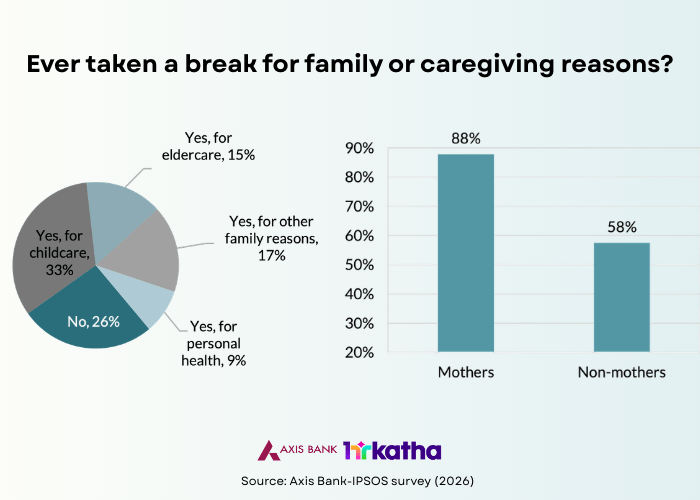
Three out of four educated women in India step away from their careers at some point.
That is the striking finding of a new study by Axis Bank, which surveyed nearly 11,000 college-educated women across 42 Indian cities. The number challenges a common assumption in corporate India: that women primarily exit the workforce after childbirth.
In fact, 74 per cent of respondents reported taking a career break at some stage. Even among women without children, 58 per cent had stepped away from work. Among mothers, the number rises to 88 per cent.
The implication is uncomfortable for organisations. Career interruptions are not merely a motherhood problem; they are a feature of how work itself is structured.
“Career interruptions are not merely a motherhood problem; they are a feature of how work is structured.”
The hidden architecture of career breaks
Corporate careers still assume a linear trajectory—uninterrupted work through one’s 20s, 30s and 40s, with promotions tied to continuous presence.
Women’s lives rarely follow that template.
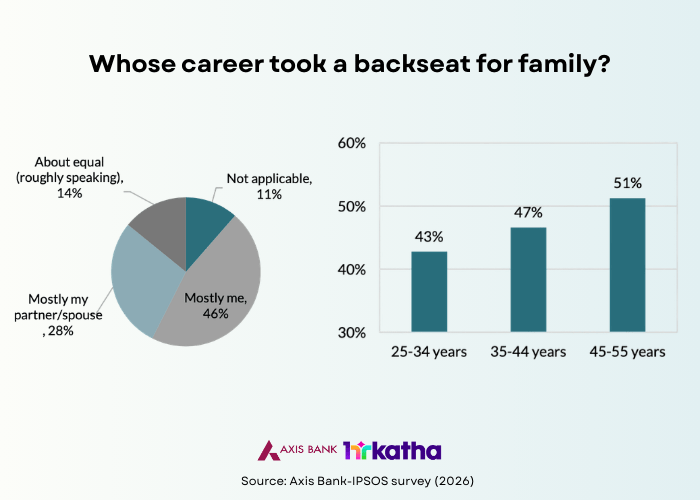
According to the survey, 46 per cent of women believe their career took a backseat to family responsibilities at some stage. The perception intensifies with age: 43 per cent among women aged 25–34, rising to 47 per cent among those 35–44, and 51 per cent among those 45–55. Early compromises compound over time.
This helps explain a puzzle visible in many corporate diversity dashboards. Companies hire women in large numbers at entry level, yet representation drops steadily at middle management.
It is not always because women quit permanently. Many step away temporarily—only to find that re-entry into corporate careers is far harder than exit.
 The flexibility paradox
Sixty-two per cent of respondents rate workplace flexibility as “very important” or “essential”. Among mothers the number rises to 67 per cent, compared with 56 per cent among childless women.
Yet flexibility often arrives as informal accommodation rather than structural design. Many companies treat it as a concession primarily for mothers, even though the survey shows it matters across life stages: childcare, eldercare, relocation, health issues and personal commitments.
Flexibility, in other words, is no longer merely a benefit. It is increasingly a participation condition.
Despite this demand, relatively few women describe workplaces as highly supportive. Many characterise them as only “somewhat supportive”. The gap has consequences: 24 per cent say they have left jobs due to work-family conflicts, while 47 per cent have seriously considered doing so.
For HR leaders, this raises an awkward question. If most careers assume uninterrupted availability, how realistic is that assumption in a society where caregiving demands remain substantial?
The “greedy work” trap
The survey also reveals how workplace culture compounds the problem.
Nearly 49 per cent of respondents say jobs demanding long hours and constant availability are “often” or “always” rewarded. Among younger women aged 25–34, the figure rises to 51 per cent, compared with 40 per cent among those aged 45–55.
When “greedy work” defines the path to advancement, caregiving becomes career poison.
Jobs that demand inflexible schedules are widely seen as gateways to promotion, reinforcing the perception that caregiving and career progression exist in tension.
Unsurprisingly, childcare responsibilities remain unevenly distributed. Among working mothers, 58 per cent say they are primarily responsible for their children’s daily care. Only 18 per cent report equal sharing with partners, while 16 per cent say their partner is primarily responsible.
These norms are even stronger outside major metros. In tier-2 cities, 78 per cent believe childcare is primarily a mother’s responsibility, compared with 63 per cent in metros.
 India’s participation paradox
India’s female labour force participation rate remains among the lowest in the G20, despite rising levels of education.
The country produces large numbers of educated women, yet many do not remain in the workforce long enough to reach leadership positions.
The consequences are economic as well as social. Economists increasingly see female labour participation as a crucial driver of long-term growth, especially as India’s demographic window gradually narrows.
The Axis Bank study suggests improving participation will require redesigning work itself, rather than merely persuading women to work.
The real barrier: re-entry
Career breaks are common. Successful returns are not.
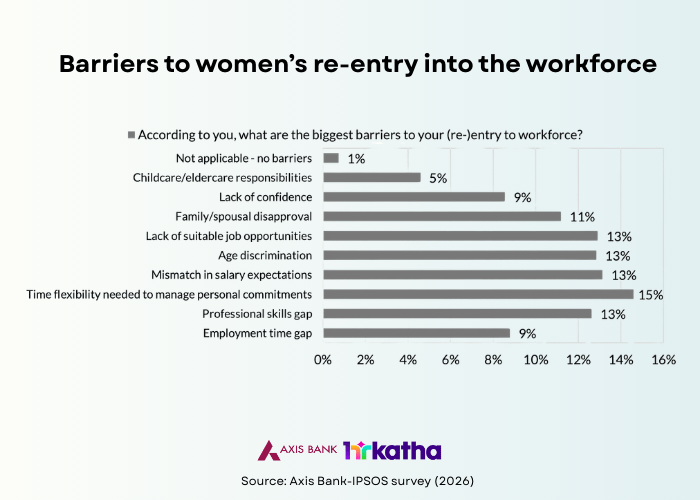
Time flexibility emerges as the biggest barrier to re-entry, cited by 15 per cent of respondents. Age discrimination, salary mismatches and skills gaps follow closely at 13 per cent each. Employment gaps and loss of confidence register at 9 per cent.
But the deeper issue is perception. Many returnees believe employers treat career breaks as a signal of reduced commitment—whether in shortlisting, interviews or role assignments.
The result is a quiet but powerful penalty. A relatively short break can translate into a long-term career slowdown.
For organisations, this creates a strategic dilemma. Companies invest heavily in hiring and developing women early in their careers—only to lose that talent precisely when leadership pipelines are forming.
Education as strategic insurance
One particularly revealing insight concerns education choices.
Sixty per cent of respondents say their education decisions reflected a deliberate strategy to hedge career risk or ensure future flexibility.
This awareness—formed years before motherhood—suggests how deeply structural barriers are understood. Education becomes a form of insurance against potential career interruptions.
Why the problem persists
Several structural forces reinforce the cycle.
Childcare infrastructure remains uneven, particularly in urban areas where dual-career households are most common. Workplace cultures still frequently assume caregiving is primarily a woman’s responsibility.
Social norms, though gradually shifting, remain stubborn. Seventy-three per cent of respondents agree that men’s careers should take priority when conflicts arise.
The belief varies by age and geography. Among women aged 25–34, the figure stands at 71 per cent; among those 45–55, it rises to 81 per cent. In metros 64 per cent agree, compared with 80 per cent in tier-2 cities.
Many organisations treat career breaks as anomalies rather than predictable life events. Yet the survey suggests interruptions are normal.
What is unusual is a career system designed on the assumption that they will not happen.
What employers may need to rethink
The implications for corporate India are clear.
If three out of four educated women take career breaks, then HR strategies built around continuous careers will inevitably lose talent.
The answer may lie less in incremental benefits and more in structural redesign. Returnship programmes, mid-career re-entry pathways and genuinely flexible work models could prove decisive.
Equally important is normalising non-linear careers. If promotions and performance evaluation assume uninterrupted tenure, diversity targets will remain difficult to meet.
“If three out of four women take career breaks, continuous-career workplaces will inevitably lose talent.”
The broader lesson
India’s growth ambitions increasingly depend on making full use of its educated workforce.
Yet the Axis Bank study suggests a large share of that talent pool remains only partially engaged.
The striking statistic—74 per cent of women taking career breaks—is therefore not merely a workforce issue. It is an economic one.
The challenge, ultimately, is not persuading women to remain in the workforce.
It is redesigning careers so that stepping away temporarily does not mean falling permanently behind.