


When competence met understanding
Richa Dubey would have liked her younger self to understand organisations as systems, not just roles.
Early in her career, she focused almost entirely on doing the right work well. Over time, however, she realised that effectiveness depends equally on understanding how decisions are made—shaped by context, priorities, timing, and trust.
As Peter Drucker often emphasised, results are achieved not in isolation, but within a social system. That insight reshaped how Dubey approached her work—learning to communicate intent clearly, respect differing perspectives, and align effort with purpose.
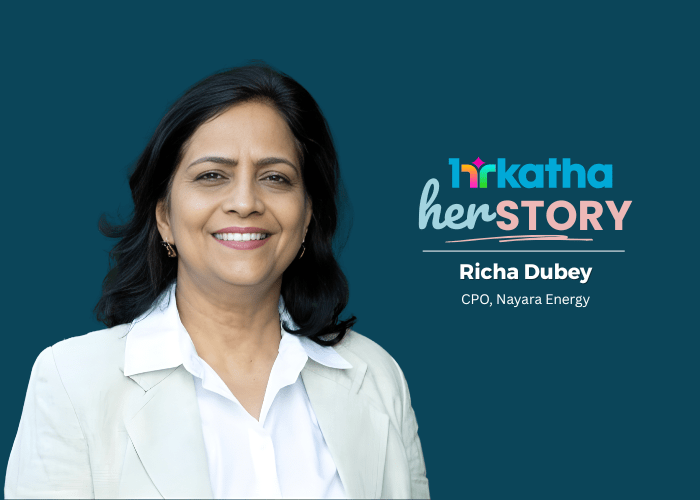
Today, as chief people officer at Nayara Energy, Richa Dubey leads with a clear belief: leadership is not about certainty, but about courage.
“When competence meets contextual understanding, your impact becomes far more enduring.”
Taking calculated risks
Comfort can be deceptive.
As roles become familiar, problem-solving turns instinctive, crises easier to manage, and decisions more predictable. While that brings confidence, it can also limit growth.
For Dubey, progress meant stepping away from that comfort.
“Leading change in complex, high-pressure environments, rather than remaining in stable roles, carries significant professional risk—and it is one I chose to take.”
Such roles demanded difficult decisions, long-term thinking amid short-term uncertainty, and persistence even when results were not immediately visible.
The experience reinforced a defining lesson:
Leadership is not about certainty. It is about courage.
Leader of the people
Every leadership role Dubey has held has deepened her understanding of people—and what it truly means to lead them.
Her leadership style has evolved to become more collaborative and inclusive.
Today, she believes in involving senior leaders not just in decision-making, but also in execution—ensuring shared ownership of outcomes and clarity on organisational direction.
A participative culture, she believes, begins with listening.
Dubey places strong emphasis on hearing voices from across the organisation—insights that reveal how decisions are experienced on the ground and enable more thoughtful responses.
Whilst achieving business goals remains critical, it cannot come at the cost of trust, respect, or inclusion.
Her focus, therefore, is on building an environment where people feel empowered, valued and treated fairly.
“Continuous learning is non-negotiable. No one can choose to stand still in this dynamic ecosystem without losing relevance.”
Beyond intent
The evolution of women in HR leadership, Dubey believes, is encouraging.
The shift from supporting business strategy to actively shaping it is already visible.
Yet, she is clear that progress remains incomplete.
“We must continue to equip ourselves with the right knowledge and skills that will help us push for stronger representation in decision-making forums, succession pipelines, and roles with P&L or transformation accountability.”
Because inclusion, she stresses, cannot remain an intent. It must translate into measurable outcomes.
Quick fire round
What’s the best career advice you’ve ever received?
Earn your seat every day, justify your role through impact, stand up for yourself, and stand firmly for the value of your profession.
One thing you wish people understood about being a woman in HR leadership:
Empathy and toughness are not opposites; they are complementary strengths.
Morning ritual that sets you up for success:
Morning workout, quiet reflection, and prioritising the one decision that will have the most impact that day.
If not HR, what career path would you have pursued?
Civil services.
What energises you most about your work?
Seeing people and organisations realise potential they didn’t think was possible.
Motivated by curiosity and resilience
Dubey draws inspiration not from a single individual, but from people and experiences across her journey.
She admires leaders who balance integrity with courage, make difficult decisions thoughtfully, and treat culture as a strategic priority.
Teams that demonstrate resilience and curiosity amid constant change continue to motivate her.
Sharing perspectives with confidence
To young women entering HR, Dubey’s advice is grounded and direct.
“Build strong business acumen alongside functional HR expertise.”
Understanding how value is created, how decisions are made, and how culture shapes outcomes is essential to long-term effectiveness.
She encourages seeking roles that stretch thinking and build real capability.
In a dynamic environment, she emphasises, continuous learning is not optional.
Equally important is the confidence to express one’s perspective.
Too often, she observes, individuals hesitate to share their views, treating them as limitations rather than strengths.
But perspectives only create impact when they are voiced.
The objective, she suggests, is not to fit in—but to contribute meaningfully.