



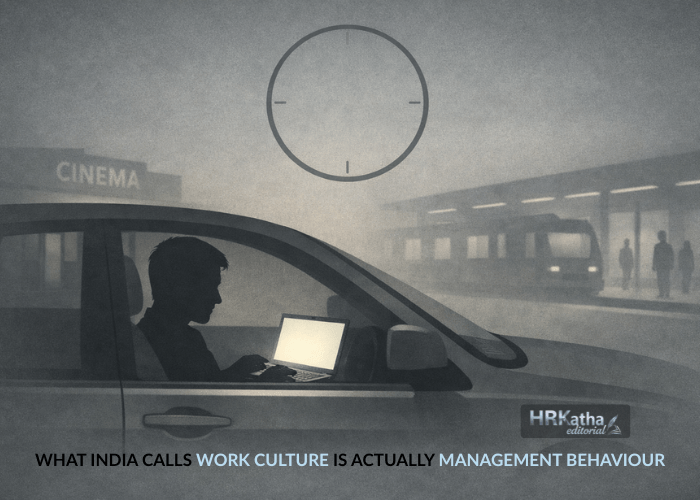
The image circulated widely: a professional working from a parked car, laptop balanced precariously, joining calls between errands. Another showed someone crouched in a cinema hall, responding to emails before a film began. A third captured an employee on a metro platform, presentation open on a phone screen.
These are not isolated incidents. They are signals of something deeper.

The immediate reaction frames this as hustle, as commitment, as personal choice. The reality is structural. These moments reveal not dedication but the failure of management to create boundaries, prioritise outcomes over visibility, and distinguish urgency from performative availability.
India’s work culture problem does not sit in HR policy documents. It lives in the daily decisions managers make, the expectations they set, and the behaviours they reward.
Where the problem actually sits
HR can write policies on working hours, leave, and mental health. Most organisations have them. Well written, widely ignored.
The gap between policy and practice sits with managers.
A manager who messages at 11 p.m. and expects a response renders official working hours meaningless. When visibility is treated as productivity, employees remain perpetually available. Rewarding speed over quality makes working from a parked car a rational choice.
HR cannot enforce what managers do not model.
“The system does not lack commitment. It misdefines it”
Why managers create these conditions
This behaviour is not accidental. It is rational within existing incentives.
Managers are evaluated on delivery, not on how that delivery is achieved. Targets, deadlines and output matter. Sustainability, workload distribution and team health rarely do.
If a deadline slips because someone was unavailable, the manager is accountable. The safest approach becomes ensuring that everyone is always reachable.
Micromanagement reinforces this. Managers who do not trust their teams require constant updates, real-time visibility and immediate responses. Disconnection is interpreted as disengagement.
The system rewards managers who extract maximum output. It does not reward those who build sustainable teams.
The geography of availability
Work culture is not shaped only within organisations. It is also shaped by where those organisations sit in the global hierarchy of work.
In multinational teams, the asymmetry is visible. When teams span India, the United States and Europe, it is usually the Indian employee who adjusts. Late evening calls, extended availability and flexible boundaries are treated as standard. The reverse is rare.
This pattern is sometimes attributed to cultural deference. The explanation is simpler and more structural: teams positioned as execution support adjust to teams positioned as revenue owners.
Geography matters. But hierarchy matters more.
Teams closer to revenue ownership, client relationships or market decision-making set the rhythm. Teams positioned as execution support are expected to adapt. In many global organisations, Indian teams sit disproportionately in delivery, operations and support functions, rarely in strategy, product ownership or market-facing roles.
Labour market conditions reinforce this. In environments where talent supply is high and competition intense, the cost of refusing unreasonable expectations is perceived to be higher. Employees comply not because they prefer to, but because alternatives appear limited.
This is not unique to India, but it is more visible here because scale and competition amplify it.
Cultural narratives then legitimise what is fundamentally structural. Long hours are reframed as dedication. Flexibility becomes a virtue. Endurance becomes identity.
The result is a system where constant availability is normalised, not because it is optimal, but because it is expected.
Change will not come from appealing to culture. It will come when the underlying asymmetry shifts, when Indian teams move closer to decision-making, when labour markets tighten in specific skill areas, and when organisations begin to value output over time-zone compliance.
Until then, the burden of adjustment will continue to flow in one direction. And Indian managers, operating within this asymmetry, will continue to transmit those expectations downward, treating late-night availability not as dysfunction but as requirement.
The performance of productivity
What emerges is a culture where being seen to work matters more than the work itself.
Logging in early signals commitment. Responding late at night demonstrates seriousness. Being available on weekends becomes proof of dedication. Output becomes secondary to being seen to work.
Employees adapt quickly. It is safer to appear busy than to work efficiently and disconnect. Saying “I am unavailable” carries risk, even when policy permits it.
Working from cars, cinema halls or metro platforms becomes a signal. It communicates commitment through sacrifice.
Managers reinforce this, often unintentionally. The employee who responds from anywhere becomes the default for the next urgent request. The pattern sustains itself.
The system does not lack commitment. It misdefines it.
“Managers will optimise for output. Employees will optimise for visibility.”
What gets normalised
Over time, exceptions become expectations.
Working beyond formal hours becomes routine. Leave requires justification. Disconnecting feels risky because availability is how commitment is measured.
Employees check messages during meals, respond during family time, and work through illness not because they are told to, but because the system has made the consequences of not doing so clear.
This is how culture shifts. Not through single decisions, but through repeated small adjustments that become the norm.
Language reflects this shift. “Quick call” at 9 p.m. “Just a question” on a Sunday. “When you have a moment” sent at midnight.
The phrasing softens the intrusion. It does not reduce it.
The structural enablers
Technology enables this behaviour, but it does not cause it.
Smartphones ensure constant access. Messaging platforms collapse the boundary between work and personal time. Video calls remove physical constraints.
But the underlying driver is management culture that equates accessibility with productivity and responsiveness with commitment.
Paradoxically, the same technology that enables boundaryless work also exposes its costs. Social media circulates images of professionals working from cars and cinema halls. What earlier generations normalised quietly, newer employees critique publicly.
Indian workplace dynamics amplify this tension. The idea that long hours reflect virtue remains deeply embedded. Calls for extended work weeks formalise beliefs many organisations already practice. Yet hierarchy makes resistance difficult. Saying no carries professional risk. Boundary-setting is often interpreted as lack of commitment.
The result is predictable. Managers set expectations. Employees comply. HR policies remain disconnected from lived reality.
What change would actually require
The system is not failing. It is operating as designed.
Fixing this is not about correcting individual behaviour. It requires changing what organisations measure.
Managers must be evaluated not only on output but on how that output is delivered. Team sustainability, attrition, and boundary management must carry weight in performance decisions.
Organisations must distinguish between urgency and convenience. Not every request requires immediate response. When everything is treated as urgent, nothing is.
Leadership behaviour matters. Leaders who send emails at midnight define the norm. Leaders who disconnect create permission for others to do the same.
Trust must replace surveillance. Managers who trust their teams enable output-based work. Those who do not create systems that demand constant visibility.
None of this is difficult. It requires a shift in what organisations choose to reward.
The generational shift managers are not prepared for
What makes this moment different is not policy, but demography.
In many organisations, managers today are predominantly millennials, with some Gen X leadership above them. Their teams, increasingly, are Gen Z.
Gen Z has entered the workplace with different expectations. Boundaries are not seen as entitlement, but as baseline. Availability is not equated with commitment in the same way. The willingness to push back, disengage, or leave is structurally higher.
This creates tension in systems built on older assumptions. Managers who equate responsiveness with performance encounter teams that do not accept constant availability as default.
What appears as declining commitment often reflects a different definition of work: output over presence, effectiveness over responsiveness.
This is not a generational virtue argument. Gen Z is not inherently better at setting boundaries. Nor are millennials uniquely responsible for eroding them. The difference lies in tolerance. Previous generations absorbed unsustainable expectations and normalised them. Gen Z is less willing to do so.
This does not mean less commitment. Gen Z employees often demonstrate high intensity when working. What they resist is performative availability.
As Gen Z moves into management, some patterns may shift. But incentives remain unchanged. Organisations still evaluate managers on delivery, not on how sustainably that delivery occurs.
The generational shift creates pressure. It does not guarantee change.
The real cost
The images of professionals working from cars and cinema halls are not signs of dedication. They are signs of system failure.
Failure to create boundaries. Failure to evaluate managers on sustainability. Failure to distinguish between productivity and the appearance of it.
Employees are not choosing this behaviour freely. They are responding rationally to incentives that reward visibility and penalise disconnection.
HR can design policy. Employees can raise concerns. But unless managers are held accountable for how they lead, nothing changes.
The question is not whether employees are committed. They clearly are.
The question is whether organisations will stop rewarding management practices that treat exhaustion as engagement and boundaries as weakness.
Managers will optimise for output. Employees will optimise for visibility. And the performance of dedication will continue to replace sustainable productivity.
The problem is not HR. It is not policy. It is not employee resilience.
It is management. And the systems that reward it.