


BLS International is not a company most people think about until they need it. It processes visa applications, consular services and citizen-facing government documentation across more than 70 countries. It operates at the intersection of regulation, sovereignty and human mobility. When it works, nobody notices. When it does not, the consequences are personal and immediate.
Managing people in that environment is its own discipline. The workforce is large, globally distributed, heavily compliance-driven and in direct contact with members of the public navigating some of the more stressful administrative experiences of their lives. HR here is not a support function in any conventional sense. It is operational infrastructure.
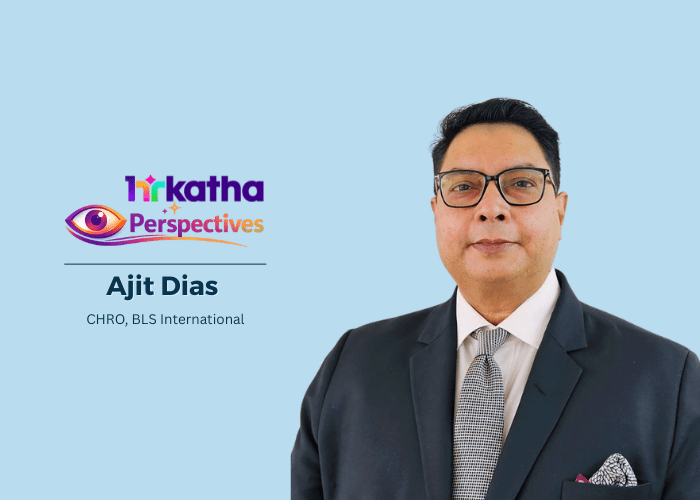
Ajit Dias has built his HR practice inside that reality. In conversation with HRKatha, he explains why future-readiness is a mindset rather than a credential, why the diversity numbers at BLS tell only half the story, and why resistance to AI is almost never really about the technology.
Mindset over skillset
Skills are changing rapidly in sectors such as technology and manufacturing. How have skills evolved in the visa and consular services sector?
For us, future-ready talent comes down to three things: digital fluency, problem-solving ability and comfort with ambiguity. But underneath all three is something more fundamental. Future-readiness is not a skillset. It is a mindset of continuous reinvention. That cannot be hired in. It has to be recognised and then cultivated.
Skills are becoming obsolete faster than ever, but what is changing more fundamentally is what we hire for. At BLS International, we have shifted from hiring for static skillsets to hiring for learning agility and adaptability. In a business that operates across more than 70 countries and is being reshaped by AI and automation, many of the roles we are building today did not exist a few years ago.
In a sector like ours, where accuracy, compliance and customer interaction intersect in real time, the ability to adapt quickly is not just valuable, it is essential. The focus is less on what you know and more on how quickly you can learn, unlearn and apply in new contexts. As frontline roles evolve away from routine processing towards decision-making and problem resolution, the people who thrive are those who can read unfamiliar situations and navigate them effectively, not those who rely on pre-existing answers.
“What differentiates a strong HR leader here is the ability to hold operational discipline and human-centred leadership simultaneously.”
Consistent in principle, adaptable in practice
Can a single culture genuinely serve five generations simultaneously?
I believe a strong, purpose-led culture can, but only if it stops conflating consistency with uniformity.
At BLS International, we anchor ourselves in a common foundation: service excellence, integrity and accountability. How employees experience that foundation varies across geographies and life stages, and that is by design.
The shift we are making is from standardisation to contextualisation. Gen Z may prioritise flexibility and rapid growth. More experienced cohorts may value stability and structured progression. Neither is unreasonable. The role of HR is to design systems that are consistent in principle but adaptable in practice, so that different cohorts can engage meaningfully without losing alignment with the organisation’s core values.
Culture is not the same thing as a uniform experience. Treating it as such is where organisations lose people they did not need to lose.
“The resistance to AI is almost never really about the technology. It is about uncertainty.”
Build pipelines, stay pragmatic
In your sector, ready talent is not always available externally. How has the approach to building versus buying talent evolved?
There is always a tension between building and buying talent, and over-reliance on either creates problems. External hiring offers speed and fresh thinking. Internal development builds continuity, cultural alignment and contextual understanding that cannot be acquired quickly, particularly in a globally distributed and compliance-heavy business.
In our context, talent that understands both regulatory nuance and frontline service delivery is not easily available in the market. That makes internal development not just a preference but a necessity.
Our philosophy at BLS International is to build leadership pipelines deliberately, using structured development centres and individual development plans to identify potential early and create leadership readiness through focused, ongoing investment. Succession is deliberate, not assumed.
At the same time, we are pragmatic. In fast-evolving areas, particularly technology and new market entry, external hiring brings in capabilities and perspectives we may not yet have internally. The goal is not to choose between building and buying. It is to be intentional about which situations call for which approach.
“That shift does not happen through policy. It happens through the consistent behaviour of managers.”
From representation to outcome
Diversity may not appear to be a challenge at the entry level in your sector. Where do you see the real systemic barriers?
The most persistent barrier is not intent. It is the gap between intent and systems.
Many organisations, including ours, have made meaningful progress on representation. At BLS International, 46 per cent of our workforce comprises women, and several of our Visa Application Centres are entirely women-led. Those numbers matter, but they are not the end of the conversation. Representation that does not translate into equitable access to development, progression and leadership opportunity is incomplete.
We have focused on integrating inclusion into core talent decisions. This includes how people are assessed, how opportunities are allocated and how leaders are held accountable for inclusive behaviour, rather than treating inclusion as a parallel initiative.
What proves harder to shift are deep-rooted perceptions about who is ready, who is credible and who looks like a leader. Changing processes is relatively straightforward. Changing those mental models takes sustained and deliberate effort. That is where the real work lies.
“The goal is not to choose between building and buying. It is to be intentional.”
Hierarchy and openness
Can Indian organisations build cultures where junior employees genuinely challenge senior leaders?
Psychological safety is not a Western concept. It is a business necessity, particularly in a compliance-driven and service-delivery environment where the cost of silence can be significant.
The challenge in India is balancing respect for hierarchy with openness. These are not inherently in conflict, but organisations often treat them as if they are. The result is a culture where deference is the default and dissent requires unnecessary courage.
Our focus has been on manager capability, because the day-to-day experience of psychological safety is shaped largely by how managers lead. We invest in leaders who practise active listening, transparent communication and inclusive decision-making.
When that becomes the norm, speaking up begins to feel like a contribution to better outcomes rather than a challenge to authority. This shift does not happen through policy. It happens through consistent behaviour over time.
“Succession is deliberate, not assumed.”
Uncertainty is the real obstacle
How do you help employees see AI as an enabler rather than a threat, and where does resistance actually come from?
At BLS International, AI is positioned as an enabler of scale, accuracy and better decision-making, not as a replacement for people. In a business like ours, where processes are high-volume and time-sensitive, AI helps reduce manual load while improving consistency and precision.
The resistance, when it exists, is rarely about the technology. It is about uncertainty. Employees want to understand what the change means for their role, their career and their sense of value. Addressing that requires clear communication, visible use cases and credible pathways forward.
Our approach to reskilling is anchored in linking new capabilities to career pathways rather than standalone training programmes. When employees can see where learning leads, adoption follows.
“Culture is not the same thing as a uniform experience.”
Understanding HR in a high-complexity sector
What is most misunderstood about HR in the visa and consular services industry, and what differentiates a strong HR leader in this context?
What is most underestimated is the scale and complexity of the operating environment. This is a highly regulated, globally distributed business where HR must manage large frontline workforces, navigate cross-cultural dynamics and operate within strict compliance frameworks across jurisdictions.
HR in this sector cannot be purely conceptual. It has to be operationally fluent. Policies designed at headquarters must translate into consistent execution across locations with very different realities. That requires a deep understanding of both people and operations.
What differentiates a strong HR leader here is the ability to hold operational discipline and human-centred leadership simultaneously. Comfort with process design, compliance and scale must sit alongside an ability to shape employee experience and culture. Those who have worked in high-volume, service-driven environments tend to develop this balance more effectively.
“Future-readiness is not a skillset. It is a mindset of continuous reinvention.”