



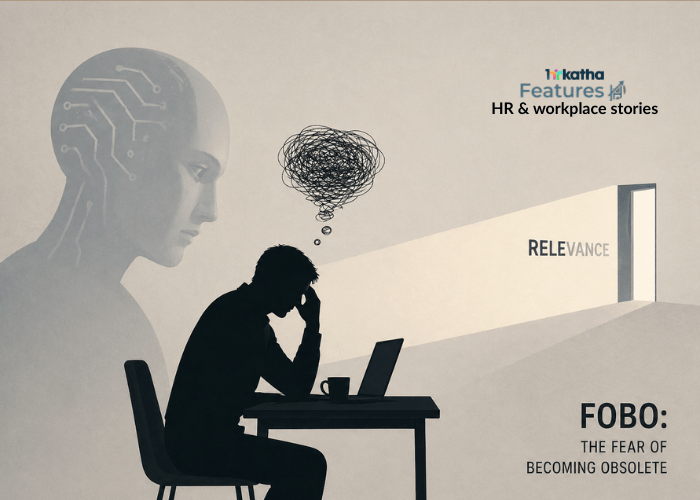
At 11:47 pm, long after her workday officially ended, a mid-level marketing manager in Gurugram refreshed her LinkedIn feed for the fifth time in an hour. New certifications. AI tools mastered. “10x productivity hacks.” Somewhere between admiration and quiet panic, she bookmarked another course she might never complete.
She was not afraid of losing her job. She was afraid of something subtler, becoming irrelevant, while still employed.

Welcome to FOBO: Fear of Becoming Obsolete. A workplace anxiety that has quickly turned into an industry of courses, credentials, and constant comparison.
The question is not whether FOBO exists. It clearly does. The real question is whether it reflects genuine disruption, or the latest version of workplace insecurity – repackaged for the AI era and monetised along the way.
A new fear, or a familiar one?
Workplace anxiety is hardly new. Factory workers feared assembly lines in the 1920s. Secretaries feared word processors in the 1980s. Bookkeepers feared Excel in the 1990s. Each wave brought predictions of mass obsolescence. Each time, the outcome was mixed: some roles disappeared, most evolved, and entirely new ones emerged that nobody had anticipated.
What distinguishes this moment is speed.
“Technological shifts that once took years are now unfolding in months,” observes Ramesh Shankar, a senior HR leader. “AI has compressed the timeline of disruption so drastically that employees barely have time to process one change before the next arrives.”
The compression is real. The gap between “AI can’t do this” and “AI does it better” has shrunk from decades to months. That creates a peculiar psychological state: permanent anticipation of displacement, without clarity on when or how it will occur.
Earlier disruptions were visible. Workers could see what was being replaced. Today’s knowledge workers face something more abstract—algorithms that may replace thinking, not just doing. The invisible competitor is harder to assess, and therefore harder to ignore.
Shankar offers a useful analogy. “In cricket, even top players know someone is waiting to replace them. Today, that ‘bench’ is not just human – it’s also algorithms that don’t tire or negotiate.”
The comparison is telling. Performance anxiety is not new. What has changed is the nature of competition, and the uncertainty around what “good enough” now means.
The performance of productivity
Inside organisations, FOBO is already reshaping behaviour.
Employees are working longer hours, not always because the workload demands it, but because visibility has become a proxy for relevance. If machines are always on, humans feel they must appear to be as well.
Upskilling, once a structured organisational effort, has become an individual survival strategy. Courses are accumulated quickly, often without depth or direction. The goal shifts from mastery to signalling—proof that one is keeping up.
Mukul Chopra, CHRO, ConveGenius, points to the structural gap. “The structured learning ecosystems that organisations once had – training cells, planned development journeys – have quietly eroded.”
Upskilling has been outsourced to individuals, without enough guidance or prioritisation. The result is a workforce that is simultaneously overactive and underprepared.
This creates a paradox. FOBO should, in theory, drive innovation. Instead, it often produces caution. When relevance feels fragile, people optimise for safety. They experiment less, challenge less, and avoid stepping into unfamiliar roles.
The anxiety meant to accelerate adaptation may, in practice, be slowing it down.
Silence as a multiplier
Equally significant is what organisations are not saying.
In earlier periods of disruption, uncertainty triggered communication – town halls, strategy briefings, transition plans. In many organisations today, AI-related communication remains vague or sporadic.
This silence creates a vacuum. It is quickly filled by speculation, social media narratives, and what Chopra describes as a “doom-scrolling” culture.
The business model around that anxiety is straightforward. Diagnose widespread obsolescence risk. Offer courses as insurance. Repeat.
Employees, meanwhile, try to interpret signals: a new tool here, a smaller team there, an automated workflow introduced without context. FOBO thrives in that ambiguity. It is not just change that creates fear, but the absence of clarity around it.
Some of this reflects genuine uncertainty. Leaders themselves do not fully know which roles will evolve and which will disappear. But some of it reflects a quieter truth: anxious employees often work harder, ask fewer questions, and are easier to manage.
What is actually at risk
Beneath the anxiety lies a more grounded question: what is genuinely at risk?
Across industries, a pattern is emerging. Transactional, rules-based work faces real pressure – data entry, routine analysis, basic coding, standardised responses. These are precisely the areas where AI performs efficiently.
Work that requires contextual judgment, ethical reasoning, and relationship management remains far more resistant.
“AI can enhance efficiency, but it cannot replace human insight,” Shankar notes.
The distinction matters. AI can draft a memo. It cannot decide whether the memo should be sent. It can analyse data. It cannot determine which questions matter. It can optimise a process. It cannot question whether the process itself is flawed.
In many roles, the job is not disappearing. It is intensifying.
Customer service offers a clear example. Routine queries are increasingly handled by chatbots. But complex cases—those involving ambiguity, emotion, or conflicting systems – still require human intervention. The role becomes less repetitive, more demanding.
Similar patterns appear in finance. Basic reconciliation and data entry face displacement. But restructuring advice, stakeholder negotiation, and crisis management require human judgment that AI cannot yet replicate.
The real shift is not job loss, but job redesign. The challenge is that this shift is uneven.
Two professionals with the same title may face very different futures. One may be highly exposed to automation. The other may become more valuable. Yet the anxiety spreads uniformly across both.
FOBO is part rational response, part contagion effect.
The India context
In India, the dynamics are sharper.
Organisations are becoming leaner. Roles are increasingly multi-functional. At the same time, the supply of educated talent remains large and competitive.
That combination reduces the margin for redundancy. The bench is always full.
India’s position in global services industries adds another layer. IT, BPO, and consulting have long operated on labour cost arbitrage. As AI reduces the cost of certain tasks, that advantage begins to narrow.
Will work disappear? Unlikely. But it will change.
Routine coding and basic analytics face pressure. Complex problem-solving, client engagement, and strategic work remain valuable. The real question is whether the workforce can transition fast enough from one to the other.
What would actually help
FOBO cannot be addressed through motivational messaging.
“Stay curious” is not a strategy. Nor is “learn everything.”
What would help is more concrete.
Clear communication from organisations about how AI will affect roles. Not broad reassurance, but specifics.
Rebuilding learning infrastructure. Not leaving employees to navigate thousands of courses on their own, but offering structured pathways.
Framing AI as a tool, not a threat. “When AI is introduced as something to fear, employees retreat. When it is introduced as a tool, they explore,” Chopra observes.
And perhaps most importantly, clarity about where real risk lies. Not every role faces the same level of disruption. Treating all anxiety as equally valid only amplifies confusion.
For individuals, the path forward may be less about constant upskilling and more about deliberate positioning. Depth in areas of human advantage—judgment, strategy, relationships—combined with functional fluency in new tools.
The anxiety economy
An uncomfortable question sits beneath all of this: who benefits from FOBO?
EdTech platforms. Certification providers. Consultants. Influencers. Entire ecosystems built around diagnosing risk and selling reassurance.
The underlying disruption is real. But the gap between actual and perceived risk is being actively amplified.
The question worth asking is not just “Am I becoming obsolete?” but “Who is telling me I might be, and what are they selling in response?”
Beyond fear
FOBO reflects a deeper uncertainty about value.
What makes a professional relevant when machines can perform an increasing share of cognitive work?
The answer is unlikely to lie in accumulating credentials or mimicking machine-like productivity. It is more likely to lie in capabilities that remain difficult to automate—judgment, context, trust, and the ability to navigate ambiguity.
These are slower to build. Harder to measure. And less visible on a LinkedIn profile.
Which is precisely why they matter.
The future of work may not be about competing with machines at all. It may be about focusing on the kinds of value machines cannot replicate.
The real risk, then, is not obsolescence.
It is allowing the fear of obsolescence to dictate how we work, what we learn, and what we become.